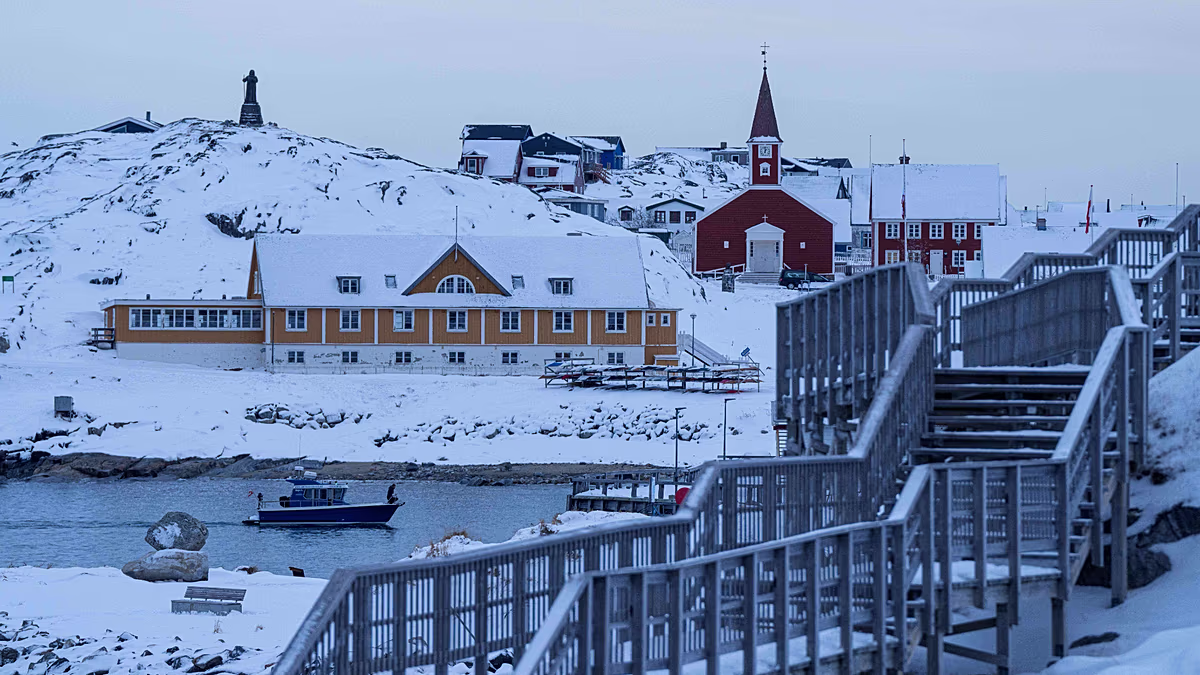

Renewed threats from former US President Donald Trump to acquire Greenland have sparked debate over Europe’s potential response and the complex legal framework governing the Arctic territory. Following the US intervention in Venezuela, Trump reiterated his interest in a deal for the island, citing security concerns and the possibility of Chinese or Russian influence. This has raised questions about whether the United States could attempt to seize control of Greenland and, crucially, how NATO and the European Union would react to such a move.
The possibility of US action, however unlikely, has prompted analysis of existing treaties and defense capabilities. European leaders have expressed concern over the extent to which Washington might be willing to intervene in foreign territories, and the implications for the transatlantic alliance are significant. The situation highlights the delicate balance of power within NATO and the potential for a crisis if a member state were to act against the interests of another.
Could Europe Defend Greenland?
Greenland, while a semi-autonomous territory, is part of the Kingdom of Denmark. Ordinarily, this would mean protection under Article 5 of the NATO treaty, which states that an attack on one member is an attack on all. However, the unique dynamic of a potential US-led intervention creates a challenging scenario, as NATO is designed to defend against external aggressors, not internal disputes between members.
Additionally, a lesser-known provision, Article 42.7 of the Treaty on European Union, could come into play. This article obligates EU member states to provide aid and assistance to a fellow member – in this case, Denmark – if it faces armed aggression on its territory. European Commissioner for Defence and Space, Andrius Kubilius, confirmed this obligation to Reuters on Monday.
Understanding Article 42.7
According to Tim Haesebrouck, assistant professor of international politics at Ghent University, a key strength of Article 42.7 is its ability to be activated by a single country without requiring unanimous consent. The clause mandates that other member states offer assistance “by all the means in their power.”
While invocation of Article 42.7 triggers an expectation of response, the nature of that response is deliberately broad, encompassing economic, political, or military aid. The clause was last invoked in 2015 following the Paris terrorist attacks, when France requested support in its fight against the so-called Islamic State group (IS).
However, Greenland’s specific status complicates matters. Having left the European Economic Community in 1985, and now classified as an Overseas Country and Territory, many EU laws, including those related to defense, do not fully apply. Aurel Sari, a public international law professor at the University of Exeter, notes that there is no definitive legal ruling on whether Article 42.7 extends to territories like Greenland.
Limits to European Defense Capabilities
Even if Article 42.7 is deemed applicable to Greenland, it doesn’t automatically guarantee military defense. While military support is an option, it’s not a requirement. Experts suggest that Europe’s capacity to militarily confront the United States is limited, with a significant power imbalance favoring Washington. Haesebrouck argues that the US possesses “escalatory dominance,” meaning it could consistently escalate a conflict to a level Europe couldn’t match.
From a legal standpoint, Sari emphasizes that the clause shouldn’t be interpreted as a promise of automatic military force. He adds that political commitment from individual member states is crucial. “It’s not only military assistance that is relevant… It could also be political, it could be exerting economic pressure,” he stated. Germany, for example, has expressed a desire to increase its military contribution to Arctic security, but within the existing NATO framework. Reuters provides further coverage of this developing situation.
The situation underscores the broader debate surrounding European strategic autonomy and its ability to act independently on the world stage. While the EU has been working to strengthen its defense capabilities, it remains heavily reliant on the United States for security.
Looking ahead, the likelihood of the US attempting to acquire Greenland remains low. However, Trump’s renewed rhetoric serves as a reminder of the potential for disruption in transatlantic relations and the need for Europe to carefully consider its options for defending its interests in the Arctic region. Monitoring the political responses from key European nations and any further statements from the US will be crucial in the coming weeks.