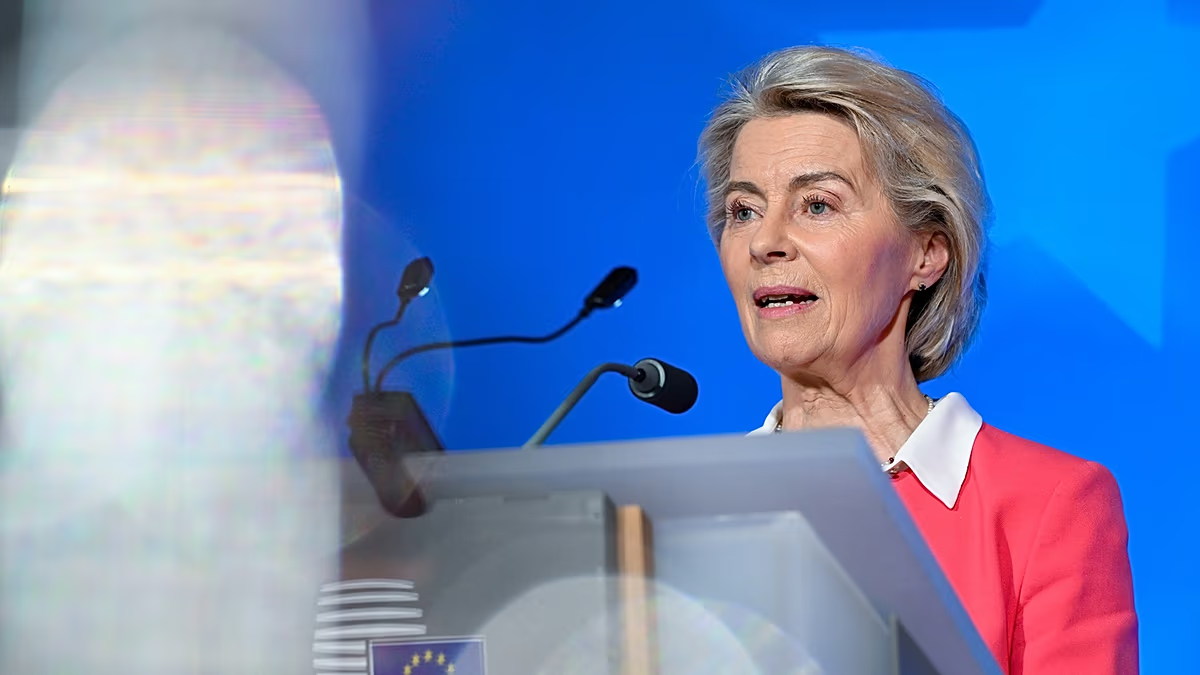

The future of Greenland remains a point of international contention as U.S. President Donald Trump continues to express interest in a potential purchase, or even seizure, of the territory. Despite these ongoing threats, European Commission President Ursula von der Leyen affirmed the European Union’s commitment to strengthening Arctic security in close collaboration with the United States. This pledge comes amid heightened tensions and a flurry of diplomatic activity surrounding the strategically important island.
Von der Leyen made the statement during a visit to Limassol, Cyprus, on Thursday, emphasizing the EU’s strong relationship with Greenland and its intention to “double down” on investments and cooperation. She acknowledged the importance of maintaining alliances, including the U.S., even while navigating Trump’s unconventional approach to foreign policy. The situation underscores the growing geopolitical significance of the Arctic region.
Trump’s Pursuit of Greenland and International Response
President Trump has repeatedly framed his interest in Greenland as a matter of national security, arguing that U.S. control of the island would bolster NATO and prevent undue influence from Russia and China. He recently stated on his social media platform, Truth Social, that Greenland’s inclusion in the U.S. would make the alliance “more formidable and effective,” and that anything less is “unacceptable.”
These remarks followed a meeting in Washington between Danish Foreign Minister Lars Løkke Rasmussen, Greenland’s foreign minister, U.S. Senator Marco Rubio, and Vice President JD Vance. Rasmussen described the discussions as “frank and constructive” but conceded a “fundamental disagreement” persists, stating the President “has this wish of conquering over Greenland.” A high-level working group has been established to attempt to find a “common way forward,” though the prospect of a resolution remains uncertain.
Meanwhile, several European nations are demonstrating their support for Denmark and Greenland by preparing to send military personnel on a reconnaissance mission to the territory. France, Germany, Sweden, Norway, and the Netherlands are among those contributing to the mission, signaling a unified European response to Trump’s overtures. This increased military presence reflects the escalating tensions in the region and a desire to monitor developments closely.
EU’s Mutual Assistance Clause and Arctic Security
The European Commission has clarified that Denmark could invoke the EU’s mutual assistance clause – Article 42.7 TEU – in the event of an armed attack against Greenland, despite the island’s semi-autonomous status and non-membership in the EU. This clause obligates member states to provide aid and assistance “by all the means in their power” if another member is attacked.
However, the Commission noted that the situation has not yet reached that point, as Trump’s threats have not materialized into military action. The mutual assistance clause is linked to NATO’s Article 5, which outlines collective defense commitments, but the application of either article in a scenario involving the U.S. violating Danish sovereignty is unprecedented.
The EU’s commitment to NATO and its own security interests are converging in the Arctic. The region’s increasing strategic importance, driven by climate change and access to resources, is prompting a reassessment of security arrangements and a strengthening of international cooperation. The potential for increased Russian and Chinese activity in the Arctic is a key concern for both the U.S. and Europe.
The situation also highlights the complexities of international law and the potential for conflict when long-standing alliances are challenged by unconventional diplomatic approaches. The 2020 standoff between Turkey and Greece over gas exploration in the Mediterranean serves as a reminder of the delicate balance required to prevent disputes between NATO members from escalating.
Looking ahead, the formation of the U.S.-Denmark working group will be crucial in de-escalating tensions and finding a diplomatic solution. The increased European military presence in Greenland signals a commitment to monitoring the situation and supporting Denmark’s sovereignty. Continued dialogue and a focus on shared security interests will be essential to prevent further instability in the increasingly contested Arctic region. Observers will be watching closely for any shifts in the U.S. position and the effectiveness of the diplomatic efforts underway.
Stay informed about developments in the Arctic region and the evolving geopolitical landscape by following reputable news sources and analysis.