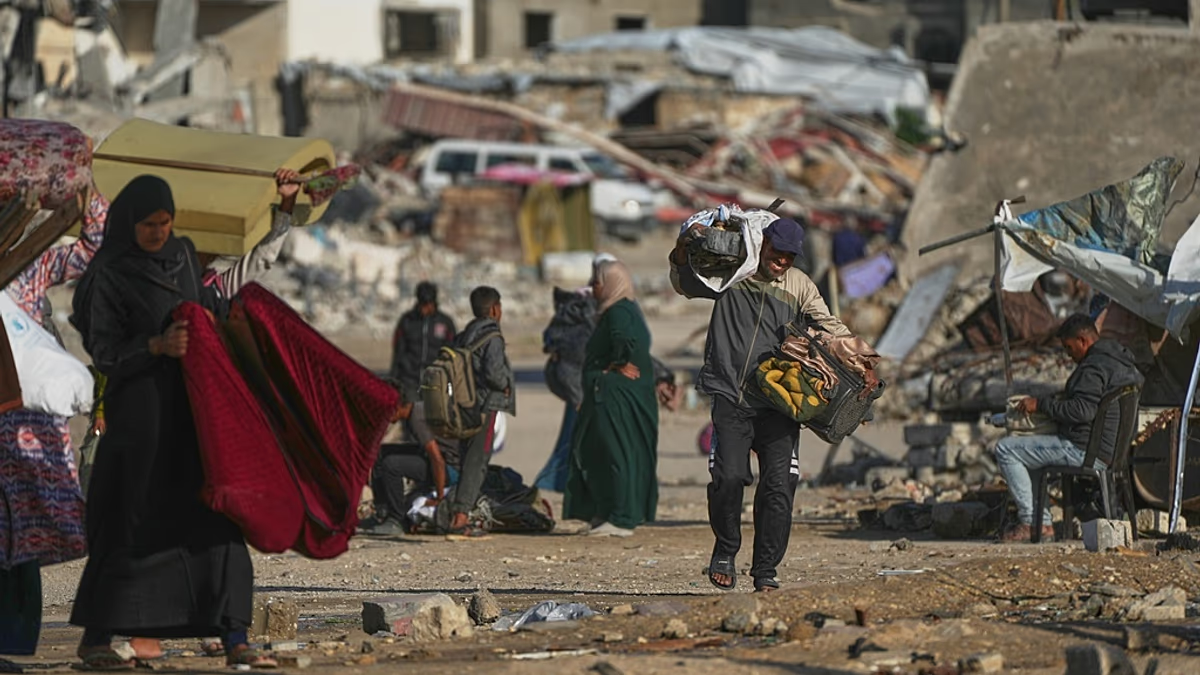

The European Union is considering a role on a proposed “Board of Peace” for Gaza, an initiative spearheaded by former US President Donald Trump. EU Commissioner for the Mediterranean, Dubravka Šuica, stated on Tuesday that the EU deserves a seat given its substantial financial and political involvement in the region. This comes after the UN Security Council recently endorsed Trump’s 20-point plan for Gaza, despite concerns about potential US overreach and the sidelining of other key players.
Šuica emphasized the EU’s position as the largest donor to the Palestinian territories and its geographical proximity to Gaza, arguing for its inclusion in any governing body overseeing reconstruction and future administration. She indicated that discussions with the US regarding European representation are ongoing, with the issue expected to be formally addressed by EU foreign ministers this Thursday. The potential board aims to oversee Gaza’s recovery, coordinate aid, and support a future Palestinian administration.
EU Weighs Participation in Gaza Peace Process
Trump first proposed the “Board of Peace” in early October, outlining a plan that would see him chair the body. He has stated the board will include “the most powerful and respected Leaders throughout the World,” and has already named former UK Prime Minister Tony Blair as a potential member. The full composition of the board remains undisclosed, with further announcements anticipated in the coming weeks.
However, the proposal has been met with skepticism from some quarters, who fear it could concentrate too much power in the hands of the US and potentially undermine existing diplomatic efforts. Concerns center on the plan’s potential impact on the long-stalled two-state solution, a framework the EU continues to support.
Donor Group Meeting and Palestinian Authority Support
Alongside the consideration of the “Board of Peace,” the EU is actively involved in more immediate efforts to prepare for Gaza’s post-war future. Commissioner Šuica will co-chair a Palestine Donor Group meeting on Thursday with Palestinian Prime Minister Mohammad Mustafa. Approximately 60 international delegations, including representatives from Europe and the Middle East, are expected to participate.
The focus of this group will be on bolstering the Palestinian Authority (PA), the governing body of parts of the West Bank, and preparing it to potentially resume services in Gaza. Šuica stated the EU aims to “empower” the PA to take on a greater role in the region.
The EU is the largest provider of aid to the Palestinians, but disbursements to the PA are often contingent on progress in economic and governance reforms. Currently, the PA faces a severe financial crisis, exacerbated by Israel’s withholding of tax revenues, a practice described by UN experts as a “financial stranglehold”. Šuica urged Israel to release these funds and demonstrate a commitment to a future resolution.
Internal divisions within the EU regarding the conflict in Gaza have hampered a unified response. Šuica acknowledged the difficulty in achieving consensus among member states, stating that broader recognition of a Palestinian state would simplify the situation, but isn’t a prerequisite for moving forward.
Successful reconstruction and long-term stability in Gaza will require a collaborative effort, according to Šuica. She emphasized the need for continued support from the US, as well as significant contributions from Gulf countries. The situation remains fluid, and the EU’s role in the Gaza peace process will depend on ongoing negotiations and the evolving political landscape.
Looking ahead, the EU foreign ministers’ discussion on Thursday will be crucial in determining the bloc’s official stance on the “Board of Peace.” Observers will be watching closely to see if the EU can forge a unified approach to supporting Gaza’s recovery and fostering a sustainable future for the region. For more information on the EU’s involvement in the Middle East, visit the European Commission’s website.