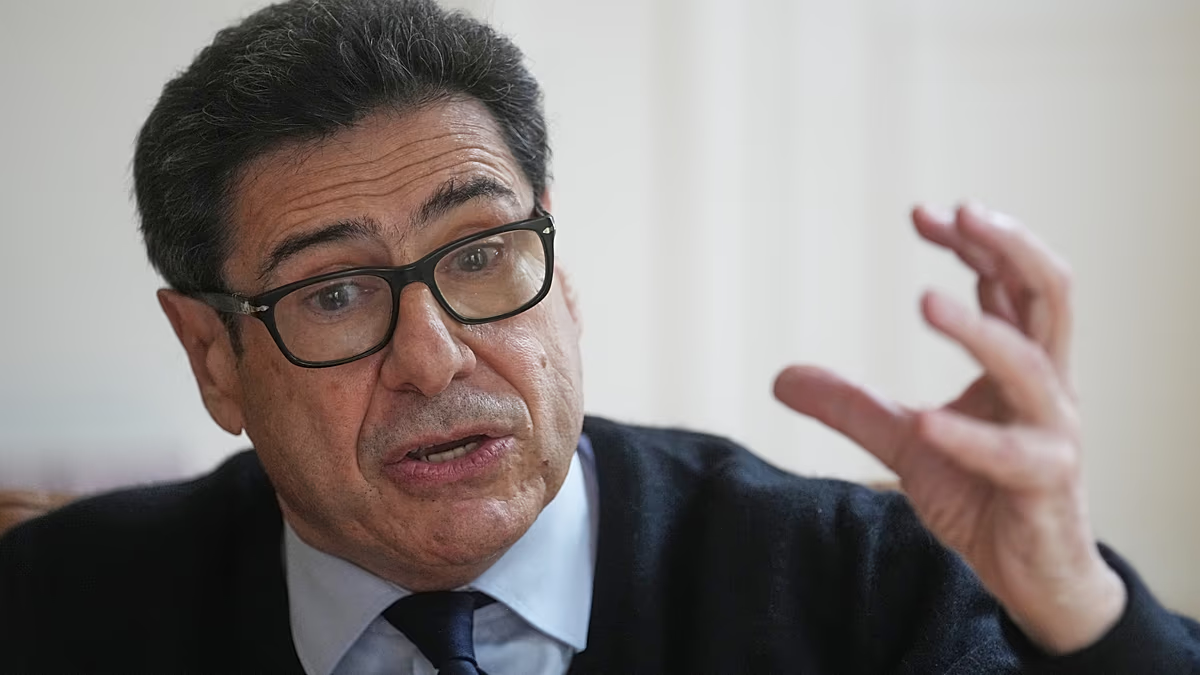

Nobel laureate in economics Philippe Aghion has called for a substantial overhaul of the European Union’s single market, advocating for the removal of internal barriers to foster greater competition and innovation. Aghion’s remarks, made during a recent interview on Euronews, come as the EU faces increasing pressure to bolster its economic position relative to the United States and China. The economist argued that the current regulatory landscape hinders growth and discourages risk-taking.
Speaking on Euronews’ Europe Today program on December 3, 2025, Aghion pressed the need for a “true single market” within the EU bloc, emphasizing that member states often add their own regulations (“gold plating”) on top of existing European rules. This creates unnecessary complexity and impedes the free flow of goods, services, and capital, impacting the EU’s overall economic performance.
The Case for a Stronger European Single Market
Aghion’s arguments are not new and align with recommendations from prominent figures like former European Central Bank president Mario Draghi and Enrico Letta. Last year, both published reports outlining the necessity for greater integration and simplified regulations within the EU. Draghi, in particular, warned of “slow agony” if the bloc failed to undergo “radical change.”
A key aspect of the issue, according to Aghion, is a cultural difference in how Europe and the United States approach failure. In the US, failure is often viewed as a stepping stone to innovation, while in Europe, it is frequently stigmatized and discouraged. This risk aversion stifles entrepreneurial activity and hinders the development of groundbreaking technologies.
Additionally, Aghion pointed to a lack of sufficient investment in high-risk, innovation-driven sectors. He believes that financial institutions and venture capital firms within the EU need to be more proactive in supporting these endeavors. The availability of capital is a crucial factor influencing the pace of technological advancement and economic growth.
Addressing Regulatory Burdens and Investment Gaps
The call for simplifying regulations is aimed at encouraging new businesses to enter the market and compete with established players. Aghion highlighted the need to reduce unnecessary bureaucratic hurdles that can deter investment and innovation. He summarized the issue succinctly as “We regulate too much, but we don’t invest enough.”
Aghion stresses that bolstering the single market is not solely about reducing regulations, but also increasing strategic investment in sectors deemed critical for future competitiveness. These sectors may include areas like artificial intelligence, renewable energy, and biotechnology, where sustained funding is essential for long-term success.
The 2023 Nobel Prize in Economic Sciences, awarded to Aghion along with Peter Howitt and Joel Mokyr, recognized their “pioneering research into the relationship between technological innovation and long-term economic growth.” This research provides a foundation for Aghion’s current advocacy for a more dynamic and competitive European economy.
The current economic climate, marked by geopolitical uncertainties and increasing global competition, adds urgency to his concerns. Strengthening the European economy and fostering innovation are seen as vital for maintaining the EU’s influence and prosperity. He pointed to the need for the EU to increase its own fiscal capabilities, acknowledging the current situation as “a budgetary dwarf.” This underscores the need for more coordinated financial policies across member states to enable larger-scale investments.
The concept of a truly integrated economic union within Europe has been debated for decades, facing hurdles stemming from national interests and differing regulatory priorities. The calls to action from figures like Aghion, Draghi, and Letta serve as a renewed push for addressing these long-standing challenges.
Looking ahead, the EU will likely face increased debate on these issues. The implementation of policies aimed at streamlining regulations and boosting investment will be a key test of the bloc’s ability to adapt to the evolving global landscape. Businesses operating within the EU should monitor these developments closely, as changes to the single market could significantly impact their operations and opportunities. Further analysis of the proposed reforms and their potential effects is expected in the coming months.