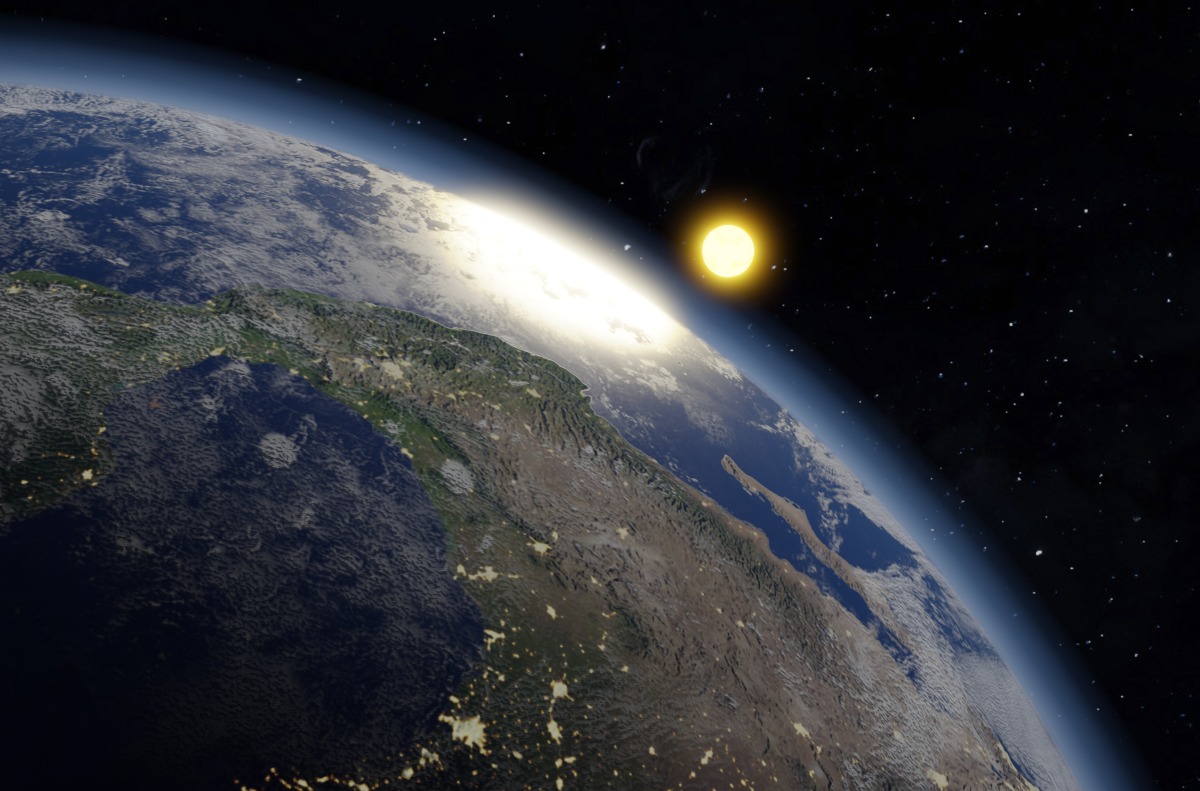

Earth will reach perihelion – its closest approach to the sun in its annual orbit – on January 3, 2026, according to the Qatar Calendar House. At this point, our planet will be approximately 147 million kilometers from the sun, roughly 5 million kilometers nearer than its farthest distance. This event, an expected occurrence each January, offers a natural point to understand Earth’s orbital dynamics and its relationship to seasonal changes.
Dr. Bashir Marzouq, an astronomy expert at the Qatar Calendar House, announced the upcoming perihelion on Thursday. The event will specifically occur on the evening of 14 Rajab 1447 AH. Understanding the timing and distance of this event is crucial for astronomical calculations and observing celestial phenomena.
What is Perihelion and Why Does it Happen?
Perihelion isn’t a sudden shift, but rather a predictable point in Earth’s elliptical orbit. Unlike a perfect circle, Earth travels around the sun in an oval shape. This means the distance between Earth and the sun fluctuates throughout the year. The sun is positioned at one focus of this ellipse, leading to a closest (perihelion) and farthest (aphelion) point in the orbit.
This elliptical orbit is a result of the way the solar system formed from a rotating cloud of gas and dust, and the gravitational influences of other planets over millions of years. It’s important to note that this variation in distance isn’t what causes Earth’s seasons, despite common misconceptions. Instead, the tilt of Earth’s axis is the primary driver of seasonal temperature changes.
Debunking Climate Myths
The Qatar Calendar House emphasized that the change in Earth-sun distance doesn’t directly correlate with climate. Claims linking perihelion to extreme weather events, frequently circulated online, are not supported by scientific evidence. According to Dr. Marzouq, this is a natural phenomenon with no negative impact on the planet’s inhabitants.
However, understanding the relationship between the sun and Earth is vital in the field of astronomy. It’s a core concept used in calculating solar energy received at different points in the year, impacting climate modeling and long-term ecological studies.
The Paradox of Perihelion and Seasons
A striking observation is that Earth is closest to the sun in January, during winter in the Northern Hemisphere. Conversely, the farthest point, aphelion, occurs in July when the Northern Hemisphere experiences summer. This seemingly contradictory situation is resolved when considering the angle of sunlight.
During the Northern Hemisphere’s winter, sunlight strikes the region at a shallower angle, spreading energy over a larger area. This also means the light travels through more of the atmosphere, losing heat. In the summer, the more direct sunlight delivers concentrated energy and a shorter atmospheric path, leading to warmer temperatures. The effect is reversed in the Southern Hemisphere.
This angle of incidence, directly related to the Earth’s axial tilt, is the key determining factor in seasonal variations. The slight difference in distance caused by Earth’s orbit, while measurable, has a comparatively minor effect on overall temperatures.
Related analyses of solar radiation and Earth’s energy balance continue to refine our understanding of long-term climate trends. These studies highlight the complex interplay of factors influencing Earth’s temperature, moving beyond simple distance calculations.
Looking ahead, the next occurrence of perihelion will be on January 3, 2026. Astronomers will continue to observe and analyze this event, refining climate models and planetary science understanding. Further research may also uncover subtle, previously unknown impacts of Earth’s orbital variations, but current data strongly confirms the dominant role of axial tilt in establishing the seasons.