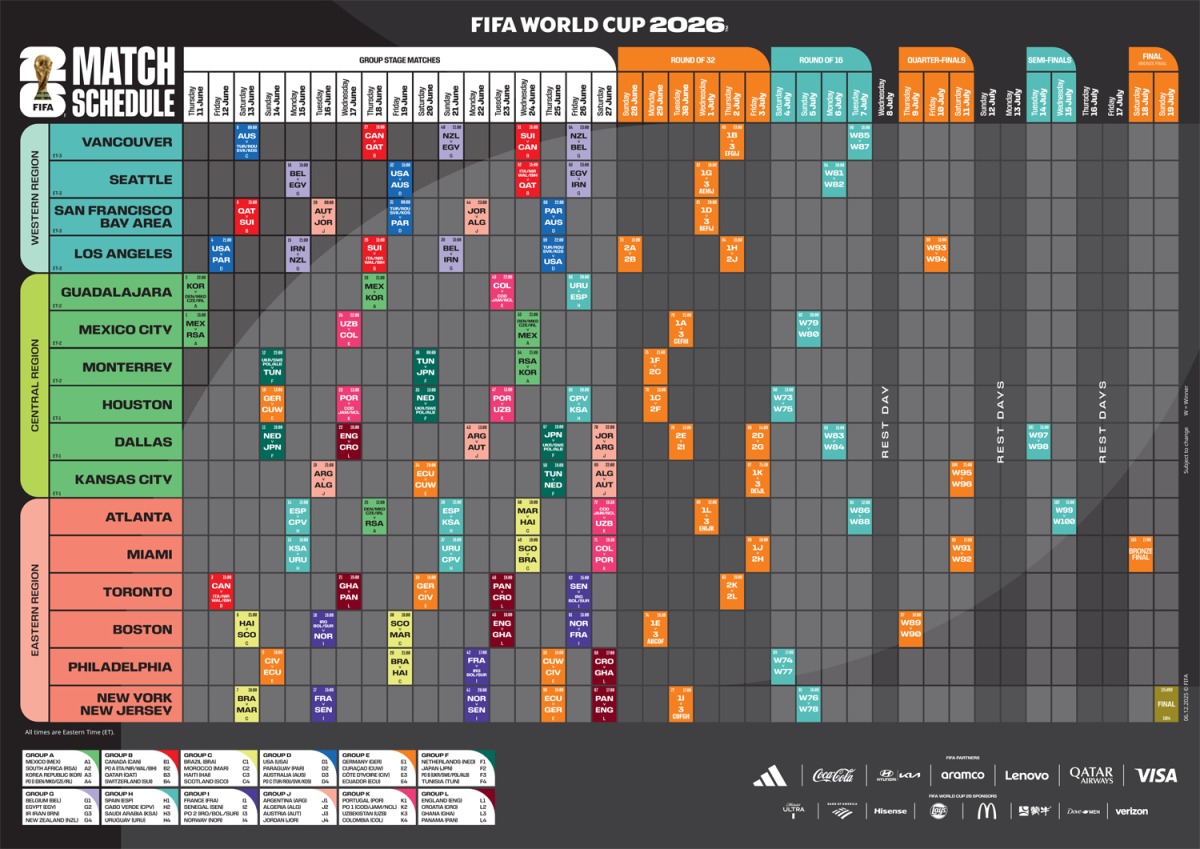

The official draw for the 2026 FIFA World Cup took place on December 5th in Washington, D.C., revealing the groups for the expanded 48-team tournament. The competition, jointly hosted by the United States, Mexico, and Canada, will run from June 11th to July 19th next year. Several Arab national teams received what analysts are calling manageable draws, setting the stage for potentially competitive showings in the expanded field.
The draw distributed teams across sixteen groups of three, with the top two from each group, plus the eight best third-placed teams, advancing to the knockout stage. This marks the first time the tournament will be held across three nations and features a significant increase in participating teams from the traditional 32.
Arab Nations Face Varied Challenges in the 2026 FIFA World Cup
Algeria and Jordan found themselves grouped together in Group J alongside defending champions Argentina and Austria. This presents a significant challenge for both teams, particularly Jordan, who will be making their World Cup debut. However, the group isn’t insurmountable, offering potential for competitive matches and a chance to advance.
Morocco, coming off a historic semi-final run in the 2022 Qatar World Cup, landed in Group C with Brazil, Scotland, and Haiti. This is arguably the most difficult group for an Arab nation, facing the perennial powerhouse Brazil and a strong Scottish side. Their performance will be closely watched to see if they can replicate their previous success.
Tunisia was drawn into Group F with the Netherlands, Japan, and a team determined by UEFA Playoff 2. This group presents a balanced challenge, with Japan offering a strong Asian opponent and the Netherlands possessing considerable European pedigree. The outcome of the playoff will significantly impact the group’s dynamic.
Saudi Arabia will compete in Group H against Spain, Cape Verde, and Uruguay. This group is considered competitive, with Spain and Uruguay as clear favorites. Saudi Arabia will need to leverage their recent experience and tactical flexibility to contend for a qualifying spot.
Other Notable Groupings and Playoff Implications
Elsewhere in the draw, Group A features co-host Mexico, South Africa, South Korea, and the winner of UEFA Playoff 4. The United States, also a co-host, is in Group D with Paraguay, Australia, and the winner of UEFA Playoff 3. These playoff matches, involving European teams, will determine the final participants in these groups.
Germany headlines Group E, while France leads Group I. England and Croatia were placed in Group L, creating a potentially exciting clash of European giants. Qatar, meanwhile, will face Canada, Switzerland, and the winner of UEFA Playoff 1.
Additionally, several groups feature intercontinental playoffs, adding an element of uncertainty as teams from different confederations battle for a place in the finals. These playoffs, involving nations from Asia, Africa, and the Americas, will be crucial in finalizing the World Cup roster.
The expansion to 48 teams is intended to provide more opportunities for nations from across the globe to participate in the World Cup. This change aims to foster greater inclusivity and promote the growth of football in developing regions, according to FIFA officials.
The next key date is the completion of the remaining playoff matches, scheduled to take place in March 2026. These matches will finalize the tournament lineup and provide a clearer picture of the competitive landscape. Observers will be watching closely to see which underdogs can secure their place in the finals and potentially cause upsets during the tournament.
The final match schedule is available for download on the FIFA website.