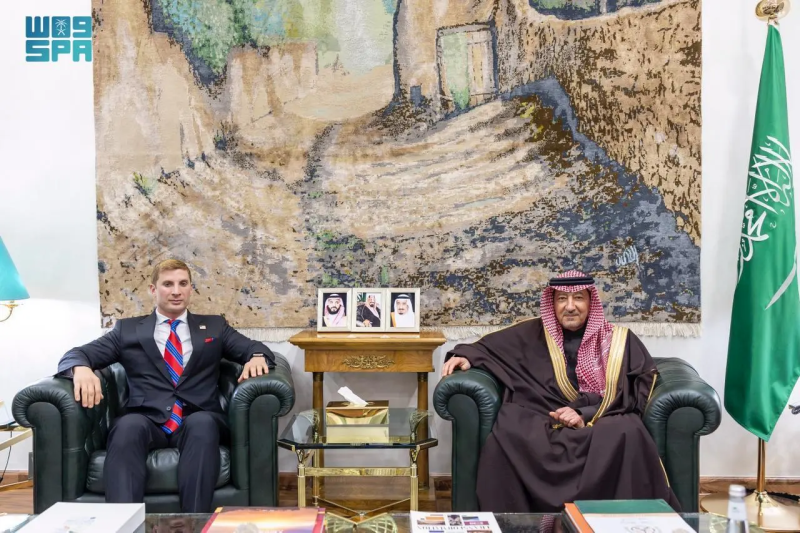

RIYADH – Saudi Arabia and the United States reaffirmed their commitment to strengthening bilateral ties and addressing key regional issues during a meeting in Riyadh on Monday between Deputy Minister of Foreign Affairs Waleed Al-Khereiji and U.S. Undersecretary of State for Economic Growth, Energy, and Environment Jacob Helberg. Discussions focused on boosting economic cooperation and navigating complex geopolitical challenges, the Saudi Ministry of Foreign Affairs stated. The meeting underscores the ongoing dialogue between the two nations despite broader international tensions.
The session, held at the Ministry of Foreign Affairs headquarters, involved a comprehensive review of the existing relationship and exploration of opportunities for expanded collaboration. Attendees included Deputy Minister of Foreign Affairs for Economic and Development Affairs Abdullah bin Zarah, and U.S. Embassy Charge d’Affaires Alison Dilworth, demonstrating the high-level importance assigned to this diplomatic exchange. The talks reportedly covered a wide range of topics, extending beyond economic matters.
Strengthening Economic Cooperation Between Saudi Arabia and the U.S.
The core of the meeting centered on enhancing economic cooperation between Saudi Arabia and the United States. This is particularly significant as Saudi Arabia pursues its Vision 2030 plan, a national strategy designed to diversify the nation’s economy and reduce its reliance on oil. The U.S., for its part, seeks strong partnerships in the energy sector and investment opportunities abroad.
Focus Areas in Bilateral Economic Relations
While specific details were not released, areas of potential collaboration likely included investments in renewable energy, technology transfer, and infrastructure projects within Saudi Arabia. The U.S. has expressed interest in supporting Saudi Arabia’s diversification efforts, offering expertise in areas like digital transformation and sustainable development. Saudi Arabia is also a key importer of U.S. goods and services, creating further economic links.
According to recent trade data, the U.S. is a significant trading partner for Saudi Arabia, with billions of dollars in goods exchanged annually. However, both countries recognize the potential for further expansion, particularly in non-traditional sectors. The meeting represents a continued push to unlock that potential.
Beyond trade, conversations likely touched upon energy security and global energy market stability. Saudi Arabia, as a leading oil producer, plays a crucial role in global energy supplies. The U.S. seeks to maintain a constructive dialogue with Saudi Arabia on these matters, especially given the current geopolitical realities. Discussions regarding potential investments in U.S. energy infrastructure by Saudi entities may also have taken place.
The officials also addressed broader geopolitical issues affecting the region and the world. These sessions are vital for aligning strategies and coordinating responses to shared challenges, like regional conflicts and global economic volatility. The two sides stressed the necessity of diplomatic solutions and maintaining peace and stability.
The discussion on regional developments likely encompassed ongoing efforts to address the conflict in Yemen, the situation in Sudan, and the broader concerns surrounding regional security. The U.S. and Saudi Arabia have historically collaborated on counterterrorism initiatives and share concerns about the influence of destabilizing actors in the Middle East. The ministry indicated a common desire to work toward de-escalation and peaceful resolutions.
Meanwhile, the meeting served as a venue to exchange views regarding international cooperation on climate change. Saudi Arabia has recently pledged increased investments in green technologies and aims to achieve net-zero emissions by 2060. The U.S. emphasized its commitment to global climate action and highlighted opportunities for joint projects in this domain.
In contrast to some periods of strained relations, this meeting reinforces a trend of renewed diplomatic engagement between Washington and Riyadh. This engagement follows a series of high-level visits and discussions in recent months, demonstrating a shared commitment to navigating the complexities of the current global landscape together. This cooperation extends to defense and security partnerships, a long-standing element of the relationship.
It’s important to note that the timing of this meeting coincides with ongoing negotiations surrounding a potential U.S.-Saudi civil nuclear agreement, a topic that has garnered significant attention. While not explicitly mentioned in the official statement, it’s plausible this was discussed informally given the broader scope of the talks related to energy and economic partnership. This potential agreement could reshape the energy landscape and deepen the strategic alliance.
The collaborative spirit demonstrated in Monday’s meeting is also influenced by the evolving dynamics in the broader Middle East, including the recent normalization of relations between Saudi Arabia and Iran. This shift creates new opportunities for regional stability and may require adjustments in the strategies of external actors, including the U.S., in the region.
Looking ahead, further technical discussions are expected to follow, focusing on specific areas of economic cooperation identified during the meeting. While a concrete timeline for any new agreements remains uncertain, both parties have expressed a desire to accelerate progress. Analysts will be watching for official announcements regarding potential investments or joint initiatives in the coming weeks, as well as continued discussions on broader international trade issues.