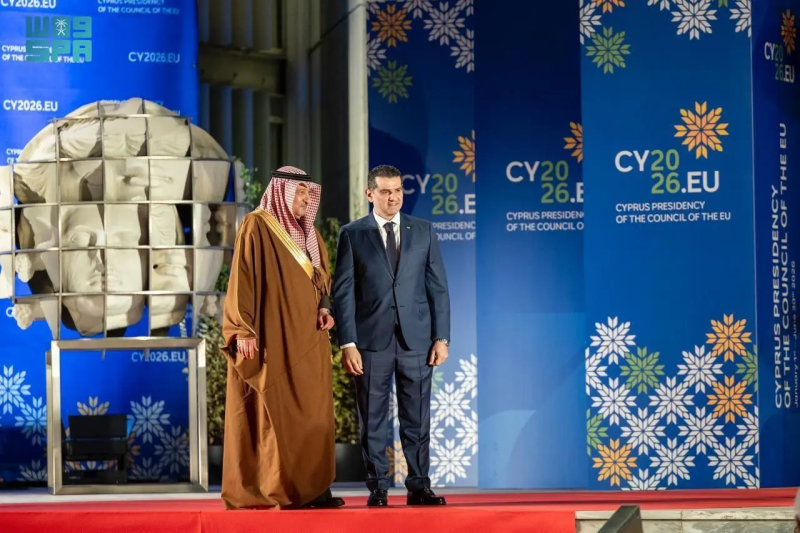

Nicosia, Cyprus – Deputy Minister of Foreign Affairs Waleed Al-Khereiji of Saudi Arabia attended the opening ceremony marking Cyprus’s assumption of the Council of the European Union presidency in Nicosia on Thursday. The rotating presidency, which begins January 2026 and lasts for six months, signifies a key opportunity for Cyprus to advance its agenda within the EU and strengthen its international relationships, including those with Saudi Arabia. This event underscores growing diplomatic engagement between the Kingdom and the European bloc.
Al-Khereiji’s presence, representing Crown Prince and Prime Minister Mohammed bin Salman, highlights the importance Saudi Arabia places on its relationship with Cyprus and the EU. Following the ceremony, the Deputy Minister held bilateral talks with Cypriot Foreign Minister Constantinos Kombos, focusing on strengthening ties and addressing shared regional concerns. The meeting took place as Cyprus prepares to lead the Council’s work.
Saudi Arabia and the Council of the European Union Presidency
The Saudi Arabian delegation’s attendance at the ceremony is a notable gesture of support for Cyprus as it takes on the Council of the European Union presidency. This rotating leadership role allows Cyprus to set the agenda and chair meetings of EU ministers, influencing policy across a wide range of areas. According to the Cypriot Ministry of Foreign Affairs, the discussions between Al-Khereiji and Kombos centered on enhancing cooperation in areas such as energy, investment, and security.
Bilateral Relations and Regional Stability
The strengthening of bilateral ties between Saudi Arabia and Cyprus is occurring within a broader context of increased Saudi engagement with European partners. Saudi Arabia is a significant investor in Europe, and both sides have expressed interest in expanding economic cooperation. The two nations share concerns regarding regional stability, particularly in the Eastern Mediterranean and the Middle East.
Additionally, energy security was reportedly a key topic of discussion. Cyprus is actively developing its natural gas resources, and Saudi Arabia is a major energy producer and consumer. Collaboration in this sector could benefit both countries. The potential for joint ventures and investment in renewable energy sources was also likely explored.
However, the geopolitical landscape remains complex. The ongoing conflict in the Middle East and broader regional tensions present challenges to stability and cooperation. Cyprus, strategically located at the crossroads of Europe, Asia, and Africa, plays a crucial role in regional security efforts.
Implications for EU-Saudi Arabia Relations
Cyprus’s presidency of the Council of the European Union provides a platform to further develop the EU’s relationship with Saudi Arabia. The EU is a major trading partner of the Kingdom, and there is growing interest in strengthening political and economic ties. The Cypriot government has previously indicated its commitment to fostering constructive dialogue with Saudi Arabia on issues of mutual concern.
The EU-Saudi Arabia relationship has evolved in recent years, with a focus on diversifying cooperation beyond energy. Areas of increasing collaboration include counter-terrorism, climate change, and digital technology. The EU is also seeking to promote human rights and good governance in Saudi Arabia, a topic that often features in diplomatic discussions.
Meanwhile, the Kingdom is actively pursuing its Vision 2030 diversification plan, seeking to reduce its reliance on oil revenues and develop new industries. European investment and expertise are seen as crucial to the success of this plan. The Cypriot presidency could facilitate discussions on attracting further European investment to Saudi Arabia.
In contrast to some other EU member states, Cyprus maintains relatively strong diplomatic ties with Saudi Arabia. This position could allow Cyprus to act as a bridge between the Kingdom and other European nations during its presidency. The potential for Cyprus to advocate for increased EU-Saudi cooperation on specific initiatives remains a key factor to watch.
Looking Ahead: The Cypriot Presidency and Beyond
As Cyprus prepares to formally assume the Council of the European Union presidency in January 2026, the focus will shift to implementing its agenda and navigating the complex challenges facing the EU. The success of the presidency will depend on Cyprus’s ability to build consensus among member states and effectively address pressing issues such as migration, economic recovery, and security.
The next steps involve finalizing the Cypriot presidency’s work program and coordinating with other EU institutions. The outcome of ongoing negotiations on key policy initiatives will also be crucial. Observers will be closely monitoring how Cyprus leverages its position to advance its priorities and strengthen its relationships with key partners, including Saudi Arabia. The long-term impact of this strengthened diplomatic engagement remains to be seen, but it signals a potentially evolving dynamic in EU-Saudi relations and regional diplomacy.