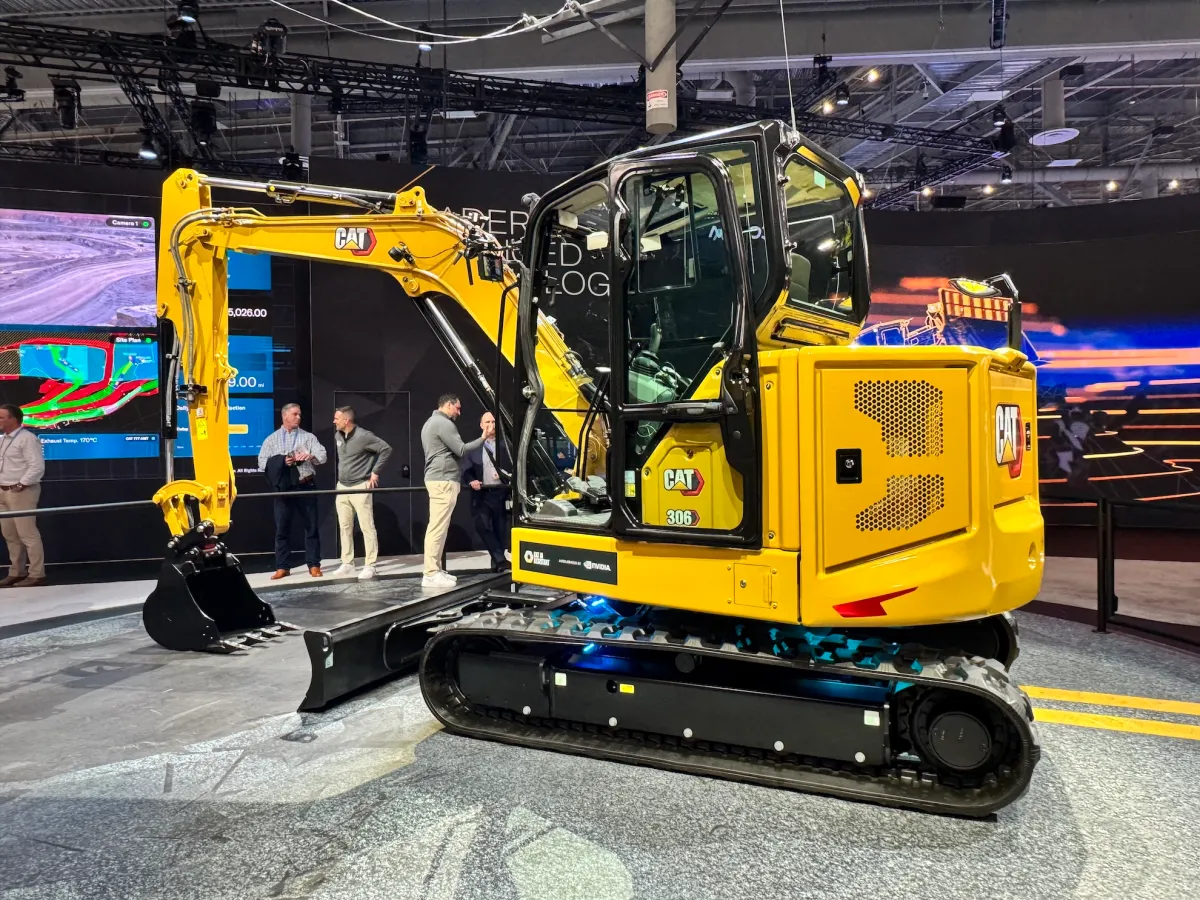

Construction equipment manufacturer Caterpillar is significantly expanding its integration of artificial intelligence (AI) into its machinery, partnering with technology leader Nvidia to develop and deploy AI-powered systems. The collaboration, unveiled at the Consumer Electronics Show (CES) this week, focuses initially on a pilot program for the Cat 306 CR Mini Excavator, featuring an AI assistive system dubbed “Cat AI.” This move signals a growing trend of AI adoption within the traditionally analog construction industry.
The pilot program, demonstrated at CES in Las Vegas, represents a key step in Caterpillar’s broader strategy to leverage data and automation to improve efficiency and safety on construction sites. Caterpillar’s machines currently generate approximately 2,000 data messages per second, providing a rich dataset for AI development. This partnership aims to transform that data into actionable insights for operators and project managers.
The Rise of AI in Construction Machinery
Caterpillar’s “Cat AI” system, built on Nvidia’s Jetson Thor platform, is designed to function as an intelligent assistant for machine operators. According to Brandon Hootman, Caterpillar’s vice president of data and AI, the system can answer operator questions, provide access to relevant resources, offer safety guidance, and facilitate service scheduling. This hands-free access to information is intended to address a core need of construction workers who spend their time actively working in the field, rather than at a desk.
Digital Twins and Simulation
Beyond the in-cab AI assistant, Caterpillar is also utilizing Nvidia’s Omniverse platform to create digital twins of construction sites. These virtual replicas allow for testing of scheduling scenarios and more accurate estimations of material requirements. The simulations are powered by the vast amounts of data collected from Caterpillar’s connected machines, enabling more realistic and predictive modeling. This capability is expected to reduce project delays and optimize resource allocation.
However, the integration of AI isn’t limited to new machines. Caterpillar already employs fully autonomous vehicles in the mining sector, and this pilot program is viewed as a logical progression toward broader automation across its product lines. The company’s approach is to address immediate customer challenges while building a scalable technology foundation for future innovation.
Nvidia views this collaboration as a prime example of its “physical AI” strategy, which extends beyond traditional robotics applications. Deepu Talla, Nvidia’s vice president of robotics and edge AI, emphasized that the company defines physical AI broadly, encompassing any system that interacts with the physical world. Nvidia is providing the computing power, AI models (like the Cosmos family), and simulation tools necessary to bring these systems to life.
This partnership aligns with Nvidia’s broader push into the industrial sector, leveraging its GPU technology to power increasingly sophisticated AI applications. Bill Dally, Nvidia’s chief scientist, has identified physical AI as the next major frontier for the company, building on its success in areas like gaming and data centers. The company’s full-stack ecosystem for physical AI includes open AI models, simulation tools, and developer kits designed to accelerate innovation.
The benefits of automation in construction extend beyond increased efficiency. Improved safety is a significant driver, as AI-powered systems can help identify and mitigate potential hazards on the job site. Furthermore, the data generated by these systems can be used to optimize machine performance, reduce maintenance costs, and extend the lifespan of equipment. The use of machine learning algorithms allows for continuous improvement as the systems gather more data and refine their models.
While the initial focus is on the Cat 306 CR Mini Excavator, Caterpillar plans to expand the “Cat AI” system to other equipment models in the future. The company is also exploring additional applications for digital twins and simulation technology, including predictive maintenance and remote diagnostics. The success of these pilot programs will be crucial in determining the pace of AI adoption across Caterpillar’s entire product portfolio.
Looking ahead, the widespread implementation of AI in construction machinery will likely depend on factors such as data security, operator training, and the development of industry standards. Caterpillar has not provided a specific timeline for full-scale deployment of “Cat AI,” but the company is actively gathering feedback from pilot users and refining the system based on real-world performance. The industry will be watching closely to see how this partnership between a legacy manufacturer and a technology innovator reshapes the future of construction.