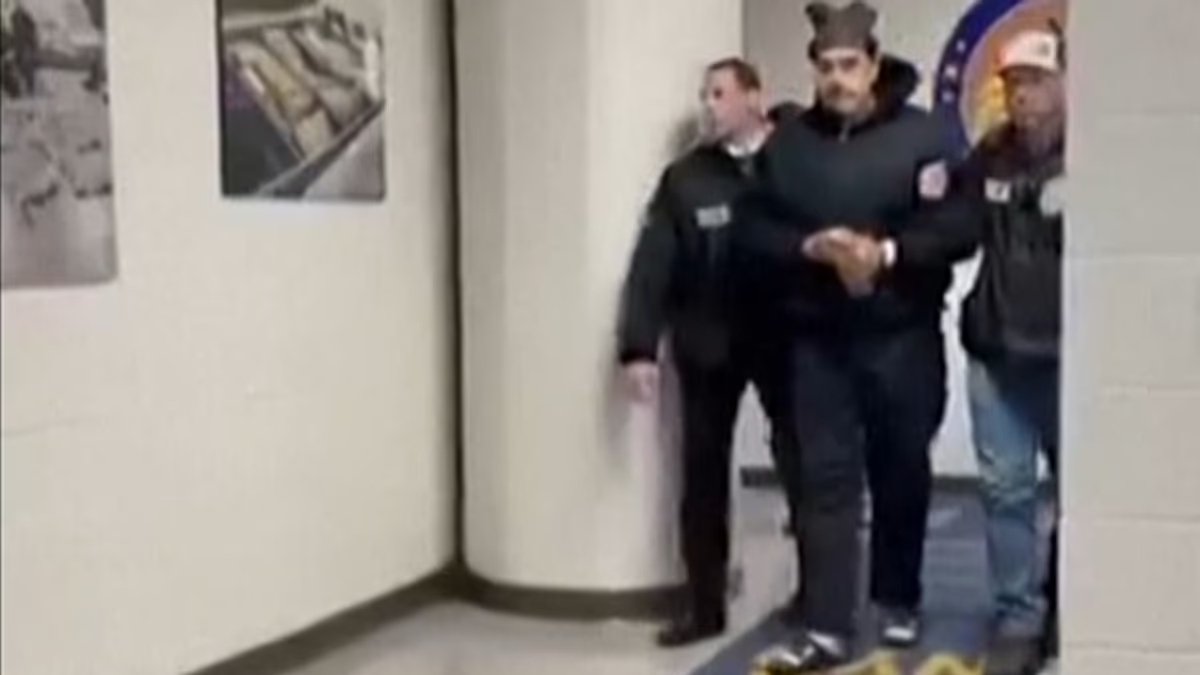

Venezuelan President Nicolás Maduro has been taken into custody by U.S. authorities and is currently awaiting trial at the Metropolitan Detention Centre in New York, facing charges of narco-terrorism. The dramatic capture, carried out by a U.S. military operation originating from Venezuela’s capital, Caracas, marks a significant escalation in the Trump administration’s efforts to exert pressure on the South American nation. The operation, dubbed “Absolute Resolve,” represents the most assertive American action toward regime change in Venezuela in decades.
According to reports, Maduro and his wife, Cilia Flores, were removed from their residence in what the Venezuelan government has condemned as an “imperialist” act. President Trump stated that the United States will remain involved in Venezuela until a “safe” transition of power is achieved and expressed intentions to gain control of the country’s substantial oil reserves. Some casualties were reported on both sides, with Venezuelan Vice President Delcy Rodríguez alleging civilian and military deaths, while President Trump confirmed injuries to U.S. forces but no fatalities.
The Aftermath of Maduro’s Capture and Venezuela’s Future
The immediate future of Venezuela remains uncertain. President Trump has not yet announced a successor to Maduro, and notably suggested that opposition leader Maria Corina Machado lacks sufficient support to govern effectively. Delcy Rodríguez, next in the line of presidential succession, has been ordered by Venezuela’s high court to assume the role of interim president.
However, there was no public televised swearing-in ceremony for Rodríguez. During a televised address, she was identified as Vice President, and provided no indication of cooperation with the U.S., stating, “What is being done to Venezuela is an atrocity that violates international law,” and promising legal repercussions against those she deemed responsible.
Diosdado Cabello, a leading figure within Maduro’s government, has called for widespread demonstrations to defend Venezuelan sovereignty. Scattered rallies in support of the government occurred in Caracas, with protestors burning American flags, although many residents remained indoors due to fear and uncertainty. One resident, Yanire Lucas, described the situation as “unprecedented” after an explosion near a military base damaged her home.
International Reactions to the Operation
The international community is sharply divided in its response to Maduro’s capture. European leaders, while acknowledging Maduro’s perceived lack of legitimacy, have urged restraint and de-escalation. EU Foreign Policy Chief Kaja Kallas stated on X (formerly Twitter) that Maduro’s legitimacy has been questioned by the EU, but emphasized that international law and the UN Charter must be respected.
Germany’s Chancellor Friedrich Merz echoed these concerns, pointing to the flawed nature of recent Venezuelan elections and Maduro’s “problematic role” in the region. France also welcomed the arrest, with officials expressing satisfaction at the development. Meanwhile, China has demanded Maduro’s immediate release and advocated for a resolution through dialogue, while Russia expressed “extreme alarm” and requested clarification from the U.S. government.
UN Secretary-General António Guterres expressed concern over the operation, and warned that it “constitutes a dangerous precedent”. His spokesperson added that the Secretary-General emphasizes adherence to international law and the UN Charter.
Concerns Over Legality and Potential Consequences
The legality of the U.S. operation is facing scrutiny from both sides of the political aisle in the United States. Lawmakers have raised questions about the lack of congressional authorization for the use of military force in Venezuela. Jim Himes, the top Democrat on the House Intelligence Committee, has requested an immediate briefing from the administration, seeking clarification on its plan for regional stability and the legal basis for its actions.
Senator Mark Warner, a leading Democrat on the Senate Intelligence Committee, cautioned against setting a precedent, questioning what would prevent other nations from using similar justifications for intervention. Ilan Katz, an international law analyst, indicated that the U.S. may have violated several principles of international law during the capture of Maduro. A UN Security Council meeting has been scheduled for Monday, at Colombia’s request, to discuss the situation in Venezuela.
The unfolding situation in Venezuela presents significant geopolitical challenges. As the country navigates this period of upheaval, the international community will be closely watching for further developments, particularly regarding the establishment of a new government and the potential for continued instability. Continued monitoring of the political and economic situation in Venezuela is crucial.