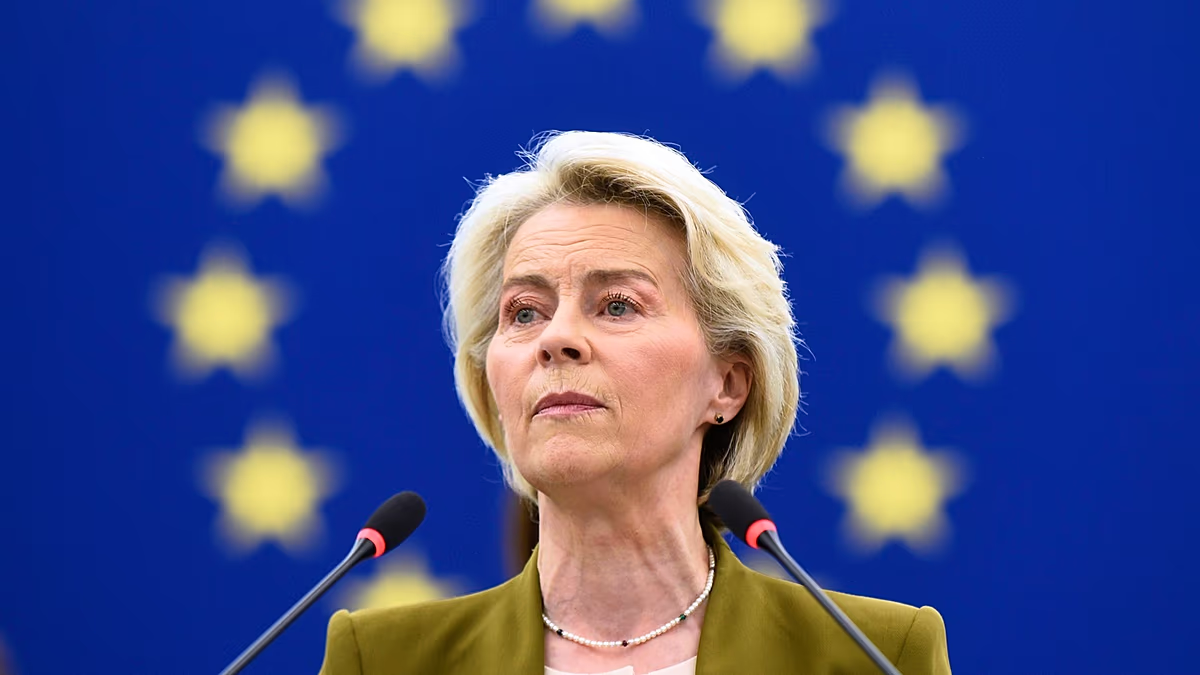

The European Union has taken a significant step to bolster its financial leverage against Russia, indefinitely immobilizing approximately €210 billion in Russian Central Bank assets. This move, enacted on Thursday, circumvents the typical six-month renewal process for sanctions and aims to pressure Moscow to de-escalate the war in Ukraine. The decision comes amid escalating tensions with the United States over potential negotiations regarding the frozen Russian assets and follows recent criticisms of European resolve from former U.S. President Donald Trump.
The bulk of the immobilized funds, €185 billion, are held at Euroclear in Brussels, with the remaining €25 billion distributed across banks in five EU member states. Until now, these assets have been subject to sanctions requiring unanimous member state approval for renewal – a process that has become increasingly fraught with difficulty.
EU Secures Control of Russian Assets
The EU’s decision to utilize an emergency clause in its treaties was prompted by concerns over potential vetoes and the risk of destabilizing the financial system should the funds be unexpectedly released. Earlier this year, Hungary twice threatened to veto the renewal of sanctions, highlighting the fragility of the current system. This led the European Commission to explore alternative legal mechanisms to ensure continued pressure on Russia.
Initially, the Commission considered invoking Article 31.2, often referred to as the “passerelle clause,” which would have shifted the renewal process to a qualified majority. However, this article allows individual countries to veto the change based on “vital and stated reasons of national policy,” effectively maintaining the need for unanimity.
Instead, the Commission opted for Article 122, which permits member states to act “in a spirit of solidarity” to address economic situations. This article requires only a qualified majority and bypasses the European Parliament, allowing for a faster and more decisive response. Article 122 was previously used during the COVID-19 pandemic and the 2022 energy crisis, according to the European Commission.
In March, the Commission broadened the interpretation of “economic situation” to include security threats, establishing a €150 billion loan-for-loan defense program. This move sparked a legal challenge from the European Parliament. Last month, the Commission argued that Russia’s war had created a “serious economic impact” across the EU, justifying the use of Article 122 to immobilize the Russian funds.
While some legal experts questioned the justification, particularly given the length of the conflict, the Commission maintained its position. Valdis Dombrovskis, the European Commissioner for the Economy, stated the EU had “met above and beyond what is required” to demonstrate economic damage.
The new arrangement effectively prevents the premature release of the assets, a scenario that was recently proposed in a leaked 28-point peace plan reportedly involving the United States and Russia. This plan suggested splitting the assets into investment vehicles benefiting both Washington and Moscow, a proposal that drew sharp criticism from European leaders. Reuters reported on the strong reaction to the plan.
German Chancellor Friedrich Merz recently published an op-ed emphasizing the importance of European autonomy in this matter, arguing that decisions regarding frozen assets should be made by Europe, not external actors. He stated that the choices made now will “shape Europe’s future.”
Hungary’s Viktor Orbán has already condemned the use of Article 122 as “Brusselian dictatorship” and vowed to challenge the decision legally. However, officials and diplomats largely welcomed the move, seeing it as a step towards greater EU foreign policy coherence and a reduction in the potential for blackmail from individual member states. This decision also reinforces the EU’s commitment to supporting Ukraine financially and strategically.
Looking ahead, the EU will continue to monitor the economic impact of the war and assess the need for further sanctions. The immobilization of these Russian assets represents a significant escalation in the EU’s response and signals a willingness to take bolder action to achieve its policy objectives. Stakeholders should watch for potential legal challenges from Hungary and continued debate over the long-term use of these funds for Ukraine’s reconstruction.