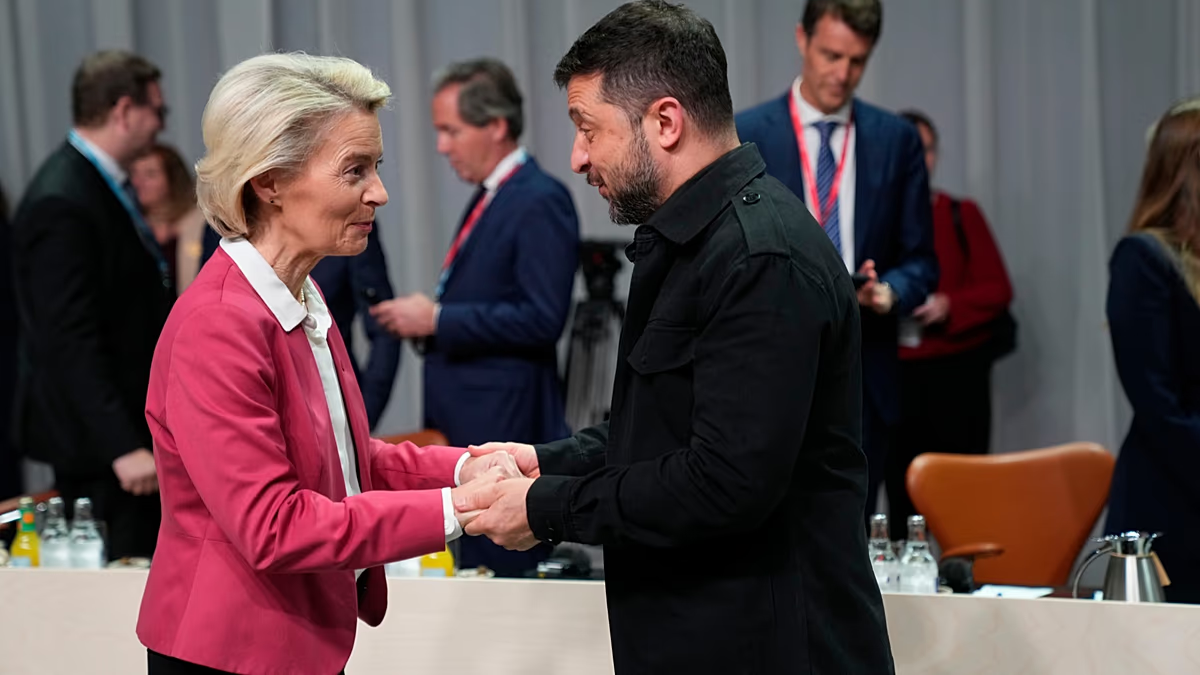

The European Commission has proposed a €90 billion loan for Ukraine, aiming to provide crucial financial support over the next four years. The proposal, unveiled on Wednesday, seeks swift approval from the European Parliament and member states to begin disbursing funds as early as April, addressing Ukraine’s urgent need for economic and military assistance amidst the ongoing conflict. This substantial financial package is intended to bolster Ukraine’s economy and defense capabilities as it continues to resist Russian aggression.
According to the Commission, roughly €60 billion of the loan will be allocated to military spending, while the remaining €30 billion will support Ukraine’s national budget. European Commissioner for Economy and Productivity Valdis Dombrovskis emphasized the urgency, stating the goal is to begin distributing funds in April to help bridge a significant funding gap. The plan requires approval by the co-legislators – the European Parliament and the Council of the European Union – by late February or early March.
Securing the €90 Billion Loan for Ukraine
The proposal for a large-scale loan comes after EU leaders initially favored utilizing frozen Russian assets to finance Ukraine’s reconstruction and defense. While the idea of using these assets – estimated at over €210 billion held within Europe – gained traction, particularly from Commission President Ursula von der Leyen and several member state leaders, strong opposition, notably from Belgium, ultimately led to the joint debt instrument as the most viable option. Belgium currently holds jurisdiction over a significant portion of the immobilized Russian funds.
The loan is structured as a non-recourse agreement, meaning Ukraine will only be obligated to repay the funds if and when Russia agrees to pay war reparations. This shields Ukraine from potential debt burdens during and immediately after the conflict. To secure unanimous agreement, Hungary, Slovakia, and the Czech Republic have been exempted from guaranteeing the debt.
This exemption means the remaining 24 member states will bear the responsibility for covering the estimated €3-4 billion in annual interest payments. The Commission plans to initially utilize unspent funds from existing EU instruments to offset these costs, with member states covering any shortfall. Discussions are underway regarding a dedicated instrument within the next EU Multiannual Financial Framework to manage these interest payments beyond 2027.
Boosting European Defense Industries
A key component of the loan agreement is a “Made in Europe” provision. This aims to prioritize the procurement of military equipment from Ukraine and European Union member states, as well as countries within the European Economic Area (EEA) and European Free Trade Association (EFTA). Purchases from outside these regions will only be permitted if the necessary equipment is unavailable or cannot be delivered quickly enough. This initiative is intended to simultaneously support Ukraine’s defense needs and stimulate the growth of European defense industries.
However, disagreements persist regarding the proportion of the loan that should be allocated to non-European equipment. The Netherlands and Germany are advocating for greater flexibility, suggesting that up to €15 billion could be used for purchases outside Europe, potentially through the NATO PURL initiative. This initiative allows allies to purchase US-made weapons for delivery to Ukraine, following a change in US policy regarding direct military donations. Current EU defense packages generally require at least 65% of procured equipment to be of European origin.
The Commission’s proposal stipulates that Ukraine will need to submit requests for deviations from these procurement requirements, which will be assessed by an expert group to expedite the process and ensure timely access to essential equipment. This streamlined approach aims to balance the commitment to bolstering European defense with Ukraine’s immediate operational needs.
EU ambassadors are scheduled to begin discussions on the loan proposal Wednesday, and political group leaders in the European Parliament will determine whether to fast-track the process for debate at the next plenary session. The swift passage of this legislation is considered critical to providing Ukraine with the financial stability it requires to continue its defense and maintain essential government functions.
The coming weeks will be crucial as the EU navigates the final stages of approval for this significant financial aid package. Watch for potential amendments regarding procurement flexibility and the long-term funding mechanism for interest payments. For more information on the EU’s support for Ukraine, visit the European Commission’s dedicated webpage.