


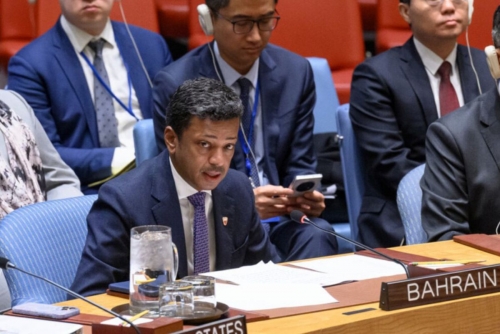

Bahrain’s Ambassador to the UN, Jamal Fares Al Ruwaiei, recently addressed the United Nations Security Council, emphasizing the critical need for international cooperation in eliminating weapons of mass destruction and supporting Syria’s path towards stability. His remarks centered on the vital role of the Organisation for the Prohibition of Chemical Weapons (OPCW) and the importance of a unified approach to regional security. This article will delve into the key points of Al Ruwaiei’s briefing, highlighting Bahrain’s stance on Syria’s chemical weapons program and the broader context of Middle Eastern stability.
Bahrain Advocates for OPCW’s Role in Global Security
Al Ruwaiei’s participation in the Security Council briefing underscored the Kingdom of Bahrain’s commitment to international security and its unwavering support for organizations dedicated to preventing the proliferation of dangerous weaponry. He specifically highlighted the crucial work of the OPCW, the global body tasked with enforcing the Chemical Weapons Convention.
The Ambassador stressed that a strong and effectively functioning OPCW is paramount in safeguarding humanity from the devastating consequences of chemical warfare. He argued that the organization’s continued success relies on the collective efforts and unwavering support of the international community. This support isn’t merely financial, but also includes political backing and a commitment to holding accountable those who violate the Chemical Weapons Convention.
The Importance of a Collective Approach
Bahrain believes that addressing the threat of chemical weapons requires a unified, global response. No single nation can effectively tackle this challenge alone. International collaboration is essential for verifying declarations, conducting inspections, and ensuring the complete destruction of chemical weapon stockpiles. This collaborative spirit extends to sharing information, providing technical assistance, and strengthening the OPCW’s capabilities.
Supporting Syria’s Stability and Chemical Weapons Resolution
A significant portion of Al Ruwaiei’s briefing focused on the situation in Syria, particularly concerning the ongoing efforts to eliminate its declared chemical weapons stockpile. He firmly stated that Syria’s security and stability are inextricably linked to the overall stability of the Middle East.
He called upon the international community to provide sustained support to the Syrian Arab Republic during this critical juncture, recognizing the complex challenges the nation faces. This support, he clarified, should be directed towards enabling the Syrian government and the OPCW to finalize the process of eliminating all traces of chemical weapons and definitively closing the file on this sensitive issue. Al Ruwaiei acknowledged Syria’s proactive steps in fulfilling its obligations to the OPCW, noting the initiatives taken to demonstrate transparency and commitment.
Highlighting Syrian-OPCW Cooperation
The Ambassador commended the close cooperation and ongoing coordination between the Syrian government and the OPCW, a partnership explicitly endorsed by Security Council Resolution 2118. He emphasized that this collaboration is a positive sign, demonstrating Syria’s willingness to address the concerns surrounding its chemical weapons program.
He specifically pointed to Syria’s transparency in providing information and granting access to OPCW inspectors as evidence of its good faith. This transparency, Al Ruwaiei argued, is crucial for building trust and fostering a more constructive dialogue with the international community. Furthermore, he noted that Syria’s efforts are aimed at restoring its regional and international standing and initiating meaningful political reform.
Reaffirming Sovereignty and Rejecting Interference
Bahrain’s position on Syria is firmly rooted in respect for its sovereignty, independence, and territorial integrity. Al Ruwaiei unequivocally rejected any form of foreign interference in Syria’s internal affairs. He believes that any lasting solution must be Syrian-led and Syrian-owned, reflecting the will of the Syrian people.
He stressed the importance of allowing Syria to navigate its own political transition without external pressure or manipulation. This aligns with the principles outlined in Security Council Resolution 2254, which calls for a political settlement to the Syrian conflict through a comprehensive and inclusive process. The focus, according to Bahrain, should be on facilitating a smooth and orderly transition that respects the country’s sovereignty and allows for the establishment of a stable and representative government. The ongoing humanitarian crisis in Syria also requires continued international attention and assistance.
The Path Forward: A Stable and Secure Syria
Al Ruwaiei concluded his briefing by reiterating Bahrain’s commitment to supporting a peaceful and stable Syria. He emphasized that sustained international backing is essential during this transitional phase, enabling the country to overcome its challenges and embark on a path towards recovery and reconstruction. Addressing the regional implications of the Syrian conflict is a key priority for Bahrain.
Ultimately, Bahrain believes that a secure and prosperous Syria is vital for the long-term stability and security of the entire Middle East. The successful resolution of the chemical weapons issue in Syria, coupled with a Syrian-led political transition, will contribute significantly to achieving this goal. Continued dialogue, cooperation, and a commitment to upholding international law are crucial for navigating the complexities of the situation and building a brighter future for Syria and the region.