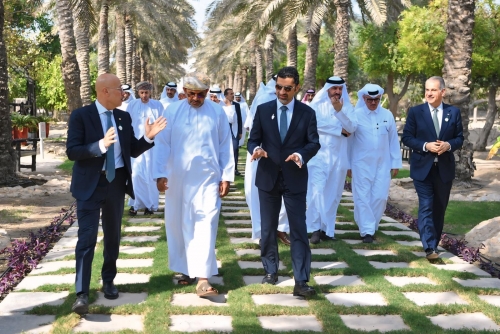

Bahrain is actively strengthening its commitment to environmental sustainability and food security, demonstrated by recent high-level visits to key ecological and agricultural projects. These initiatives, particularly the ambitious mangrove restoration program, are gaining regional recognition as models for GCC cooperation. A delegation from Oman and the UAE recently toured projects at the Gulf Petrochemical Industries Company (GPIC) and Peninsula Farms, highlighting Bahrain’s dedication to combating climate change and bolstering regional food production.
Bahrain Leads the Way in Mangrove Restoration
The visit, occurring on the sidelines of the Bahrain International Exhibition (Mara’ee 2025), saw Bahrain’s Minister of Municipalities Affairs and Agriculture, Eng. Wael bin Nasser Al Mubarak, alongside Dr. Saud bin Hamoud bin Ahmed Al Habsi, Oman’s Minister of Agricultural, Fisheries and Water Resources, and Dr. Mohammed Salman Al Hammadi, UAE Assistant Undersecretary for Food Diversity, explore the nation’s innovative environmental efforts. Central to the discussion was the “Mangroves Bahrain” initiative, a cornerstone of the Kingdom’s strategy to achieve carbon neutrality by 2060.
This initiative aims to quadruple the number of mangrove trees in Bahrain by 2035. Mangrove forests are incredibly effective carbon sinks, absorbing significantly more carbon dioxide than terrestrial forests. They also provide crucial coastal protection against erosion and storm surges, and serve as vital nurseries for marine life, boosting coastal biodiversity.
GPIC’s Pioneering Role in Mangrove Planting
Eng. Yasser Al Abbasi, CEO of GPIC, welcomed the delegation and provided a detailed overview of the mangrove plantation project. GPIC has already contributed to planting over 260,000 mangrove trees in collaboration with the Ministry of Municipalities Affairs and Agriculture, demonstrating a strong commitment to environmental responsibility. The project’s success lies in its careful implementation, focusing on maximizing environmental impact through biodiversity support, coastline protection, and increased vegetation cover.
The delegation observed the implementation mechanisms firsthand, gaining insights into the techniques used to ensure the long-term health and growth of the mangrove ecosystem. This practical demonstration underscored Bahrain’s proactive approach to environmental challenges.
Strengthening GCC Food Security Through Innovative Agriculture
Beyond mangrove restoration, the delegation also visited Peninsula Farms, a leading agricultural producer in Bahrain. Here, they were briefed on the farm’s advanced agricultural and livestock production lines. The focus was on the innovative techniques employed to improve production efficiency and enhance food security within the Kingdom.
The visit showcased Bahrain’s commitment to modernizing its agricultural sector. This included a review of ongoing research and development projects aimed at optimizing crop yields, improving livestock management, and reducing reliance on imported food. These efforts are crucial for building a more resilient and sustainable food system.
Research and Development Driving Agricultural Advancement
Peninsula Farms is actively investing in research and development to address key challenges facing the agricultural sector. This includes exploring drought-resistant crops, implementing precision farming techniques, and developing sustainable water management strategies. These innovations are not only benefiting Bahrain but also offering valuable lessons for other GCC countries facing similar environmental and agricultural constraints.
Regional Collaboration and Future Prospects
Dr. Al Habsi, Oman’s Minister of Agricultural, Fisheries and Water Resources, expressed his deep appreciation for Bahrain’s hospitality and the inspiring national projects presented. He specifically praised the Kingdom’s advancements in mangrove cultivation and agricultural production systems. He affirmed that these experiences exemplify the GCC countries’ shared commitment to achieving food security, preserving the environment, and fostering stronger Gulf cooperation.
The visit underscores the growing importance of regional collaboration in addressing shared challenges. By sharing best practices and coordinating efforts, GCC countries can accelerate progress towards a more sustainable and resilient future. The success of Bahrain’s environmental initiatives, particularly its ambitious mangrove restoration program, serves as a powerful example for the region.
In conclusion, Bahrain’s proactive approach to environmental sustainability and food security is gaining regional recognition. The recent delegation visit highlighted the Kingdom’s commitment to innovative solutions, such as the “Mangroves Bahrain” initiative and advancements in agricultural technology. This collaborative spirit and dedication to a greener future position Bahrain as a leader in the GCC region, paving the way for a more sustainable and secure future for all. Further exploration of Bahrain’s environmental policies and agricultural advancements can be found on the Ministry of Municipalities Affairs and Agriculture website.