


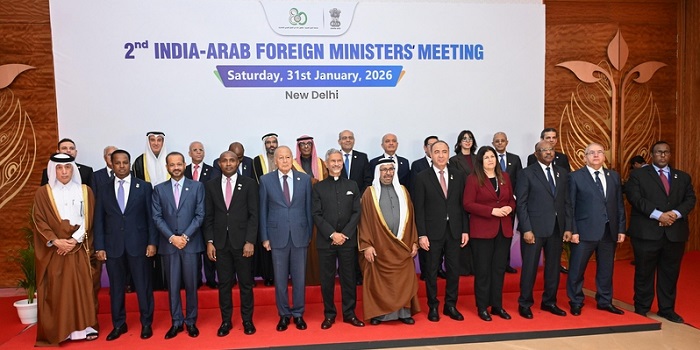

The strengthening ties between the Arab world and India took center stage at the second session of the Ministerial Meeting of the Arab-Indian Cooperation Forum, held in New Delhi this past Saturday. The Sultanate of Oman played a prominent role, with Foreign Minister Sayyid Badr Hamad Al Busaidi delivering a key address emphasizing the historical depth and strategic importance of this burgeoning Arab-Indian cooperation. This meeting signals a renewed commitment to collaborative efforts across a range of vital sectors, from trade and security to sustainable development and political alignment.
Oman Champions Deeper Arab-Indian Relations
Sayyid Badr Hamad Al Busaidi, leading the Sultanate of Oman’s delegation, underscored the long-standing and deeply rooted relationship between the Arab nations and the Republic of India. He highlighted a shared civilizational heritage and centuries of cultural exchange as the foundation for mutual understanding and respect. This historical connection, he argued, has fostered a partnership built on constructive cooperation and a commitment to the sovereignty of all involved nations.
A Legacy of Shared Values
The Foreign Minister specifically noted how these historical ties have actively promoted tolerance, coexistence, and a shared understanding of global challenges. This emphasis on shared values is crucial in an increasingly interconnected world, providing a strong basis for future collaboration. Oman’s commitment to these principles is a driving force behind its active participation in the Arab-Indian Cooperation Forum.
Focus on Economic and Security Cooperation
A key theme of the Sultanate of Oman’s address was the strategic importance of expanding Arab-Indian cooperation in critical economic sectors. Sayyid Al Busaidi specifically highlighted trade and investment as areas with significant potential for growth, emphasizing the benefits for the private sector and economic diversification. He believes that unlocking these opportunities will lead to wider horizons for businesses in both regions.
Beyond economics, the discussion extended to crucial areas like health, pharmaceutical industries, and environmental protection. Addressing cross-border challenges, such as terrorism, extremism, and hate speech, was also identified as a priority. These shared concerns necessitate a unified approach, and Oman is actively advocating for collaborative solutions.
Energy, Food Security, and Supply Chain Resilience
The Foreign Minister pointed to the complementary strengths of Arab nations and India, suggesting that combining Arab resources and expertise with India’s advanced industrial and technological capabilities could significantly enhance cooperation in energy security, agriculture, and food security. This collaboration is particularly vital for building resilient supply chains in these critical sectors, safeguarding against future disruptions. Trade relations between the two regions are expected to benefit significantly from these initiatives.
Maritime Security and Regional Stability
Oman also stressed the importance of coordinated efforts in maritime security, emphasizing the need to ensure freedom of international trade and the safety of vital sea lanes. This is not only crucial for regional economies but also for global trade and stability. Protecting these shared interests requires a collaborative approach, and Oman is committed to working with India and other Arab nations to achieve this goal. This focus on maritime security is a key component of the broader strategic partnership.
Addressing Regional and International Issues
The meeting also provided a platform for discussing pressing regional and international developments. Sayyid Al Busaidi underscored the need for a just and comprehensive solution to the Palestinian cause, advocating for the legitimate rights of the Palestinian people in accordance with international law and the two-state solution. He specifically called for the establishment of an independent Palestinian state based on the 1967 borders, with East Jerusalem as its capital, and its full membership in the United Nations.
Furthermore, the Foreign Minister emphasized the importance of reforming the United Nations system to enhance its effectiveness, fairness, and ability to address the growing complexities of international challenges. A more robust and equitable UN is seen as essential for promoting global peace and security.
A Vision for a Comprehensive Partnership
In conclusion, the Sultanate of Oman reaffirmed its commitment to fostering partnerships based on mutual respect and common interests. Sayyid Badr Hamad Al Busaidi expressed his hope that Arab-Indian cooperation will evolve into a comprehensive partnership that meets the aspirations of both peoples and effectively addresses future challenges. This vision requires continued dialogue, collaboration, and a shared commitment to building a more stable, prosperous, and equitable future for all. The outcomes of this Ministerial Meeting in New Delhi represent a significant step towards realizing this ambitious goal, and further strengthening the historical bonds between the Arab world and India.