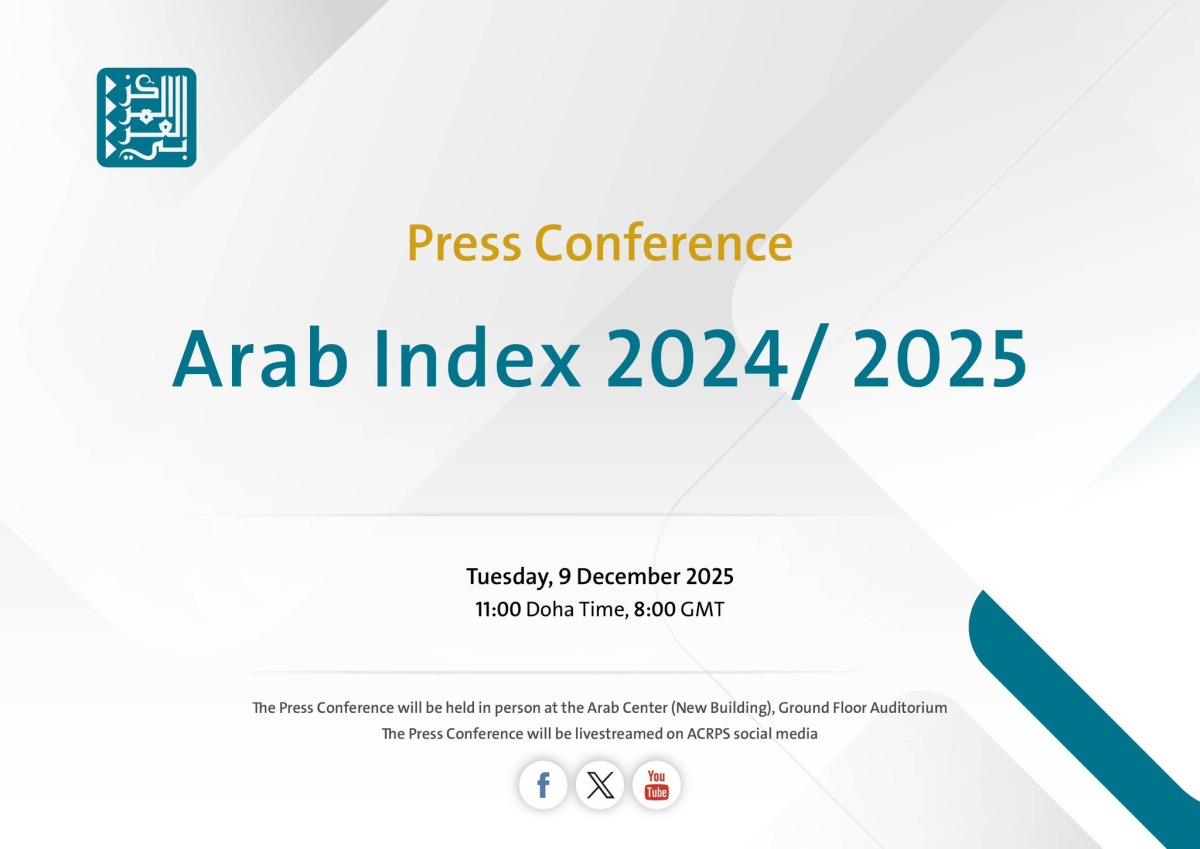

The Arab Center for Research and Policy Studies will release the findings of its ninth Arab Opinion Index (AOI) on Tuesday, December 9, 2025, in Doha, Qatar. This comprehensive survey of public opinion across the Arab world provides critical insights into the social, economic, and political attitudes of citizens in 15 countries. The AOI represents over a decade of dedicated research into evolving perspectives throughout the region.
The press conference, scheduled for 11:00 AM Doha time (8:00 AM GMT), will detail results gathered from a substantial survey of 40,130 individuals. Data collection involved a massive undertaking, encompassing over 413,000 hours of work by a team of 1,000 researchers and requiring extensive travel – more than 900,000 kilometers – across the participating nations.
Unprecedented Scope of Arab Public Opinion Research
The 2025 AOI is particularly noteworthy for its scale and inclusion of previously unstudied areas. According to the Arab Center, this is the largest survey of its kind ever conducted in the Arab region, exceeding previous efforts in sample size, country participation, and the range of variables examined – over 540 in total. Significantly, for the first time, the survey includes data from Syria, offering a crucial snapshot of attitudes within a country grappling with prolonged conflict.
Expanding Geographic Coverage
The fifteen countries included in the 2025 AOI are Saudi Arabia, Kuwait, Qatar, Iraq, Jordan, Palestine, Lebanon, Libya, Egypt, Sudan, Tunisia, Morocco, Algeria, Mauritania, and Syria. This broad geographic representation is essential for understanding the diversity of viewpoints within the Arab world. The inclusion of Sudan and detailed questioning about the Gaza Strip also demonstrate the survey’s responsiveness to current events.
Researchers explored a broad spectrum of issues impacting daily life, ranging from assessments of economic conditions to perceptions of government performance and trust in institutions. The political landscape, including attitudes towards democracy and civic participation, was also a key focus.
Additionally, the AOI delves into the increasingly important realm of digital media. The survey examines the use of social media and the internet, as well as levels of trust in these platforms, reflecting their growing influence on public discourse. This aspect of the research is vital for understanding how information is consumed and shared across the region.
The survey also addresses long-standing geopolitical concerns. Public attitudes towards the Palestine question, the Israeli-Gaza conflict, and the broader Arab-Israeli conflict are included in the findings. Furthermore, the AOI gauges opinions on the policies of international and regional powers and identifies perceived threats to Arab national security.
A recurring theme in the AOI is the examination of Arab perceptions of the United States. This year’s survey revisits this topic after a ten-year hiatus, exploring attitudes towards American society and its foreign policy in the Middle East. This provides a valuable opportunity to assess how views of the U.S. have evolved over the past decade, particularly given shifts in regional dynamics and global power structures.
The development of this comprehensive database, freely accessible to researchers, academics, policymakers, and journalists, is intended to foster a deeper and more nuanced understanding of Arab societies. The information gathered will aid in informed decision-making and potentially contribute to more effective policies tailored to the specific needs and concerns of Arab citizens.
Following the press conference, the Arab Center plans to publish a detailed report containing the full findings of the 2025 Arab Opinion Index. While no firm date for the report’s release has been set, it is anticipated within the next few months. Analysts will be closely watching for trends in public sentiment related to governance, economic security, and regional conflicts, as well as how these attitudes vary across the 15 countries surveyed.