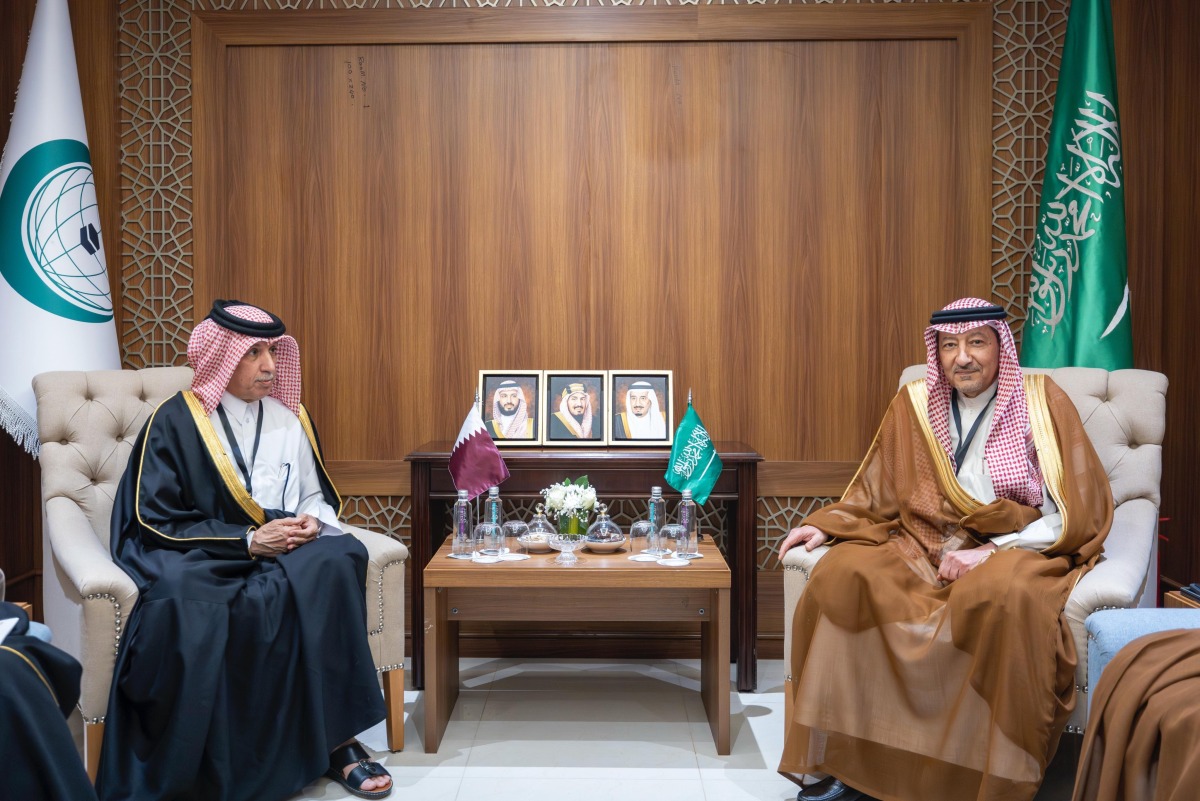

Qatar and Saudi Arabia reaffirmed their commitment to strengthening bilateral ties during a meeting between their top foreign affairs officials in Jeddah on Sunday. Minister of State for Foreign Affairs H.E. Sultan bin Saad Al Muraikhi met with Saudi Deputy Minister of Foreign Affairs H.E. Eng. Waleed bin Abdulkarim Al Khuraiji on the sidelines of an extraordinary session of the Organization of Islamic Cooperation (OIC). Discussions focused on enhancing Qatar-Saudi Arabia relations and addressing regional issues of common concern.
The meeting took place at the King Abdulaziz International Conference Center in Jeddah, following an urgent gathering of the OIC Council of Foreign Ministers convened to discuss escalating tensions in the Red Sea and the potential impact on maritime security. The officials’ discussion signals a continued effort to foster diplomatic solutions and collaboration within the Gulf region, despite ongoing geopolitical complexities. The focus also suggests a desire for unified regional responses to international challenges.
Strengthening Qatar-Saudi Arabia Relations
According to the Qatari Ministry of Foreign Affairs, the meeting provided an opportunity to review the progress made in various areas of cooperation between Doha and Riyadh. Both nations expressed a shared interest in expanding their collaboration, building upon recent diplomatic improvements. The discussions were described as productive and focused on practical steps to deepen the relationship.
Key Areas of Focus
While specific details of the cooperative initiatives were not disclosed, it is anticipated that economic partnerships, particularly in the energy sector, will remain a priority. Increased collaboration in regional security, including counter-terrorism efforts, also frequently features in bilateral discussions. Furthermore, the officials likely addressed strategies for de-escalation and promoting stability in neighboring countries.
The two countries have been working to repair strained relations following a diplomatic crisis that began in 2017. The crisis involved a blockade of Qatar by Saudi Arabia, the United Arab Emirates, Bahrain, and Egypt. The blockade was lifted in 2021, facilitating a gradual restoration of ties. This restoration has involved high-level visits, the resumption of diplomatic representation, and renewed economic cooperation.
Meanwhile, the extraordinary OIC meeting addressed the rising attacks on commercial vessels in the Red Sea by Yemen’s Houthi rebels. These attacks, linked to the ongoing conflict in Gaza, have raised concerns about disruptions to global trade and maritime security in a critical waterway. Qatar and Saudi Arabia both voiced their commitment to safeguarding navigation freedom and called for a cessation of hostilities that threaten regional stability.
Additionally, the conversations almost certainly touched on the broader implications of the conflict in Gaza. Both Qatar and Saudi Arabia have been actively involved in diplomatic efforts to achieve a ceasefire and facilitate humanitarian aid delivery to the Palestinian territory. The two nations have coordinated their positions on the crisis and are working to encourage international consensus on a lasting resolution.
In contrast to the earlier period of regional division, Qatar and Saudi Arabia now seem to be prioritizing a united front on issues of shared concern. This shift in approach reflects a growing recognition that regional challenges require collaborative solutions. Experts suggest this change is driven by a desire to diversify geopolitical alignments and address shared security threats. This is part of a wider re-evaluation of Middle East policy across the region.
The meeting underscores the importance of continuous dialogue between Qatar and Saudi Arabia to address evolving regional dynamics. The outcome suggests a continuing commitment from both sides to normalize relations, and a general agreement on the need for regional peace and stability. Further details on concrete agreements resulting from the meeting are expected in the coming weeks.
Looking ahead, observers will be watching for further high-level engagements between Qatari and Saudi officials, potentially leading to formalized agreements on topics like trade, investment, and security cooperation. The ongoing situation in the Red Sea and Gaza will continue to be key areas of focus. The duration and success of diplomatic negotiations surrounding these issues remain uncertain, but the current level of engagement between Qatar and Saudi Arabia is expected to play a pivotal role in shaping regional outcomes.
Related topics include the OIC’s response to the Red Sea crisis and the ongoing Gaza ceasefire negotiations.