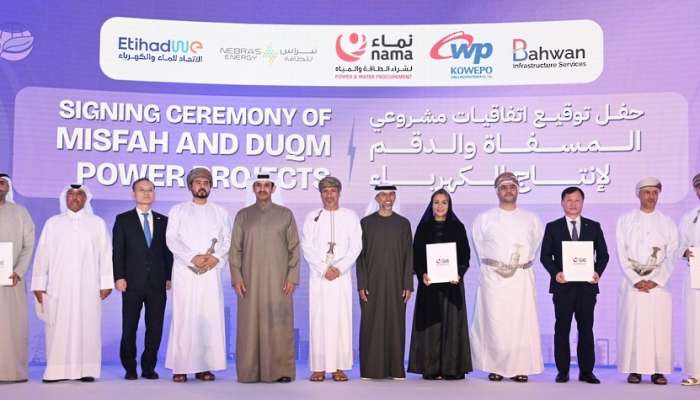

Oman is poised for a significant boost in its power generation capacity with the signing of power purchase agreements (PPAs) for two major combined cycle gas turbine (CCGT) projects. These projects, located in Misfah and Duqm, represent a substantial investment of approximately OMR 1 billion and underscore the nation’s commitment to a secure, sustainable, and modern energy future. The agreements, finalized under the patronage of Eng. Salim Nasser Al Aufi, Minister of Energy and Minerals, signal a pivotal moment in Oman’s energy transition and its pursuit of Oman power projects.
Strengthening Oman’s Energy Infrastructure with New CCGT Plants
The development of these two cutting-edge power plants is being spearheaded by international consortia, demonstrating the confidence global energy players have in Oman’s economic potential and forward-thinking energy policies. The Misfah Power project will be developed by a consortium led by Nebras Power Q.P.S.C., including Etihad Water and Electricity Company PJSC and Bahwan Infrastructure Services LLC. The Duqm project, strategically positioned to support the burgeoning Duqm Special Economic Zone, will be undertaken by a KOWEPO-led consortium, also comprising Nebras Power Q.P.S.C., Etihad Water and Electricity Company PJSC, and Bahwan Infrastructure Services LLC.
This collaborative approach highlights Oman’s openness to foreign investment and its dedication to leveraging international expertise in the energy sector. The involvement of companies from Qatar, the United Arab Emirates, and South Korea further solidifies regional cooperation in achieving shared energy goals.
Advanced Technology for Efficiency and Sustainability
Both the Misfah and Duqm power generation projects will utilize state-of-the-art combined cycle gas turbine (CCGT) technology. This technology is renowned for its high efficiency, meaning it can generate more electricity from the same amount of fuel compared to older power plant designs. This increased efficiency directly translates to lower fuel costs and reduced environmental impact.
Future-Proofing with Carbon Capture Readiness
Importantly, the plants are being designed with the future in mind. They are equipped to integrate carbon capture systems as the technology matures and becomes more economically viable. This proactive approach demonstrates Oman’s commitment to reducing its carbon footprint and transitioning towards a low-emissions energy system, aligning with its Net-Zero Target 2050. The gas turbines themselves are also designed to operate on a fuel mix containing up to 30% hydrogen, paving the way for a cleaner energy future.
Strategic Locations and Economic Impact
The placement of these projects is no accident. The Misfah plant is strategically located in the heart of Muscat Governorate, Oman’s largest electricity demand center. This proximity will enhance supply reliability and address the growing energy needs of the capital region.
Meanwhile, the Duqm project is situated within the Duqm Special Economic Zone, a rapidly developing economic hub. This location will provide a stable and reliable power supply to support the zone’s ambitious industrial projects and contribute to its overall economic growth. The Duqm plant is expected to be a key driver of regional development, attracting further investment and creating numerous employment opportunities. These energy infrastructure developments are vital for Oman’s diversification efforts.
Alignment with Oman Vision 2040 and Net Zero Goals
Eng. Salim Nasser Al Aufi, Minister of Energy and Minerals, emphasized the strategic importance of these projects, stating they represent a crucial step in strengthening the national energy system and achieving the objectives of Oman Vision 2040 and the Net-Zero Target 2050.
The projects are integral to ongoing efforts to modernize Oman’s power generation infrastructure through the deployment of high-efficiency technologies. They also support the large-scale integration of renewable energy sources, providing the necessary flexibility to manage intermittent power supply from solar and wind farms. High-efficiency gas-fired generation will act as a crucial transitional capacity, ensuring grid stability as Oman increases its reliance on renewable energy.
Collaboration and Regional Partnerships
The successful signing of these PPAs is a testament to the strong partnerships between Oman and its regional allies. Leaders from Qatar and the United Arab Emirates expressed their enthusiasm for the collaboration, highlighting the shared commitment to sustainable energy development.
Eng. Saad Sherida Al Kaabi, Qatar’s Minister of State for Energy Affairs, underscored the pivotal role of the energy sector in advancing social and economic development. Suhail Mohamed Al Mazrouei, UAE’s Minister of Energy and Infrastructure, emphasized the importance of regional cooperation in strengthening energy security and transitioning to lower-emissions energy systems.
Long-Term Vision and Future Readiness
With 20-year power purchase agreements in place and a combined land area of 587,000 square meters allocated for future expansion, including carbon capture facilities, these projects demonstrate a long-term, future-ready approach to power generation. Ahmed bin Salim Al Abri, CEO of Nama Power and Water Procurement, highlighted the company’s commitment to enhancing the efficiency of the power generation system since 2005.
The Misfah and Duqm Oman power projects are not simply about meeting current energy demands; they are about building a resilient, sustainable, and future-proof energy infrastructure for the Sultanate of Oman. The involvement of experienced players like Nebras Energy and KOWEPO, coupled with the strategic vision of the Omani government, positions these projects for long-term success and a significant contribution to the nation’s economic and environmental goals.