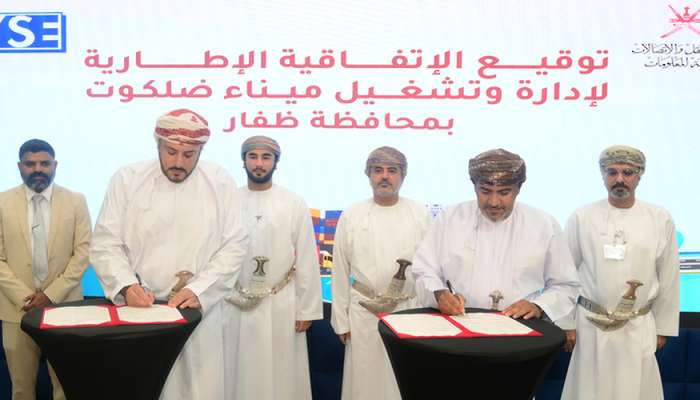

Oman is strategically investing in its maritime infrastructure, and the latest development exemplifies this commitment. A significant framework agreement has been signed between the Ministry of Transport, Communications and Information Technology and Abu Sultan Enterprises, paving the way for the redevelopment, management, and operation of Dhalkut Port in the Dhofar Governorate. This three-year partnership represents a crucial step in realizing Oman’s ambitions for a thriving logistics sector and bolstering its economic growth.
Dhalkut Port Redevelopment: A Landmark Agreement
The signing ceremony solidified a collaborative vision for transforming Dhalkut Port into a key asset within Oman’s expanding network of maritime facilities. Eng. Khamis bin Mohammed Al Shammakhi, Undersecretary of the Ministry for Transport, and Abdulaziz bin Salim Al Rawahi, Chairman of the Board of Directors of Abu Sultan Enterprises, formally sealed the agreement, marking the beginning of a new era for the port.
This isn’t simply about upgrading physical infrastructure; it’s a strategically aligned effort supporting both Oman Vision 2040 and the National Logistics Strategy 2040. These ambitious frameworks outline the Sultanate’s desire to become a leading regional logistics hub, capitalizing on its advantageous geographical location and consistently improving its logistical capabilities.
Key Objectives of the Partnership
The primary objective of the agreement is to substantially enhance the efficiency and capacity of Dhalkut Port. This will be achieved through several phases, beginning with Abu Sultan Enterprises developing a comprehensive financial and commercial model. This detailed plan will be essential for securing long-term investment and guaranteeing the project’s success.
Central to this model will be the identification and implementation of best-in-class operational and commercial practices. This exploration will cover everything from cargo handling techniques to streamlined administrative processes, all designed to maximize output and minimize delays. Furthermore, a crucial component of their remit is to formulate a strategic vision for the port’s future, focusing on expanding its services and attracting greater trade volume.
Aligning with Oman’s National Strategies
The revitalization of Dhalkut Port is not an isolated project. It is deeply interwoven with the Ministry’s wider strategy for developing Oman’s network of ports, particularly focusing on medium and small-sized facilities. These ports, when integrated effectively with the larger hubs like Salalah and Sohar, will create a more resilient and comprehensive logistical infrastructure.
This integration is paramount. Smaller ports play a vital role in regional trade and supporting local economies, alleviating pressure on the major ports and offering specialized services. Efficiently linking these facilities through streamlined processes and coordinated development will be a key differentiator for Oman in the competitive maritime industry.
Phased Implementation and Transition
The agreement outlines a clear timeline for implementation. Abu Sultan Enterprises is expected to assume operational control of the port within six months. This initial period will focus on conducting essential maintenance, addressing immediate operational needs, and establishing a baseline for future improvements.
The subsequent three-year framework will be entirely dedicated to the meticulous planning and execution of a detailed, long-term commercial operational plan. This includes securing necessary approvals, attracting investment, and building the capacity of the local workforce. The Ministry plans to closely monitor progress and provide support to ensure the project remains on track.
Boosting Economic Growth and Public-Private Collaboration
The anticipated benefits of developing Dhalkut Port extend beyond simply improving logistical efficiency. It’s anticipated to act as a significant catalyst for economic growth in the Dhofar Governorate and throughout Oman. Increased trade activity will generate employment opportunities, stimulate local businesses, and contribute to the diversification of the Omani economy.
Moreover, this project represents a successful model for public-private sector collaboration. By partnering with Abu Sultan Enterprises, the Ministry is leveraging private sector expertise, innovation, and investment to achieve its national objectives. This approach is increasingly favored in Oman as it allows for faster project delivery and reduced financial burden on the public sector. The success of this partnership could pave the way for similar initiatives across other sectors.
The development of Dhalkut Port also promises to attract further foreign investment in Oman’s burgeoning logistics landscape, solidifying its status as a crucial transit point for global trade. Oman’s commitment to modernizing its infrastructure, like this port, will ultimately enhance its competitiveness on the world stage.
In conclusion, the framework agreement for Dhalkut Port is a pivotal development for Oman’s maritime and logistics sectors. It exemplifies a strategic commitment to Oman Vision 2040 and the National Logistics Strategy 2040, fostering economic growth, enhancing trade capabilities, and promoting robust public-private partnerships. This project is poised to unlock significant potential for the Dhofar Governorate and contribute to Oman’s vision of becoming a leading global logistics hub.
For further information on Oman’s logistics strategy and investment opportunities, visit the Ministry of Transport, Communications and Information Technology’s website or explore the latest industry reports on Oman’s maritime sector.