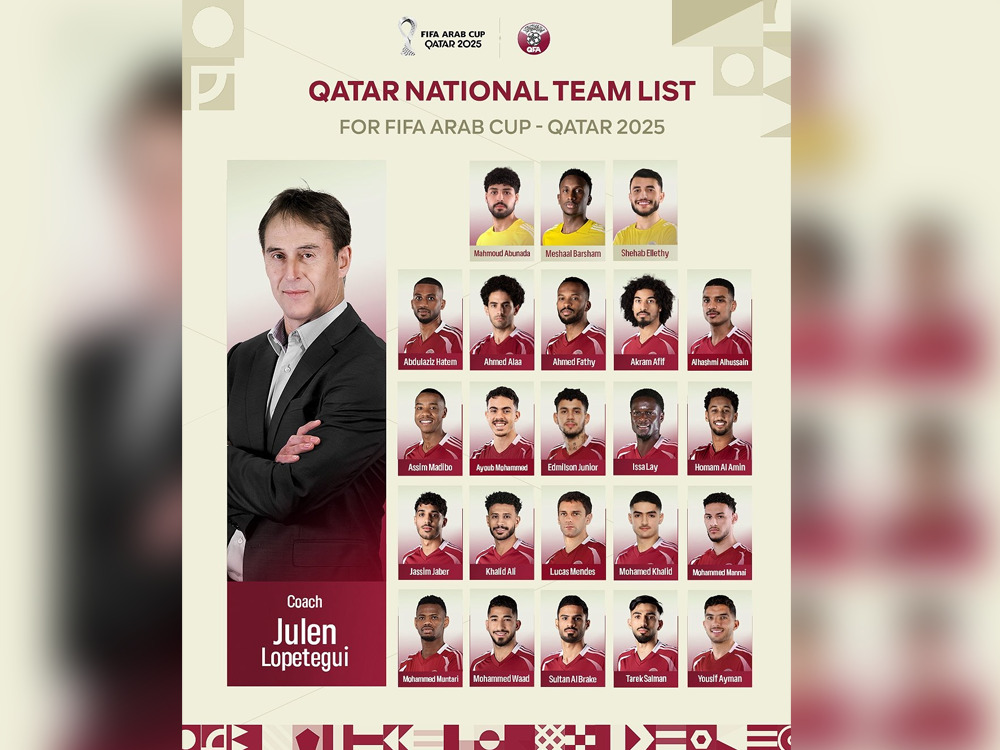

Qatar coach Julen Lopetegui has named a 23-player squad to compete in the upcoming Qatar Arab Cup, set to begin December 1st. The team will aim to improve upon their third-place finish in the 2021 tournament, navigating a challenging Group A alongside Tunisia and the winners of two qualifying matches. The announcement follows the conclusion of the Qatar Stars League’s tenth round and signals preparations for the 2026 FIFA World Cup.
The tournament will be hosted across several iconic stadiums in Qatar, including Al Bayt Stadium where Qatar will play their opening match against the winner of the Palestine-Libya qualifier. The final is scheduled for December 18th at Lusail Stadium. Key striker Almoez Ali will miss the competition due to recent leg surgery, placing increased responsibility on Akram Afif to lead the attack.
Qatar Arab Cup Squad: A Blend of Experience and Emerging Talent
Lopetegui’s squad selection reflects a strategic balance between seasoned veterans and promising young players. Several established names, including Boualem Khoukhi, Karim Boudiaf, and Pedro Miguel, were not included in the final roster. However, experienced players like Abdulaziz Hatem, Ahmed Alaaeldin, and Edmilson Junior have been recalled to bolster the team’s midfield and defense.
Goalkeeping and Defensive Lineup
Mahmoud Abunada, recently established as Lopetegui’s preferred goalkeeper, will be supported by Meshaal Barsham and Shehab Al Laithi. The defensive line will feature a mix of experience and youth, with Tarek Salman and Lucas Mendes expected to play key roles. The inclusion of young prospects like Mohammed Khalid indicates a focus on developing future national team players.
Midfield and Attacking Options
Akram Afif is expected to be the focal point of Qatar’s attack in the absence of Almoez Ali. Mohammed Muntari will also be looked upon to provide crucial goals. The midfield will be anchored by players like Assim Madibo and Jassim Jaber, providing both defensive stability and creative passing options. Additionally, the squad includes a number of versatile players capable of contributing in multiple positions.
Qatar recently participated in a friendly match against Zimbabwe as part of their preparation for the Arab Cup. The team will now enter a short training camp to fine-tune their tactics and build team cohesion before the tournament begins. This preparation is also viewed as crucial for building momentum ahead of the 2026 FIFA World Cup, where Qatar will be looking to make a strong impression on the international stage.
The omission of several veteran players suggests Lopetegui is actively evaluating options and preparing for a potential squad overhaul as they look towards future Qatar Stars League players. The coach has emphasized the importance of integrating new talent and providing opportunities for younger players to gain valuable international experience. This approach aligns with a long-term strategy of building a competitive national team capable of consistently challenging for regional and global honors.
The outcome of the Palestine-Libya and Syria-South Sudan qualifying matches will determine Qatar’s full group stage schedule. The team’s performance in the Arab Cup will be closely watched by fans and analysts alike, as it provides a valuable gauge of their progress and potential ahead of the 2026 World Cup. The next step will be the commencement of the training camp, with the focus on tactical preparation and player fitness. Further squad adjustments or injury updates remain a possibility before the tournament’s kickoff.
Qatar squad: Mahmoud Abunada, Meshaal Barsham, Shehab Al Laithi, Abdulaziz Hatem, Ahmed Alaaeldin, Ahmed Fathy, Akram Afif, Al Hashemi Al Hussein, Ayoub Mohammed, Assim Madibo, Edmilson Junior, Issa Lay, Homam Al Amin, Jassim Jaber, Khalid Ali, Lucas Mendes, Mohammed Khalid, Mohammed Mannai, Mohammed Muntari, Mohammed Waad, Sultan Al Brake, Tarek Salman, Yousuf Ayman