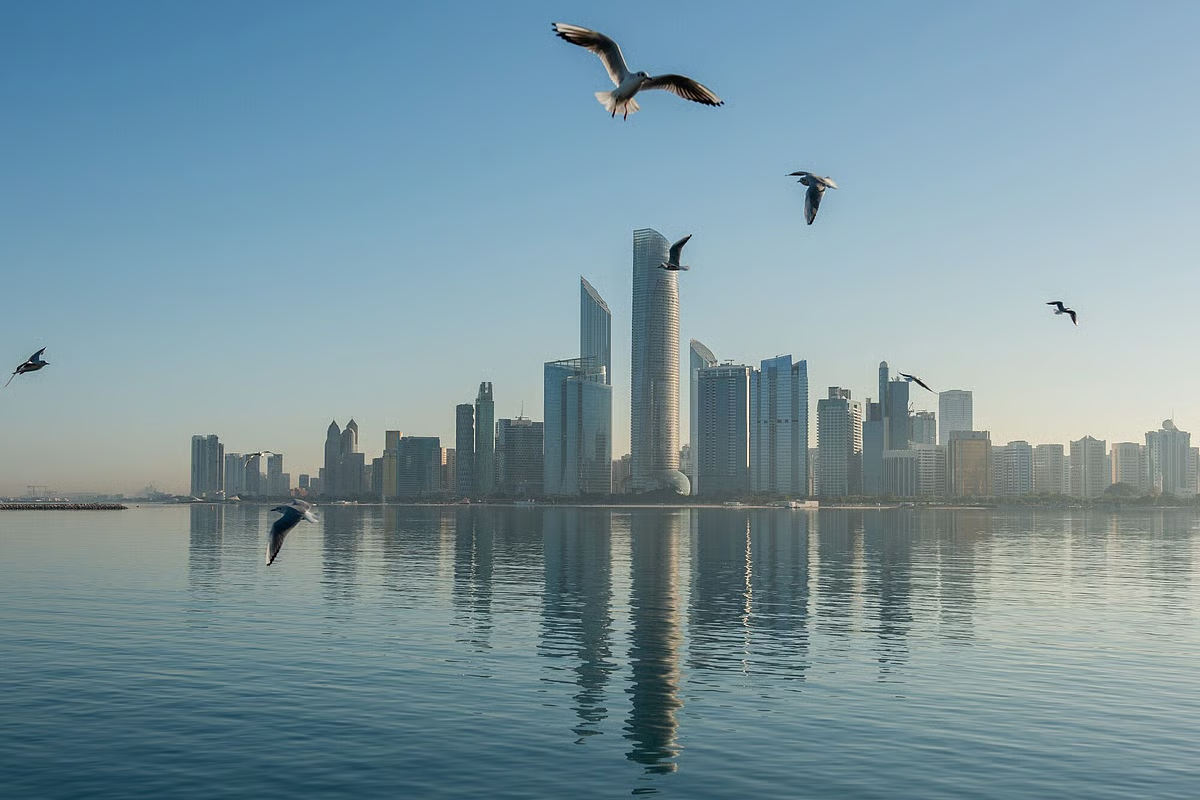

Abu Dhabi is shifting its economic development strategy, moving away from simply attracting foreign direct investment and focusing instead on maximizing the value generated from that capital. This pivot, according to the Abu Dhabi Investment Office (ADIO), emphasizes the creation of sustainable economic activity, high-skilled jobs, and the development of globally competitive industries within the emirate. The goal is to build a resilient, knowledge-based economy that extends beyond transactional inflows.
The change reflects a broader recognition that attracting capital is not an end in itself, but a means to achieving specific economic outcomes. ADIO Head of Value Creation, Ahmad Soubra, stated that success is now defined by the presence of operational factories, local research and development capabilities, and companies utilizing Abu Dhabi as a hub for international expansion. This new approach signals a long-term commitment to economic diversification and sustainability.
A Focus on Outcomes from Investment
For years, the global landscape of economic development has often been characterized by a race to attract the largest volume of investment. However, Abu Dhabi has signaled a decisive departure from this traditional metric. The emirate is now deliberately shaping its investment pipeline around pre-defined outcomes, prioritizing projects that offer lasting economic benefits.
According to ADIO, capital remains crucial, but it is viewed as an enabler rather than the primary objective. This strategy is directly linked to the Abu Dhabi Industrial Strategy, which aims for the manufacturing sector to contribute Dh172 billion to the economy by 2031. This growth will be driven by expanded production, increased exports, and substantial improvements in industrial capabilities.
To facilitate this, ADIO has adopted a cluster-led model. This approach meticulously aligns policies, regulations, infrastructure, and financial incentives around specific sectors, reducing risks for investors and bolstering the growth of key industries.
Key Sectors Driving Abu Dhabi’s Growth
Abu Dhabi’s economic diversification is centered on several strategically chosen sectors. Advanced manufacturing, encompassing technologies like additive manufacturing and robotics, is a key priority. Similarly, smart and autonomous mobility, including electric vehicles and related infrastructure, is receiving significant attention.
Life sciences, with a focus on biotechnology and pharmaceutical research, also features prominently, alongside agrifood and water technologies, critical given the region’s environmental challenges. Finally, financial and digital platforms are seen as essential for facilitating innovation and driving economic growth.
Attracting foreign investment is still a priority, but ADIO’s focus has expanded to encompass companies committed to establishing robust, long-term operations within the emirate. These operations are expected to generate skilled employment in areas such as engineering, advanced manufacturing, research, and specialized services.
The Abu Dhabi Local Content (ADLC) program reinforces this commitment by ensuring that investments benefit the broader economy, especially small and medium-sized enterprises (SMEs). Furthermore, partnerships with institutions like Rabdan Academy are designed to cultivate a skilled workforce aligned with the needs of these emerging sectors. The ultimate goal is not simply job creation, but the development of a resilient and continuously evolving talent pool.
The profile of investors actively seeking opportunities in Abu Dhabi has changed noticeably in recent years. While previously, interest was frequently driven by market access or regional expansion, contemporary investors are increasingly drawn by the prospect of building advanced engineering centers, sophisticated manufacturing facilities, and cutting-edge AI and data infrastructure. This signals a move towards higher-value, knowledge-intensive investments.
Additionally, there’s been a rise in long-term institutional capital and global asset managers establishing a permanent footprint in Abu Dhabi. This uptick reflects growing confidence in the emirate as a stable, rule-of-law-based environment capable of sustaining capital deployment throughout economic cycles. It also points to a maturing economy – one that is positioned not as a short-term gain, but as a strategic location for sustained, decades-long business development.
Amidst broader global economic uncertainty, Abu Dhabi’s refined strategy offers a competitive advantage. Shifting capital flows, geopolitical risks, and tightening financial conditions emphasize the need for stability, predictability, and effective implementation. ADIO is responding by streamlining processes, reducing friction for investors, and strengthening the overall competitiveness of the emirate.
Cluster platforms provide investors with clarity on regulatory frameworks and testing procedures, while industrial and trade initiatives aim to manage costs and enable efficient scaling. Moreover, Abu Dhabi is actively diversifying its global partnerships, building stronger investment corridors across Asia, Europe, and North America to mitigate the impact of potential disruptions in capital flows. This proactive approach aims to create an economy capable of weathering volatility due to its inherent depth, adaptability and long-term vision. Attracting venture capital and private equity remains important to Abu Dhabi’s economic goals.
Looking ahead, Abu Dhabi is prioritizing strategic focus over broad reach, concentrating on sectors where it believes it can achieve global leadership. The emirate is backing this strategy with concrete action, encompassing industrial policies, cluster development initiatives and targeted investments in talent development. While the global economic outlook remains uncertain, Abu Dhabi’s commitment to value-driven investment, coupled with its proactive approach to risk mitigation, positions it for sustained growth in the years to come. Further details of the Industrial Strategy’s progress are expected in the first quarter of 2025.
Nivetha Dayanand is Assistant Business Editor at Gulf News, where she spends her days unpacking money, markets, aviation, and the big shifts shaping life in the Gulf. Before returning to Gulf News, she launched Finance Middle East, complete with a podcast and video series.
Her reporting has taken her from breaking spot news to long-form features and high-profile interviews. Nivetha has interviewed Prince Khaled bin Alwaleed Al Saud, Indian ministers Hardeep Singh Puri and N. Chandrababu Naidu, IMF’s Jihad Azour, and a long list of CEOs, regulators, and founders who are reshaping the region’s economy.
An Erasmus Mundus journalism alum, Nivetha has shared classrooms and newsrooms with journalists from more than 40 countries, which probably explains her weakness for data, context, and a good follow-up question.
When she is away from her keyboard (AFK), you are most likely to find her at the gym with an Eminem playlist, bingeing One Piece, or exploring games on her PS5.