
By Soran Naqishbandy, Cultural Advisor
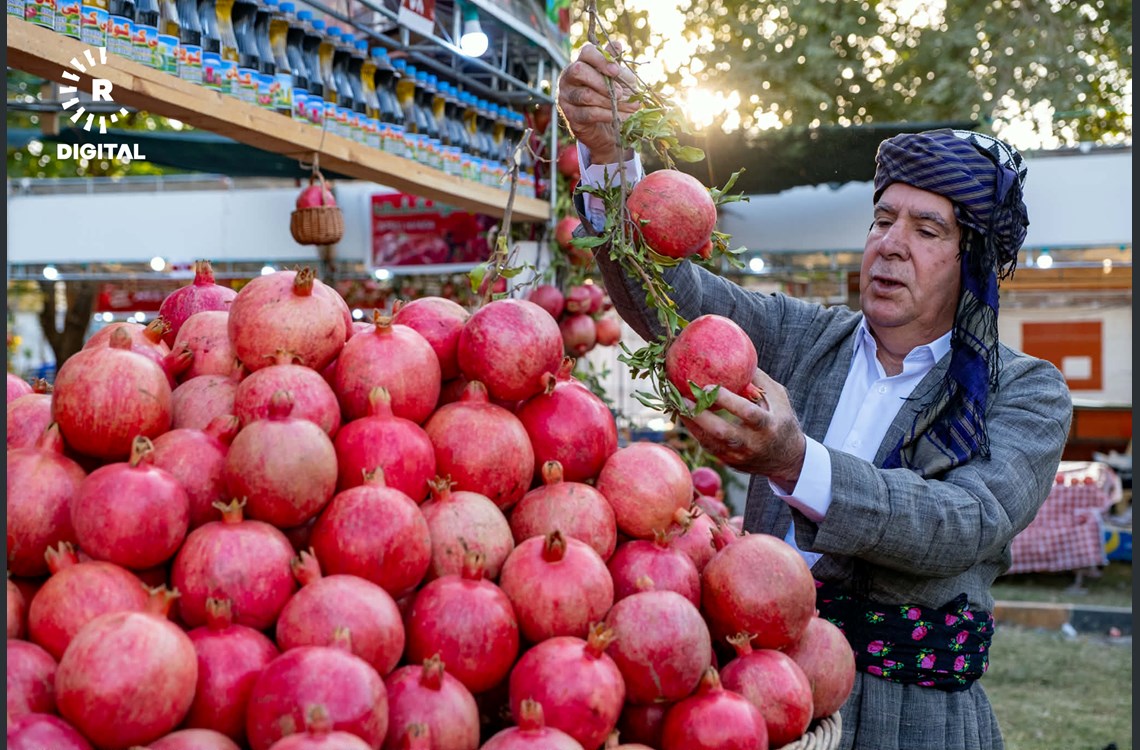
Halabja wears history like a woven sash, threads of sorrow and strength, scholarship and song, hospitality and hard work. It is a city famed for poets and pomegranates, a crossroads of faiths and families, and today a capital of civic imagination. Under the stewardship of Governor Noxsha Nasih, the province has encouraged a style of leadership that is orderly, humane, and open to innovation. That tone helped the 11th Halabja Pomegranate & Autumn Festival (HAPF-11) become far more than a seasonal celebration: it became a landmark in cultural diplomacy and public diplomacy, demonstrating how a city can welcome the nation, protect its people, pay local first, and speak to the world with facts rather than fanfare.
Between 30 October and 1 November 2025, just under 420,000 people visited the festival, an astonishing figure for a city of Halabja’s size. Traffic logs recorded about 80,000 cars, 2,000 buses (large and small), and 5,000 motorcycles over the three-day window. Day two brought the most severe stress test, with a four-hour standstill when inbound and outbound corridors saturated. Yet the festival closed with zero security incidents, zero food-related poisoning, and zero traffic accidents, compared with a normal-day baseline of roughly twenty accidents citywide. This was not good fortune. It was the product of pre-briefed vendors and inspectors, visible crowd marshals, on-site medical posts, and inter-agency coordination that kept the city’s moving parts in a single rhythm.
The economic case was equally decisive. On-site marketplace sales totaled IQD 1.7 billion (slightly over USD 1.5 million), of which more than USD 1.2 million went directly to farmers and craftspeople. The value chain looked healthy: IQD 700 million in agricultural products, IQD 800 million in food and beverages, and IQD 200 million in handcrafted goods. The spillover beyond the gates was significant as well: about 35% of visitors extended their stay to local resorts, heritage sites, and restaurants, off-site spending that does not appear in the marketplace total but nourishes the city’s broader economy. Festival operations generated 2,100 direct and 3,000+ indirect short-term jobs, offering many young people their first disciplined experience inside a complex, time-bound operation.
The people behind the numbers
Data gathered with the festival’s survey partners (including the MEED Foundation as a data partner) provides a human portrait that reads like a demographic bridge to the future. Visitors skewed young, 47% aged 20–29, with a gender split of 65% male / 35% female. Educationally, 35% reported a bachelor’s degree and 29% high school; occupationally, 38% were students and 20% self-employed. They came largely from Sulaymaniyah (37%) and Halabja (27%), arrived with family (40%) or in men’s groups (38%), and 31% were attending for the first time. Their purchases aligned with what the marketplace offered: 45% bought food and beverages, 39% bought pomegranates and derivatives. Sentiment was emphatic: 86% reported being satisfied or very satisfied; 81% praised logistics; 74% rated security “very good”; and 57% said they were very likely to recommend the festival to others.
Vendors reported a parallel confidence. Age bands clustered at 20–29 (34%) and 30–39 (29%); the split was 56% male / 44% female, with 29% holding a high-school education and 26% a bachelor’s degree. One-third (33%) were first-time participants, while 12% have been with us all eleven editions, a blend of renewal and loyalty. 51% rated booth attendance “very high,” 78% were satisfied or very satisfied with sales, and 78% said they are very likely to return. In diplomacy terms, those figures describe not just popularity but trust, and trust is what travels.
A whole-of-society partnership
If you want to see public diplomacy stripped of slogans, watch Halabja at work. The Kurdistan Regional Government served as primary enabler while the Directorates of Agriculture and Tourism, as well as Halabja Organizations Network synchronized agrifood value chains with visitor services and safety logistics, in structured coordination with the Halabja Network Organization. The private sector delivered at pace: LOGOS Agency (pro bono) led strategic communications and advancement; Ballu shaped the branding system and website; Hexa Agency operated social media; and Falcom Broadcasting produced media and live streams. Volunteers, producers, and residents, thousands of them, formed the civic backbone that turned institutional plans into hour-by-hour delivery. The formula was simple and powerful: public + private + people.
SDGs in practice, procedures, not slogans
Sustainability becomes persuasive when it is boring, when it appears as checklists rather than campaigns. HAPF-11 operationalized seven of the UN Sustainable Development Goals in ways that ordinary people could see and benefit from. Food vendors received hygiene briefings and temperature checks; inspectors enforced cold-chain rules; first-aid posts and hydration points were clearly signed; crowd-safety marshals roved high-density areas; and a digital operations cell synchronized production, streaming, and traffic updates while the website served well over one hundred thousand requests on an efficient cache. Booth layouts were engineered to reduce cross-traffic, and back-of-house corridors allowed waste to be cleared without disrupting shoppers.
One initiative deserves special note because it moved the conversation from “awareness” to substitution. Through a partnership between Nma Khani Organization and IQ Company, the festival deployed half a million sustainable food containers, spoons, and forks, dramatically reducing single-use plastic during the three days. By introducing compostable and recyclable alternatives at scale, and making them the default rather than an optional upgrade, HAPF-11 became the first large Iraqi and Kurdish festival to go green in practice, not just in messaging. That choice, multiplied across thousands of meals, kept waste out of landfills, set a market signal to suppliers, and created an expectation among visitors that sustainability is a service standard, not a slogan.
Sustainability also took the form of responsible mobility. Communications encouraged shared rides and group travel; partner fleets consolidated staff movements to cut redundant trips; and local sourcing shortened supply chains across food and craft categories, lowering the festival’s embodied-transport footprint. With only one hotel in Halabja, community hospitality, families opening their homes, often sharing meals at no cost, created temporary accommodation capacity at scale. It was a reminder that social trust can be infrastructure when it is organized with care.
A city that trends, and why that matters
The festival’s story did not end at the checkpoint. HAPF-11 trended nationally across Iraq and the Kurdistan Region for three consecutive days and dominated social platforms for four, accumulating more than seven million impressions and reach, around five million hashtag and name-tag mention, and 120,000 website visitors over 28 days, figures that place a civic event website in a league usually reserved for national campaigns. For sponsors, those numbers are not vanity metrics; they are the anatomy of return on visibility. For policy makers, they show that a city-led, community-staffed festival can command national attention and document it, the basic currency of soft power in the digital age.
The hospitality that made the difference
Visitors often judge a place not by its monuments but by how it receives strangers. Halabja’s reception committee was the city itself. With formal beds limited, homes opened and tables extended. It looked like a workaround; it felt like a welcome. As the festival grows, this civic reflex can be lightly formalized with simple registration, basic safety checks, and emergency contacts, enough structure to protect guests and hosts without choking the generosity that makes the gesture meaningful.
The friction we must fix, and a case for more days
The single persistent difficulty was mobility. The day-two standstill was not a failure of effort but a diagnosis: too many vehicles funneling through too few lanes at once. The response should be twofold and conducted in parallel. First, engineer the flow with event-time contraflow on primary corridors, park-and-ride intercept lots served by continuous shuttles, bus-priority gates at checkpoints, and variable-message signage tied to a live operations room. Daily vehicle counts by class and peak-hour logs should guide lane assignments, staffing, and shuttle frequency. Second, extend the calendar. With preparation this large and demand this high, a six-day or full-week edition would naturally flatten peaks, offer families more freedom to choose their day and time, and improve vendor economics through steadier re-stock cycles. Better engineering will help, but more days will transform, turning necessity into comfort and volume into grace.
Why investors are leaning in
Private capital is rarely sentimental; it is persuaded by evidence. HAPF-11 offered three kinds of proof. First, authentic audiences: nearly half a million in person, plus a measurable national conversation online. Second, credible measurement: clean sales tallies and a transparent digital footprint. Third, risk management: a zero-incident festival at national-trend volume. Add to that a governance model in which roles were clear and deliverables kept, and the result is obvious, strong sponsorship and co-investment interest for the next edition. For public institutions, the same evidence justifies sustained support: the festival converts popularity into prosperity and soft power into public value.
What other cities can adapt
Every city is unique; many cities rhyme. What Halabja offers is not a template to copy but a pattern to adapt. They can define the festival as a public service rather than a spectacle, with residents and producers at the center. Make SDGs procedural by writing them into checklists that specify who does what, when, how, and with what evidence. To build a real-time coalition that aligns public authority, private delivery, and citizen initiative. Measure what you want to keep, safety, hygiene, logistics satisfaction, digital signals, sales by category, jobs, spillover, and publish the results. Design for resilience with transport redundancy, homestay protocols, vendor zoning, waste routes, and shade/hydration points that treat dignity as infrastructure. And tell the story with modesty and facts; people believe what they can verify.
Toward HAPF-12
The horizon is practical and hopeful. Sustainability procedures will remain explicit and measured, with an expanded focus on waste sorting, a codified standard for reusable or compostable materials, and published local-sourcing rates alongside sales. Mobility will be engineered with contraflow, intercept parking, bus priority, and dynamic signage, paired with a six-to-seven-day festival to let the city breathe between peaks and give families time to savor Halabja’s attractions without rush. The festival’s digital voice will stay unified around verified name tags and hashtags, with a post-event transparency dashboard that reports impressions, reach, engagement, and top geographies as a standard practice.
Above all, we will protect the Halabja standard, competent, calm, hospitable, so that growth does not dilute character. The city’s diversity is not fragile; it is our competitive advantage. The festival will continue to be a table set for all, where a farmer’s year can be made, a student’s first job can be found, a craftswoman’s work can be priced fairly, and a family from another province can be hosted like kin.
Many chambers, one fruit, many voices, one city
The pomegranate is the right emblem because it captures our architecture: many chambers, one fruit. Farmers, vendors, artists, volunteers, officers, agencies, residents, each a chamber; together a city. HAPF-11 did not simply celebrate that fruit; it resembled it. In its crowds we saw our diversity; in its safety we saw our discipline; in its commerce we saw our work; in its hospitality we saw ourselves. As a work of cultural and public diplomacy, it persuaded not by argument but by example. It showed that a city can host hundreds of thousands safely, monetize culture without commodifying identity, trend nationally without losing its center, and align local practice with global goals in ways that are specific, verifiable, and human.
The task now is to give that shared effort more days, wider lanes, and the same unshakable attention to safety, sustainability, and dignity that made HAPF-11 a landmark. Do that, and Halabja will not only hold a festival; it will continue to reframe what a festival can do, for a city, for a region, and for a country learning once again to believe in itself.
Soran Naqishbandy
Cultural Advisor