






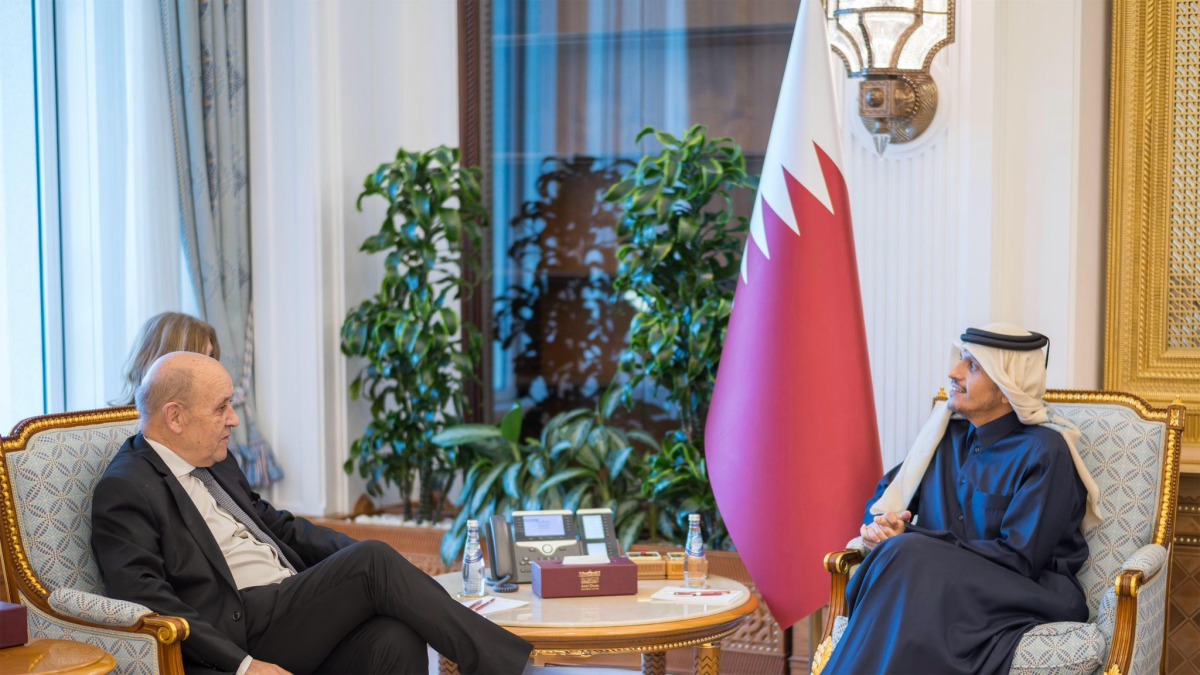

Doha, Qatar – Qatar’s Prime Minister and Minister of Foreign Affairs, Sheikh Mohammed bin Abdulrahman bin Jassim Al-Thani, met with French President’s Envoy to Lebanon, Jean-Yves Le Drian, on Wednesday to discuss the ongoing crisis in Lebanon and regional stability. The meeting focused on bolstering bilateral cooperation and coordinating international efforts to address the escalating tensions along the Lebanon-Israel border. Discussions also covered broader issues of mutual concern for both nations.
The meeting, held in Doha, comes amid heightened anxieties over potential conflict in the region, particularly following recent exchanges of fire between Hezbollah and Israeli forces. Qatar and France have both been actively involved in diplomatic initiatives aimed at de-escalation and a lasting resolution to the Lebanese political and economic challenges. The visit by Le Drian underscores the urgency of the situation and the need for a unified international approach.
Qatar and France Collaborate on Lebanon’s Future
According to a statement released by the Qatari Ministry of Foreign Affairs, Sheikh Mohammed emphasized the critical importance of Lebanon’s stability as a cornerstone of broader regional security. He stressed the necessity for all parties to adhere to United Nations Security Council Resolution 1701, which calls for a ceasefire and the withdrawal of Israeli forces from Lebanon, and to fully respect Lebanon’s sovereignty. This resolution has been a key point of contention, with ongoing accusations of violations from both sides.
Qatar has consistently condemned Israeli attacks on Lebanese territory, and Sheikh Mohammed reiterated this position during the meeting. He called upon the United Nations Security Council to fulfill its responsibilities in halting these violations and safeguarding Lebanon’s fragile stability. The international community’s response to the escalating violence remains a key concern for regional actors.
The Role of the Quintet Group
Sheikh Mohammed highlighted the significant role of the Quintet Group – comprising the United States, France, Qatar, Egypt, and Saudi Arabia – in supporting Lebanon’s recovery. The group has been working to facilitate the election of a new Lebanese president and push for necessary economic reforms. He affirmed Qatar’s commitment to continued close collaboration with its Quintet partners to ensure coordinated efforts.
These efforts are aimed at protecting Lebanon’s sovereignty and territorial integrity, as well as supporting its path towards economic and political recovery. Lebanon has been grappling with a severe economic crisis for years, exacerbated by political deadlock and the aftermath of the 2020 Beirut port explosion. The situation has led to widespread poverty and social unrest.
The French envoy’s visit follows a series of diplomatic engagements focused on Lebanon. France has historically maintained close ties with Lebanon and has been a leading advocate for international assistance. Le Drian’s mission is to assess the current situation and explore potential avenues for accelerating the implementation of reforms and securing a political breakthrough. Political stability in Lebanon is seen as crucial for preventing further regional escalation.
Additionally, the discussions likely touched upon the humanitarian situation in Lebanon, which has been severely impacted by the economic crisis and the ongoing border tensions. The displacement of civilians and the disruption of essential services are major concerns. Qatar has previously provided humanitarian aid to Lebanon and may consider further assistance in light of the current challenges.
Meanwhile, the broader context of the meeting includes the ongoing conflict in Gaza and its potential spillover effects on the region. The situation in Lebanon is particularly sensitive due to the presence of Hezbollah, a powerful armed group with close ties to Iran. The risk of a wider conflict remains a significant concern for international policymakers. The need for regional de-escalation is paramount.
Looking ahead, the effectiveness of the Quintet Group’s efforts will be closely watched. A key indicator of progress will be the election of a new Lebanese president, a process that has been stalled for months due to political divisions. The Security Council’s response to Qatar’s call for action regarding Israeli violations of Lebanese territory will also be crucial. The timing and outcome of these developments remain uncertain, but they will undoubtedly shape the future of Lebanese governance and regional stability.
Source: The Peninsula Qatar
Source: Reuters
Source: Al Mayadeen