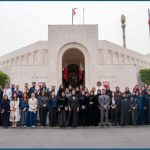

The Sultanate of Oman is charting a course for significant growth in its civil aviation sector, underpinned by the ambitious National Aviation Strategy 2040. Recent briefings by the Civil Aviation Authority (CAA) in Muscat highlighted substantial progress made in 2025, demonstrating the nation’s commitment to transforming aviation from a transport facilitator to a key economic driver. This strategy isn’t just about building airports; it’s about building a future where Oman is a globally recognized aviation hub.
Oman’s National Aviation Strategy 2040: A Roadmap for Growth
Eng. Naif Ali Al Abri, Chairman of the CAA, emphasized the strategy’s role as a comprehensive, long-term plan for the development of Oman’s civil aviation landscape. The core aim is diversification of the national economy and bolstering financial sustainability through a thriving aviation industry. The strategy sets forth impressive targets to be achieved by 2040, including accommodating over 40 million passengers annually, handling approximately one million tons of air cargo, attracting over RO 1 billion in private sector investment, and increasing the sector’s contribution to the national Gross Domestic Product (GDP) to more than 3.5 percent.
This isn’t a quick fix; the implementation is structured across three distinct phases. The first, “Initiation and Readiness Assurance” (2026-2027), focuses on laying the groundwork. This will be followed by the “Acceleration and Take-off” phase (2027-2030), designed to build momentum. Finally, the “Soaring” phase (2030-2040) aims to fully realize the strategy’s ambitious vision. The development of this strategy was a collaborative effort, involving over 60 national entities and extensive community engagement through 70 meetings and workshops.
Key Achievements in 2025: Safety, Security & Infrastructure
The CAA’s briefing detailed significant achievements in 2025 across several critical areas. These successes demonstrate tangible progress towards the goals outlined in the National Aviation Strategy 2040.
Aviation Security: Reaching New Heights
Rawya Nasser Al Adawi, Acting Director General of Civil Aviation Regulation, reported exceptional results in aviation security. Oman achieved a 94.4% compliance rate in the Universal Security Audit Programme with a Continuous Monitoring Approach, alongside a perfect 100% compliance rate for facilitation requirements. This underscores the nation’s dedication to maintaining the highest international security standards. Furthermore, the CAA signed 8 new international air transport service agreements and conducted 21 bilateral negotiation meetings, expanding Oman’s global connectivity. Over 18,000 flight permits, including diplomatic clearances, were issued, alongside 3,627 special permits for managing aviation obstacles.
Air Navigation: Increased Confidence & Traffic
Eng. Saleh Abdullah Al Harthy, Director General of Air Navigation, highlighted a substantial increase in air traffic movement, with a total of 643,069 aircraft movements recorded in 2025. A significant portion of this traffic – 585,357 aircraft – transited through Omani airspace, indicating growing international trust in the efficiency and security of Oman’s air navigation services. Passenger numbers at Omani airports also saw a strong recovery, reaching 15,213,150, demonstrating a resurgence in demand for air travel. This growth is a positive sign for the Omani economy and the success of the aviation sector development.
Modernizing Meteorological Services
Abdullah Rashid Al Khadouri, Director General of Meteorology, announced a qualitative leap in Oman’s meteorological capabilities. Key developments included the implementation of a flood modeling index, the launch of a comprehensive Oman Meteorology website and app, and the introduction of advanced weather maps with a resolution of 2.1 kilometers. The integration of artificial intelligence for data analysis and forecasting further enhanced the accuracy and timeliness of weather information. The network of meteorological observation stations expanded to 83 stations, providing more comprehensive data coverage.
Financial Performance & Future Projects
The CAA’s financial health also saw significant improvement. Hussein Salim Al Rahbi, Director General of Support Services, announced revenues exceeding RO 107 million in 2025 – the highest collection in the Authority’s history. This success is attributed to efficient financial management, improved business models, and optimized resource utilization.
Looking ahead, several key infrastructure projects are underway. The aircraft maintenance building at Muscat International Airport is 98% complete and expected to be operational this year. A tender for the construction of Sohar Airport will be announced shortly, and technical studies for the Musandam Airport project are nearing completion, with the executive plan slated for approval in the current year. These projects are vital components of the broader airport infrastructure development outlined in the strategy.
A Vision Taking Flight
The National Aviation Strategy 2040 represents a bold and ambitious vision for the future of aviation in Oman. The progress reported in 2025 demonstrates a clear commitment to achieving the strategy’s goals, positioning Oman as a significant player in the global aviation landscape. The focus on safety, security, technological advancement, and economic diversification will undoubtedly contribute to a more sustainable and prosperous future for the Sultanate.
To learn more about Oman’s economic diversification efforts, visit [relevant government website link]. Stay tuned for further updates on the implementation of the National Aviation Strategy 2040 and the exciting developments shaping the future of flight in Oman.