






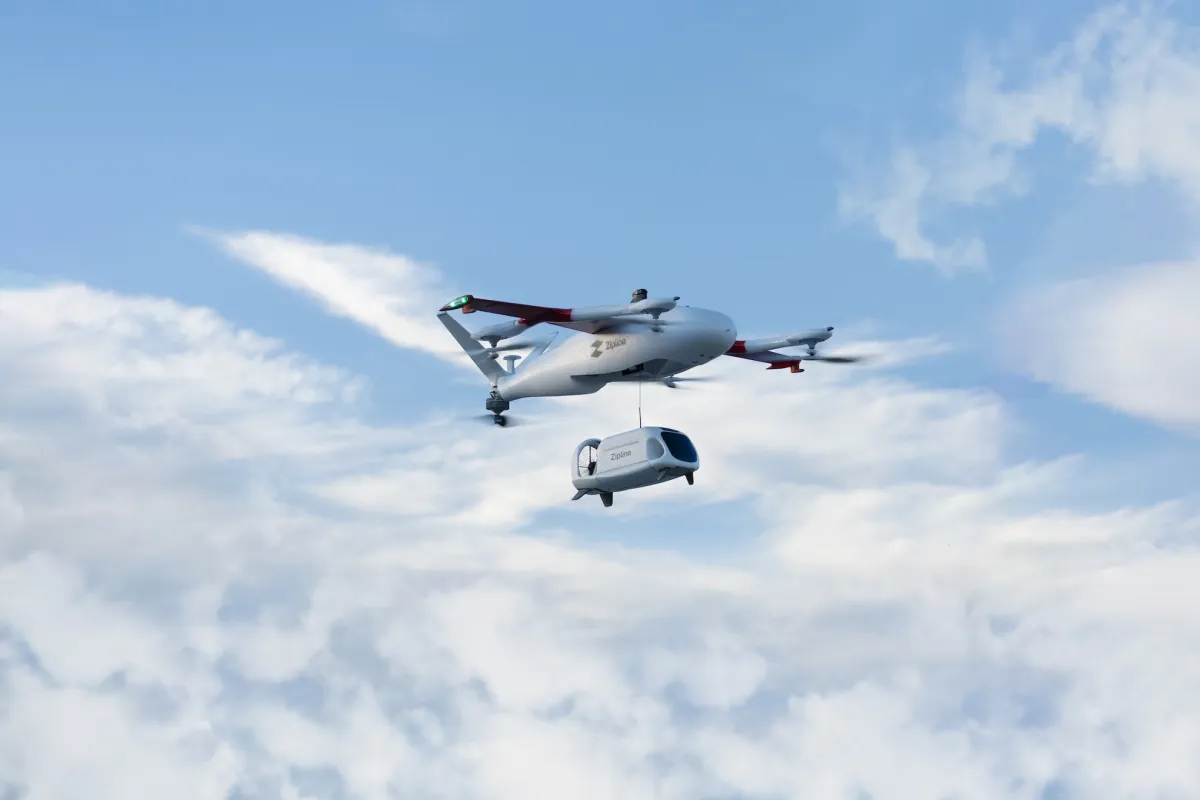

U.S.-based autonomous delivery company Zipline announced Wednesday it will expand its drone delivery services to Houston and Phoenix in early 2024, fueled by a $600 million investment. The company, which already operates in several U.S. cities and internationally, aims to bring faster, more efficient logistics to a wider customer base. This expansion marks a significant step in the growing commercial drone industry and its potential to reshape last-mile delivery.
The funding round, valuing Zipline at $7.6 billion, will support operations in at least four additional U.S. states by 2026, according to the company. Investors included Fidelity Management & Research Company, Baillie Gifford, Valor Equity Partners, and Tiger Global, signaling confidence in Zipline’s long-term viability and growth potential.
Zipline’s Expansion and the Future of Drone Delivery
Founded in 2014, Zipline initially gained recognition for its medical supply deliveries in Rwanda, utilizing drones to transport blood and other critical items to remote areas. The company has since broadened its scope to include food, retail, and agricultural products, operating in five African countries, Japan, and select locations within the United States. This diversification demonstrates the adaptability of their delivery drone technology.
Zipline currently employs two primary drone platforms. Platform 1 is designed for longer-range deliveries, capable of covering a 120-mile round trip, and caters to enterprise, business, and government clients. Platform 2, with a 10-mile radius and capacity for up to eight pounds, powers the company’s direct-to-consumer home delivery service.
U.S. Market Growth and Partnerships
The company’s U.S. presence has been rapidly increasing, beginning with a pilot program in Pea Ridge, Arkansas, and expanding to the Dallas-Fort Worth Metroplex in partnership with Walmart. Zipline reports a consistent week-over-week growth of approximately 15% in U.S. deliveries over the past seven months, having recently surpassed 2 million total deliveries globally.
Beyond Walmart, Zipline has forged commercial partnerships with a growing number of popular restaurant chains, including Panera, Chipotle, Crumbl, Blaze Pizza, Wendy’s, and Little Caesars. These collaborations are key to expanding the range of goods available through their drone services and attracting a broader customer base.
Zipline’s co-founder and CEO, Keller Cliffton, anticipates 2026 as a pivotal year for the company and the broader autonomous logistics sector. He believes the increasing demand for faster, cleaner, and more affordable delivery options will drive widespread adoption of drone technology.
“Autonomous logistics has been maturing for more than a decade, and the last year has made it unmistakably clear that when deliveries are faster, cleaner, safer, and cheaper, demand isn’t just high, it grows exponentially,” Cliffton stated. “In 2026 autonomous logistics will become an everyday staple for people across several states in the U.S.”
However, Zipline is not the only player in the emerging drone delivery landscape. Competition exists from companies like Flytrex, DroneUp, Amazon Prime Air, and Wing, a subsidiary of Alphabet (Google’s parent company) which also has a partnership with Walmart. Wing, for example, has announced plans to expand to an additional 150 Walmart stores by 2027.
The regulatory environment surrounding drone operations remains a key factor influencing industry growth. The Federal Aviation Administration (FAA) continues to refine rules governing beyond visual line of sight (BVLOS) flights, which are essential for scalable last-mile delivery using drones. Zipline and its competitors are actively working with the FAA to demonstrate the safety and reliability of their systems.
Furthermore, public perception and acceptance of drones are crucial for long-term success. Concerns regarding noise pollution, privacy, and safety need to be addressed to foster trust and encourage widespread adoption of this technology.
Looking ahead, Zipline’s planned launches in Houston and Phoenix will serve as important testbeds for scaling its operations in diverse urban environments. The company’s ability to navigate logistical challenges, secure necessary regulatory approvals, and maintain its reported growth trajectory will be critical to its continued success. The industry will be closely watching Zipline’s progress in 2024 and 2025 as it prepares for its anticipated breakout year in 2026.