






World leaders are gathering in Davos, Switzerland, for the World Economic Forum as a surprising diplomatic crisis unfolds over Greenland. German Chancellor Friedrich Merz is set to deliver the first major European address at the forum, alongside speeches from Greek Prime Minister Kyriakos Mitsotakis and Israeli President Isaac Herzog, while an emergency meeting of EU leaders is scheduled in Brussels to address escalating tensions with the United States regarding potential tariffs.
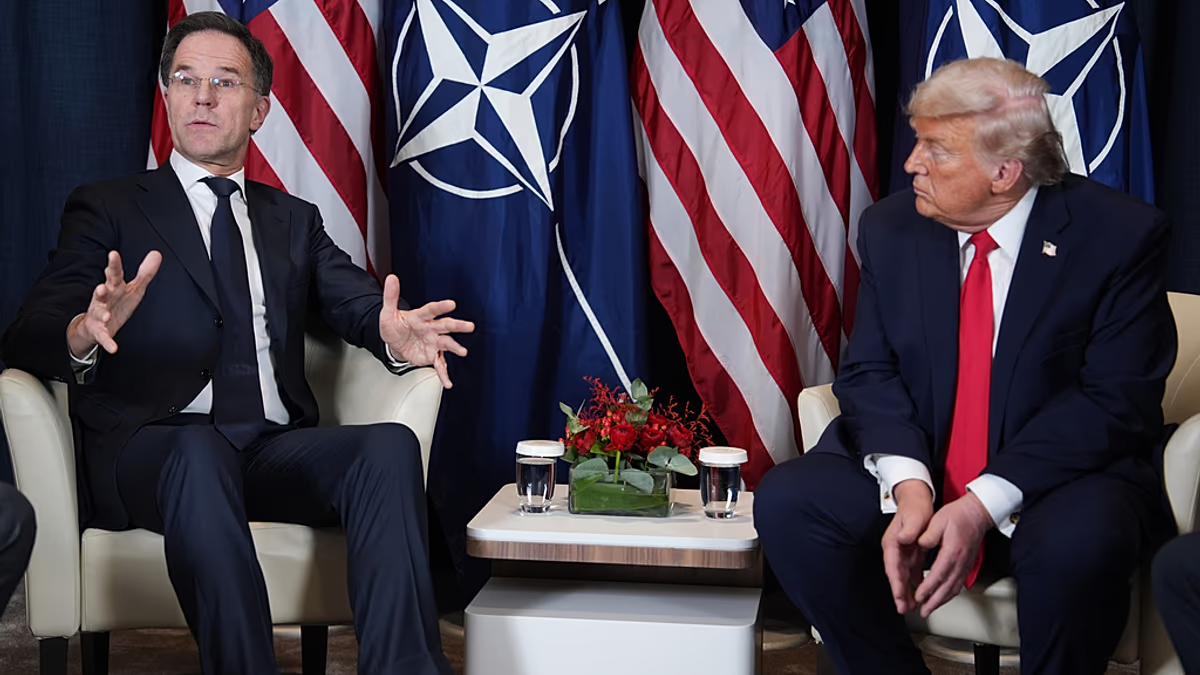
The situation arose after US President Donald Trump threatened tariffs on eight countries refusing to support his bid to acquire Greenland, a move that initially prompted a strong response from European nations. However, the threat of economic sanctions appears to have eased following an agreement with NATO Secretary General Mark Rutte on a new Arctic security framework.
Trump’s Greenland Pursuit and the US-Europe Relationship
President Trump used a lengthy speech at the World Economic Forum to reiterate his interest in “negotiating” for Greenland, despite acknowledging he would not pursue military action. He urged European leaders to agree to a sale, at times mistakenly referring to Iceland, and warned of potential consequences for non-compliance. “We want a piece of ice for world protection, and they won’t give it,” Trump stated, adding a pointed, “They have a choice: say yes and we’ll be very appreciative, or say no — and we will remember.”
The proposed deal reportedly involves limited land access for the US, control over Greenland’s natural resources, and the possible deployment of the “Golden Dome” missile defense system. This has raised concerns among Danish officials, who have sovereignty over Greenland.
Danish Foreign Affairs Minister Lars Løkke Rasmussen expressed cautious optimism following Trump’s speech, stating, “Now, let’s sit down and find out how we can address the American security concerns in the Arctic while respecting the red lines of the Kingdom of Denmark.” The situation highlights the complex geopolitical dynamics at play in the Arctic region, a territory of increasing strategic importance due to climate change and resource availability.
EU Response and Transatlantic Tensions
Meanwhile, the emergency meeting of the EU’s 27 member states in Brussels is expected to focus on a unified response to the US tariff threats and the broader implications for transatlantic relations. While the immediate crisis appears to have been averted, the incident has underscored existing tensions between the US and its European allies.
Former European Commission President Jean-Claude Juncker, speaking on Euronews, urged the EU to adopt a more assertive stance towards the US, stating, “The EU is not a slave of the United States of America.” He warned that continued threats could jeopardize the NATO alliance, noting that an attack or threat against a NATO member could trigger a breakdown of the organization. Euronews reports Juncker also suggested the EU should be prepared to “deeply harm the US economy” if necessary.
Additionally, Ukrainian President Volodymyr Zelensky is scheduled to meet with President Trump in Davos to discuss a proposed peace plan for Ukraine, adding another layer of complexity to the forum’s agenda. White House envoys are also planning visits to Moscow to engage with Russian President Vladimir Putin.
What to Watch Next Regarding Greenland
The coming days will be crucial in determining the future of the World Economic Forum discussions and the US-Europe relationship. The EU meeting in Brussels will likely set the tone for future negotiations, and the outcome of talks between Trump, Zelensky, and Putin could have significant implications for regional security. Observers will be closely watching for any further statements from President Trump regarding Greenland and whether he will continue to pursue the acquisition of the territory through diplomatic channels. Stay tuned to Euronews for continued coverage of these developing events.