





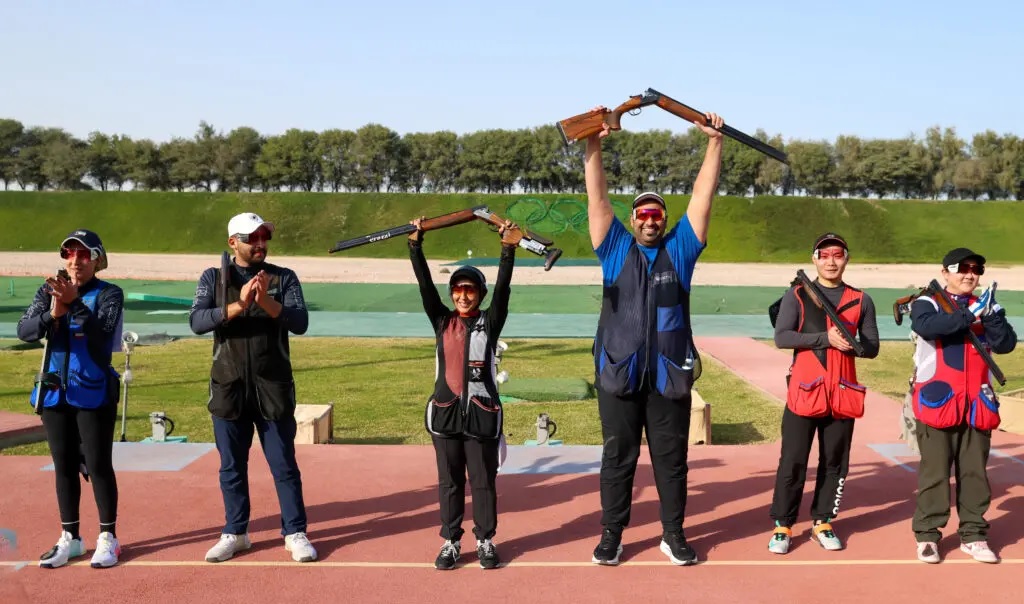

Qatar’s shooting team achieved a remarkable victory at the Asian Shotgun Championship, securing a gold medal in the mixed team trap event and concluding the competition with a total of eight medals. The championship, held at the Lusail Shooting Complex in Doha, showcased the nation’s growing prowess in the sport of shooting. Mohammed Al Rumaihi and Kholoud Al Khalaf led the charge, setting a new benchmark in the event.
The final day of the championship saw Qatar’s Al Rumaihi and Al Khalaf triumph over teams from Kuwait and Chinese Taipei. Their winning score of 30 out of 40 targets not only earned them the gold but also established a new Asian and world record in the mixed team trap discipline, according to tournament officials. Kuwait took silver with 20 targets, and Chinese Taipei secured bronze with 19.
Qatar Dominates at the Asian Shotgun Championship
This year’s Asian Shotgun Championship, which ran from January 22nd, saw strong performances across multiple disciplines. Qatar’s success wasn’t limited to the mixed team trap; the team amassed a total of four gold and four silver medals throughout the event. This impressive haul underscores Qatar’s commitment to developing its shooting sports infrastructure and athletes.
A Breakdown of Qatar’s Medal Count
Six of Qatar’s medals were earned in skeet events, demonstrating a particular strength in that area of shotgun shooting. The remaining two medals came from the trap discipline, highlighted by the record-breaking performance of Al Rumaihi and Al Khalaf. This balanced performance across both skeet and trap suggests a well-rounded and competitive national team.
The Lusail Shooting Complex, a state-of-the-art facility built for the 2015 ISSF World Cup, played host to the championship. The complex is designed to meet international standards and provides athletes with a world-class training and competition environment. Its continued use for major events like the Asian Championship is vital for promoting the sport within Qatar and attracting international talent.
The success of Qatari shooters is part of a broader national strategy to excel in sports, particularly those with a presence in major international competitions like the Olympics and Asian Games. The Qatar Olympic Committee has invested significantly in athlete development programs and infrastructure improvements in recent years. This investment appears to be yielding positive results, as evidenced by the team’s performance at the Asian Championship.
However, competition in the Asian shooting arena is consistently increasing. Countries like China, South Korea, and India have traditionally been strong contenders, and their presence adds significant pressure to all participating nations. Qatar’s ability to consistently challenge these established powers will be crucial for maintaining its position as a leading shooting nation in the region.
Meanwhile, the performance of Kholoud Al Khalaf is particularly noteworthy. Her participation and success contribute to the growing representation of women in sports within Qatar, aligning with national initiatives to promote gender equality. Al Khalaf’s achievement serves as an inspiration for aspiring female athletes in the country.
Looking ahead, the Qatari shooting team will likely focus on preparing for upcoming international competitions, including qualifying events for the Paris 2024 Olympic Games. The team’s performance at the Asian Championship provides a valuable foundation for these preparations. Further details regarding the qualification schedule and team selection are expected to be announced by the Qatar Olympic Committee in the coming weeks. The continued development of young talent and refinement of training programs will be key to sustaining this level of success.
The next steps involve analyzing the results of the championship to identify areas for improvement and tailoring training regimens accordingly. The team will also be monitoring the performance of its regional rivals to stay ahead of the curve. Whether Qatar can maintain its momentum and translate this success onto the Olympic stage remains to be seen.