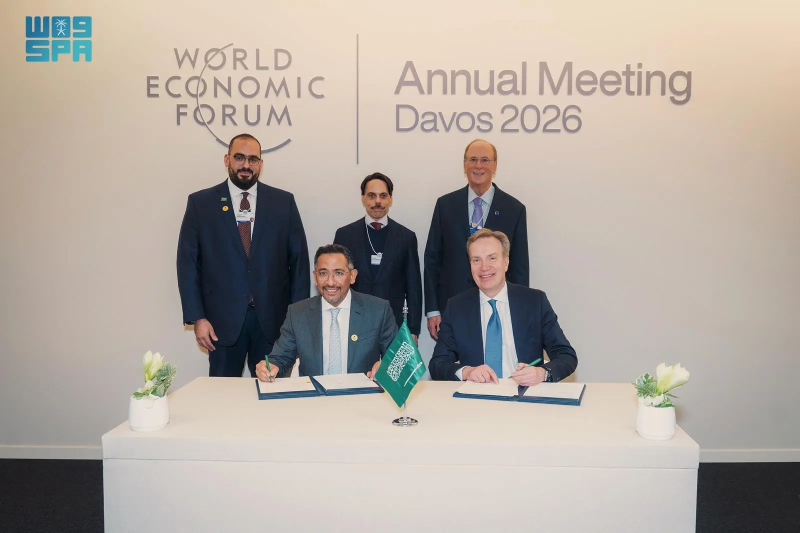

Saudi Arabia is bolstering its efforts to become a global industrial leader through a new cooperation agreement with the World Economic Forum (WEF). Signed on Wednesday in Davos, Switzerland, the partnership aims to accelerate industrial transformation within the Kingdom, focusing on skills development and technology adoption. The agreement was formalized on the sidelines of the WEF’s annual meeting, signaling a commitment to modernizing the Saudi industrial sector.
The agreement was signed by Saudi Minister of Industry and Mineral Resources Bandar Alkhorayef and WEF President Børge Brende, with Prince Faisal bin Farhan, Saudi Minister of Foreign Affairs, and Faisal Al-Ibrahim, Minister of Economy and Planning, in attendance. This collaboration underscores Saudi Arabia’s ambition to diversify its economy away from oil and establish itself as a key player in advanced manufacturing and technology. The initiative is closely aligned with the country’s National Industrial Strategy and broader Saudi Vision 2030 goals.
Accelerating Industrial Transformation in Saudi Arabia
The core of the agreement centers on creating a scalable model for industrial transformation, according to a statement released by the Saudi Ministry of Industry and Mineral Resources. This model will prioritize building capacity and enhancing skills throughout the entire industrial ecosystem, from workforce training to advanced technological implementation. The Ministry believes a skilled workforce is crucial for attracting foreign investment and fostering innovation.
A key component of this effort involves developing digital tools designed to streamline the transformation process. These tools will aim to bridge the gap between initial assessments and practical implementation, facilitating the integration of cutting-edge technologies into Saudi industrial facilities. This focus on digitization aligns with global trends in manufacturing technology and Industry 4.0.
Leveraging Global Expertise
The partnership will also provide the Saudi ministry with increased access to the WEF’s extensive network of technology providers, systems integrators, and service companies. This enhanced interaction is intended to maximize the utilization of specialized expertise and improve the efficiency and resilience of the Saudi industrial sector. The ministry aims to identify and adopt best practices from around the world.
Saudi Arabia is already demonstrating leadership in this area through the development of Lighthouse OS, a national model for industrial transformation created by Oxagon, a subsidiary of NEOM. The agreement recognizes Lighthouse OS as a leading example and aims to further refine it to meet international standards. This internal development showcases the Kingdom’s proactive approach to innovation.
Implementation of the agreement will be a collaborative effort between the WEF and the ministry’s Center for Advanced Manufacturing and Production. This center will serve as the primary hub for driving the adoption of modern technologies and enhancing industrial capabilities. The ministry anticipates this collaboration will lead to measurable improvements in productivity and competitiveness.
The move comes as Saudi Arabia continues to invest heavily in diversifying its economy. The country’s Vision 2030 plan outlines ambitious goals for industrial growth, including increasing the sector’s contribution to GDP and creating new employment opportunities. This partnership with the WEF is seen as a critical step in achieving these objectives.
Furthermore, the agreement supports the Kingdom’s broader strategy to attract foreign direct investment (FDI) in the industrial sector. By demonstrating a commitment to innovation and a willingness to collaborate with global leaders, Saudi Arabia hopes to position itself as an attractive destination for companies seeking to expand their operations in the Middle East. The development of a robust and modern industrial base is considered essential for long-term economic sustainability.
The focus on skills development is particularly important given the rapid pace of technological change. The ministry recognizes the need to equip the Saudi workforce with the skills necessary to operate and maintain advanced manufacturing systems. This includes investments in vocational training programs and partnerships with universities and research institutions. The goal is to create a highly skilled and adaptable workforce capable of driving future industrial growth.
While the specific timelines for implementation remain to be fully defined, the ministry indicated that initial projects are expected to launch within the next six to twelve months. The success of the agreement will depend on effective coordination between the WEF and the ministry, as well as the willingness of Saudi industrial companies to embrace new technologies and adopt best practices. Monitoring the progress of Lighthouse OS and its integration with other industrial facilities will be a key indicator of the initiative’s effectiveness.
Looking ahead, the next steps involve establishing detailed work plans and identifying specific areas for collaboration. The WEF and the ministry will also need to assess the existing industrial landscape in Saudi Arabia and identify the most pressing challenges and opportunities. The long-term impact of this partnership on the Kingdom’s industrial sector remains to be seen, but it represents a significant commitment to modernization and diversification.