






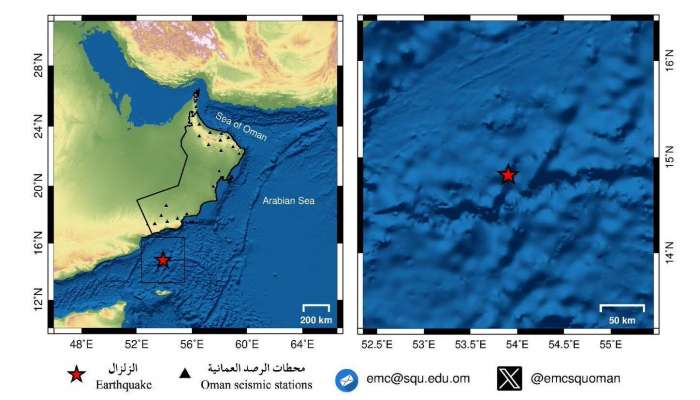

A moderate earthquake was felt across parts of Oman early Wednesday morning, prompting a report from the Earthquake Monitoring Center at Sultan Qaboos University. The tremor, registering a magnitude of 5.4, occurred in the Arabian Sea and while detected across the country, posed no immediate danger to major population centers. This event highlights the ongoing seismic activity in the region and the importance of continuous monitoring.
Details of the Arabian Sea Earthquake
The Sultan Qaboos University Earthquake Monitoring Center confirmed the earthquake occurred at 4:27 a.m. local time. The depth of the quake was recorded at 12 kilometers, a relatively shallow depth which can sometimes amplify shaking at the surface. The epicenter was pinpointed approximately 245 kilometers south of Salalah, placing it well offshore in the Arabian Sea.
Magnitude and Measurement
Seismological data indicates the earthquake was measured using the moment magnitude scale (mwp). This scale is considered more accurate than the older Richter scale, particularly for larger earthquakes, as it accounts for the physical properties of the rupture along the fault line. A magnitude of 5.4 is classified as moderate and is generally capable of causing some damage to poorly constructed buildings, but significant damage is less likely.
Oman’s Earthquake Monitoring Network
Fortunately, the remote location of the epicenter meant that the effects were limited within Oman. Monitoring stations strategically located throughout the country detected the seismic waves, allowing the Sultan Qaboos University center to quickly assess the situation. This robust network is crucial for providing timely information to the public and emergency services.
The Earthquake Monitoring Center plays a vital role in understanding and mitigating the risks associated with seismic activity in Oman and the surrounding region. They continuously analyze data, research earthquake patterns, and work to improve preparedness for potential future events. This includes public awareness campaigns and collaboration with other regional and international seismological organizations.
Impact and Aftermath of the Tremor
Despite being a moderate earthquake, the distance from populated areas meant that reports of felt tremors were relatively limited. Initial reports suggest that most people in Salalah and surrounding areas did not feel the shaking, or experienced only very minor tremors. There have been no reports of damage to infrastructure or injuries as of Wednesday afternoon.
However, it’s important to remember that even moderate earthquakes can have secondary effects. While a tsunami warning was not issued, authorities continue to monitor sea levels as a precautionary measure. The Arabian Sea is not a region known for frequent or large tsunamis, but it’s a standard protocol following an undersea earthquake.
The geological setting of Oman and the Arabian Peninsula makes it susceptible to seismic activity, although major earthquakes are relatively rare. The region lies near the complex boundary between the Arabian Plate and the Eurasian Plate, and experiences stress and strain that can occasionally result in earthquakes. Understanding plate tectonics is key to assessing seismic risk.
Regional Seismic Activity
This recent event is part of a broader pattern of seismic activity in the Arabian Sea and surrounding areas. While Oman itself is not located on a major fault line, it can feel the effects of earthquakes originating in nearby regions, such as Iran and Pakistan. The Sultan Qaboos University center collaborates with these countries to share data and improve regional earthquake monitoring capabilities.
Additionally, the Makran Subduction Zone, located off the coast of Pakistan and Iran, is a known source of large earthquakes and potential tsunamis. Although this earthquake was not directly related to the Makran zone, it serves as a reminder of the potential for larger seismic events in the region. Continued monitoring and research are essential for assessing and mitigating these risks.
Staying Informed and Prepared
The Sultan Qaboos University Earthquake Monitoring Center provides valuable information to the public about seismic activity in Oman. Their website and social media channels are regularly updated with the latest data and alerts. It is recommended that residents stay informed about earthquake preparedness measures, such as knowing what to do during and after a tremor.
While the immediate threat from this particular earthquake has passed, it underscores the importance of being prepared for future events. Simple steps like securing heavy objects, identifying safe places in your home, and having an emergency kit can make a significant difference in ensuring your safety. Resources on earthquake preparedness are available from the Oman Civil Defence and Emergency Preparedness Authority.
In conclusion, the moderate earthquake in the Arabian Sea served as a reminder of the region’s seismic activity. The quick and accurate reporting by the Sultan Qaboos University Earthquake Monitoring Center, coupled with the lack of significant impact on populated areas, demonstrates the effectiveness of Oman’s monitoring and preparedness systems. Staying informed and taking appropriate safety measures remain crucial for all residents. For more information on earthquake monitoring in Oman, please visit the Sultan Qaboos University Earthquake Monitoring Center website.