
European leaders are bracing for potential trade tensions with the United States as President Donald Trump threatens tariffs over Greenland, despite a recent pullback of European troops from the region. The escalating situation has prompted a two-track approach from the European Union: pursuing diplomatic solutions while simultaneously preparing for potential economic retaliation. This development adds another layer of complexity to transatlantic relations already strained by ongoing geopolitical challenges.
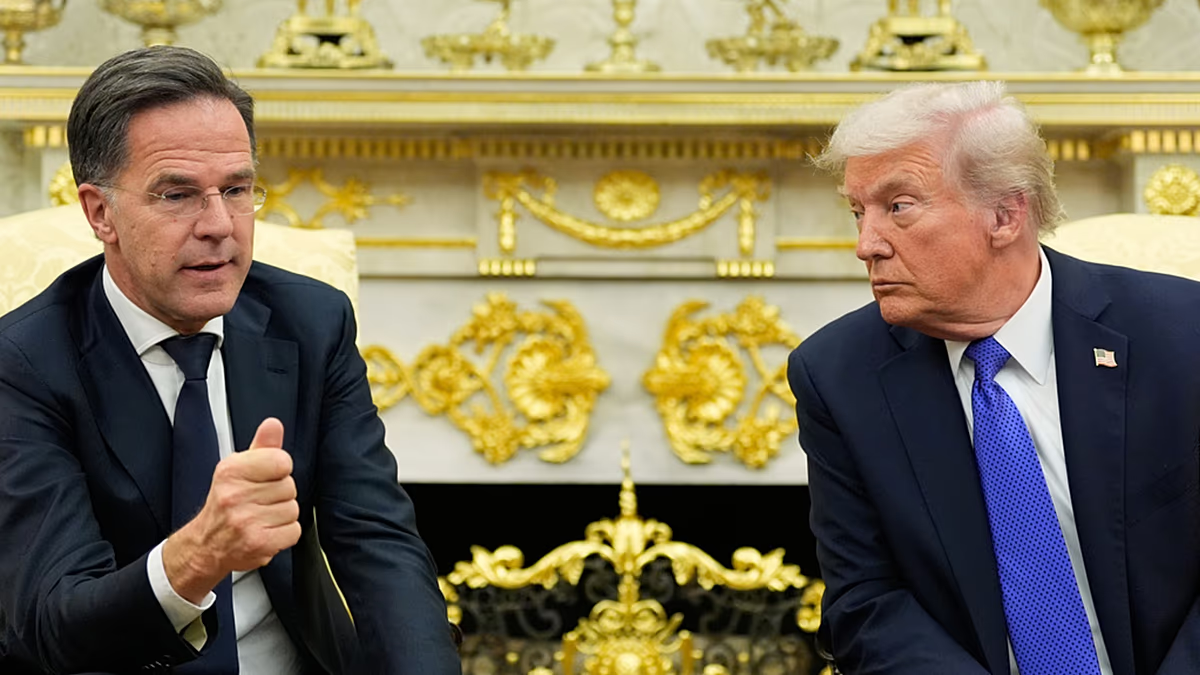
The threat of tariffs emerged after Trump expressed continued interest in acquiring Greenland, a Danish autonomous territory, citing national security concerns. He recently spoke with NATO Secretary-General Mark Rutte and proposed a meeting to discuss the issue in Davos, Switzerland. While the immediate trigger was a small European troop deployment to Greenland, the underlying dispute centers on the territory itself.
The Greenland Dispute: EU Navigates Trump’s Tariff Threats
EU governments are prioritizing dialogue and diplomacy in an attempt to de-escalate the situation, according to diplomats speaking to news outlets. However, they are also preparing for the possibility that Trump will follow through on his threat to impose tariffs on eight European countries by February 1st. The EU’s powerful trade instrument – the ability to shut out US companies from the single market – is under consideration, but officials currently show limited appetite for its immediate use.
Instead, a strategy of “passive retaliation” is being discussed, which would involve allowing existing retaliatory tariffs on US goods, totaling €93 billion, to expire as scheduled. This approach aims to signal displeasure without immediately escalating the trade conflict. The hope is that this measured response will create space for negotiations and a potential resolution.
NATO’s Role in De-escalation
There is growing optimism within NATO that Trump can be persuaded the situation stems from a misunderstanding. Senior officials believe the initial troop deployments were misinterpreted as a challenge to US interests. The planned withdrawal of many of those troops could provide an “off-ramp” for Trump to reconsider the tariffs. Sweden’s Defence Minister, Pål Jonson, emphasized the importance of resolving disputes peacefully and reaffirmed support for Denmark and Greenland’s territorial integrity.
Nordic ministers convened at NATO headquarters on Monday to discuss the threats, demonstrating regional solidarity with Denmark and Greenland. Denmark’s Defence Minister, Troels Lund Poulsen, and Greenland’s Foreign Minister, Vivian Motzfeldt, also met with Secretary-General Mark Rutte to address the concerns.
However, the fundamental desire of the Trump administration to acquire Greenland remains a key factor. The situation highlights a broader concern about the reliability of the US as a security guarantor, particularly as European leaders simultaneously work to defend Ukraine against Russian aggression.
The parallel between defending Ukraine’s sovereignty and defending Denmark’s is not lost on European officials. Some are questioning whether the US can be trusted to provide credible security guarantees for a post-war Ukraine, especially if its own actions undermine the principles of territorial integrity.
Further Complications: Trump’s Gaza Board of Peace and French Response
Adding to the tensions, President Trump has threatened to impose 200% tariffs on French wines and champagne after France indicated it would reject an invitation to join Trump’s proposed “Gaza Board of Peace.” French officials expressed concerns that the board could undermine the role of the United Nations and serve primarily US political interests. The charter for the board, which initially lacked any mention of Gaza, further fueled these anxieties.
The proposed board’s structure, including a demand for substantial financial contributions for permanent membership, has also drawn criticism. European Commissioner for the Mediterranean, Dubravka Suica, has called for the inclusion of all key stakeholders, including Palestinians, in the board’s governance structure.
No-Confidence Vote in Von der Leyen Overshadowed
A motion of no-confidence in European Commission President Ursula von der Leyen, related to the EU-Mercosur trade deal, was largely overshadowed by the unfolding Greenland dispute. The debate in the European Parliament was sparsely attended, and von der Leyen herself did not participate, sending Commissioner for Trade Maroš Šefčovič in her place. The motion is expected to fail, but highlights ongoing concerns about the impact of trade deals on European farmers.
Looking ahead, the coming days will be crucial. Intense diplomatic efforts are expected during the World Economic Forum in Davos, and the EU will continue to monitor the situation closely. European leaders will need to balance the need to defend their interests with the desire to maintain a working relationship with the United States. The outcome of these negotiations will have significant implications for both transatlantic trade and the broader geopolitical landscape.