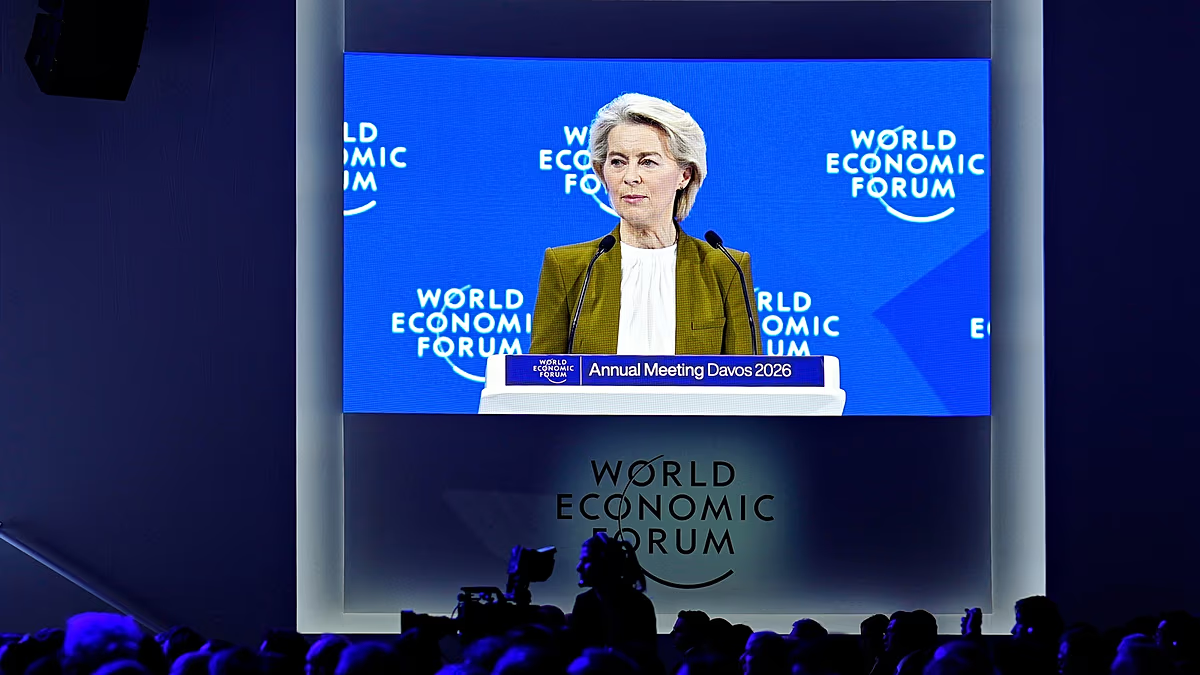

European Commission President Ursula von der Leyen made a forceful case for “European independence” at the World Economic Forum in Davos, Switzerland, amid escalating tensions with the United States. Her speech came as President Donald Trump threatens new tariffs on European nations, raising concerns about a potential collapse of the transatlantic alliance. Von der Leyen argued that global shifts necessitate a more autonomous Europe, framing geopolitical challenges as opportunities for growth and self-reliance.
The immediate catalyst for von der Leyen’s assertive stance is Trump’s recent announcement of a 10% tariff on eight European NATO members, reportedly linked to his desire to acquire Greenland. This move, set to take effect February 1st, has sparked fears of a significant fracture in the decades-long relationship between the US and Europe. According to reports, the administration is pursuing an increasingly unilateralist foreign policy agenda.
The Push for European Independence
Von der Leyen emphasized that the need for greater European autonomy isn’t a new development, but a “structural imperative” that has been growing for some time. She acknowledged past skepticism surrounding the concept of “European independence,” often associated with protectionism, but argued that the current global landscape has created a “real consensus” in its favor. The President stated Europe must accelerate its efforts toward independence in areas ranging from security and defense to the economy and democracy.
Navigating a Transatlantic Crisis
While acknowledging the strong ties between the US and Europe, von der Leyen warned against a “dangerous downward spiral” resulting from escalating trade disputes. She stressed that such a conflict would ultimately benefit adversaries. Her comments struck a balance between a conciliatory tone and a firm commitment to defending European interests. Meanwhile, Trump has continued to publicly signal his resolve, even posting digitally altered images on social media depicting Greenland, Canada, and Venezuela as US territory, reflecting his “Donroe Doctrine.”
Expanding Global Partnerships
In contrast to Trump’s unilateral approach, von der Leyen highlighted Europe’s commitment to multilateralism and open trade. She pointed to the recently concluded free trade agreement with Mercosur (Brazil, Argentina, Paraguay, and Uruguay) – encompassing over 700 million consumers – as evidence of a “new Europe” emerging. This deal, she argued, prioritizes “fair trade over tariffs, partnership over isolation, and sustainability over exploitation.”
Additionally, the European Commission is actively pursuing trade deals with Australia, the Philippines, Thailand, Malaysia, the United Arab Emirates, and India. Von der Leyen stated Europe aims to forge stronger economic ties with the “growth centres” of the 21st century. These efforts are part of a broader strategy to “de-risk” European economies and reduce reliance on single trading partners. The EU is also focused on attracting investment, scaling up businesses, and bolstering self-reliance in key areas like energy and security.
The situation in Venezuela, where the US recently removed President Nicolás Maduro from power, has further fueled concerns about a shift in global power dynamics. Trump has stated his foreign policy is guided by his “own morality,” a statement that has raised eyebrows among international observers. The Council on Foreign Relations provides ongoing analysis of global conflicts and geopolitical shifts.
Looking ahead, the coming weeks will be critical as European diplomats attempt to de-escalate the trade dispute with the US. The success of these efforts will likely determine the future trajectory of the transatlantic alliance and the extent to which Europe accelerates its pursuit of greater independence. Stakeholders should monitor developments closely as this situation unfolds, potentially reshaping the global geopolitical landscape.