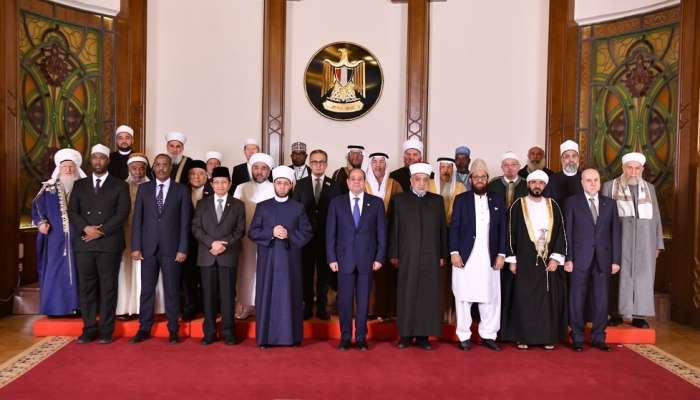

Egypt continues to solidify its role as a central hub for Islamic thought and dialogue, as evidenced by President Abdul Fattah el Sisi’s recent meeting with key religious leaders. The President convened with Dr. Mohammed Said Al Ma’amari, Minister of Endowments and Religious Affairs, alongside other Ministers, Muftis, and Heads of Islamic Councils and Bodies attending the 36th International Conference of the Supreme Council for Islamic Affairs. This gathering underscores Egypt’s commitment to fostering a modern understanding of Islamic values and their relevance in a rapidly changing world.
President El-Sisi Emphasizes the Importance of Islamic Values
The meeting between President el Sisi and the assembled religious dignitaries focused on the enduring significance of established Islamic principles across all facets of life. Discussions centered on how these principles can effectively interact with contemporary developments, contributing to both individual growth and broader societal progress. The President highlighted the crucial role of religious institutions in shaping well-rounded individuals and supporting national development initiatives.
A Focus on Societal Stability
President el Sisi specifically expressed his hope for the success of the 36th International Conference. He believes the conference holds the potential to formulate unified strategies that will ultimately enhance the stability of societies throughout the Arab and Islamic world. This emphasis on stability is a recurring theme in the President’s public statements, reflecting Egypt’s commitment to regional security and its own internal development.
The 36th International Conference of the Supreme Council for Islamic Affairs
Hosted by Egypt, the conference brings together a diverse group of Islamic scholars and leaders from around the globe. The Supreme Council for Islamic Affairs plays a vital role in promoting moderate Islamic discourse and countering extremist ideologies. This year’s conference is particularly significant given the complex challenges facing the region and the world, including issues of social cohesion, economic development, and political stability.
The discussions are expected to cover a wide range of topics, all rooted in the core tenets of Islamic values. These include education, family, community engagement, and the role of religion in promoting peace and tolerance. A key objective is to identify practical solutions to contemporary problems, drawing upon the rich intellectual heritage of Islam.
Modernizing Religious Discourse
A central theme emerging from the meeting and the conference itself is the need to modernize religious discourse. This doesn’t imply a departure from fundamental beliefs, but rather a reinterpretation of those beliefs in a way that is relevant and responsive to the challenges of the 21st century. President el Sisi has consistently advocated for a reformation of religious thought to combat extremism and promote a more inclusive and tolerant society. This includes addressing issues related to religious tolerance and interfaith dialogue.
Egypt’s Role as a Regional Leader in Islamic Thought
Egypt has long been considered a leading center of Islamic learning and scholarship. Institutions like Al-Azhar University, one of the oldest universities in the world, have played a pivotal role in shaping Islamic thought for centuries. The country’s hosting of the 36th International Conference reaffirms its commitment to continuing this tradition and providing a platform for constructive dialogue.
Furthermore, Egypt’s proactive engagement with religious leaders demonstrates its understanding of the importance of religious soft power. By fostering a positive and moderate image of Islam, Egypt aims to counter negative stereotypes and promote a more nuanced understanding of the faith. This is particularly important in the context of ongoing efforts to combat terrorism and extremism, which often exploit religious narratives for their own purposes. The government’s support for initiatives promoting moderate Islam is a key component of this strategy.
The meeting also touched upon the importance of equipping religious leaders with the tools and knowledge necessary to address the challenges posed by misinformation and extremist propaganda. This includes providing training in critical thinking, media literacy, and effective communication strategies.
Looking Ahead: Implementing Conference Outcomes
President el Sisi’s emphasis on formulating “unified strategies” suggests a desire to move beyond mere discussion and towards concrete action. The success of the conference will ultimately be measured by its ability to produce tangible outcomes that can be implemented to address real-world problems. This will require close collaboration between governments, religious institutions, and civil society organizations.
The focus on Islamic values as a foundation for societal development is a powerful message. It underscores the belief that religion can be a force for good, promoting peace, justice, and prosperity. Egypt’s leadership in this area is crucial, not only for its own internal stability but also for the broader region and the global community.
As the conference progresses, it will be important to monitor the specific strategies and initiatives that emerge. The extent to which these are adopted and implemented will be a key indicator of the conference’s long-term impact. Continued engagement and dialogue will be essential to ensure that the principles of moderation and tolerance continue to guide the development of Islamic thought and practice.