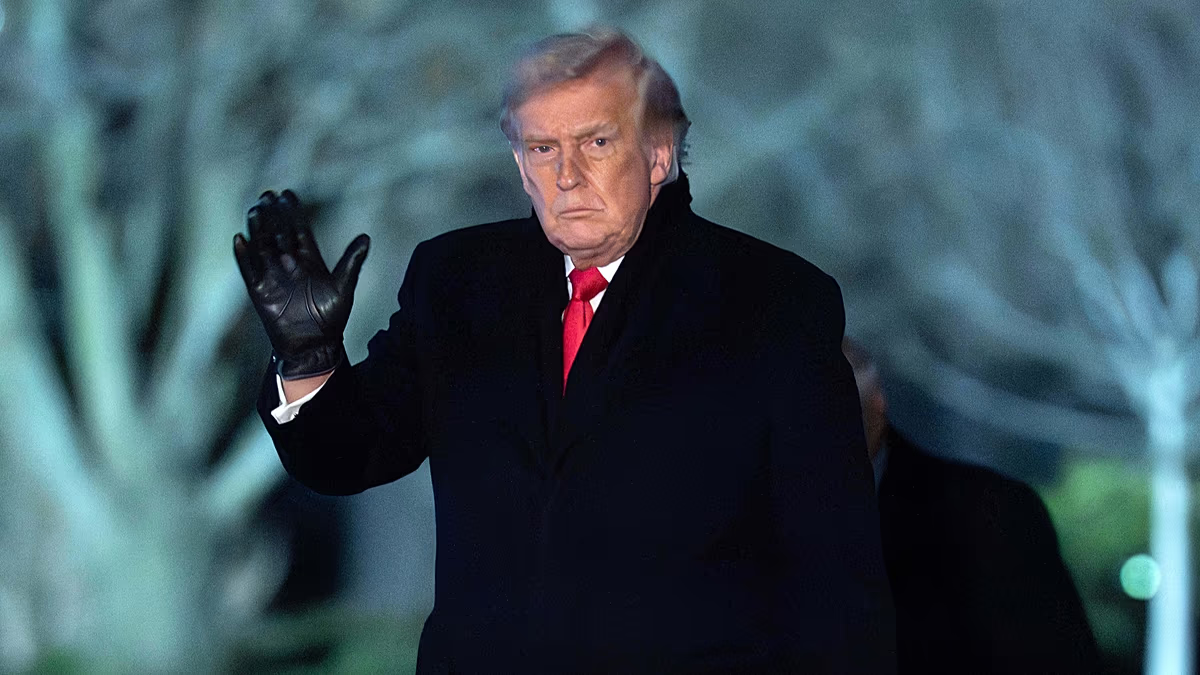

European leaders are navigating a complex diplomatic landscape as they simultaneously address security concerns in Ukraine and escalating tensions with the United States over Greenland. The situation unfolded rapidly overnight with a series of pronouncements from former President Donald Trump, including threats of tariffs and digitally altered images, placing significant strain on transatlantic relations. This developing story highlights the challenges facing Europe as it balances its commitment to international law with the unpredictable foreign policy of a potential future US administration.
The Greenland Dispute and Transatlantic Relations
The core of the current crisis stems from Donald Trump’s renewed interest in acquiring Greenland, a semi-autonomous territory of the Kingdom of Denmark. He has repeatedly asserted that US control of Greenland is “imperative for National and World Security,” a claim met with firm resistance from both Danish and European officials. Trump’s latest actions, including a proposed meeting in Davos and threats of a 200% tariff on French wine, are seen as attempts to pressure European nations into considering his proposals.
Trump’s Tariff Threats and Diplomatic Fallout
Trump threatened to impose a hefty 200% tariff on French wine and Champagne after French President Emmanuel Macron declined an invitation to join a “Board for Gaza” proposed by Trump. A source within the French president’s office stated that such tariff threats are “unacceptable and ineffective” in influencing foreign policy. This escalation follows a pattern of Trump using economic leverage to achieve diplomatic goals, a tactic that has previously strained relationships with key allies.
A Proposed G7 Meeting and Russian Involvement
Adding another layer of complexity, Trump leaked a text message from Macron suggesting a G7 meeting in Paris, following the Davos summit, with the potential inclusion of Ukrainian, Danish, Syrian, and even Russian representatives. This proposal, confirmed by the French president’s entourage, represents a significant departure from Europe’s current strategy of diplomatic isolation towards Russia, particularly in light of the ongoing war in Ukraine. Italian Prime Minister Giorgia Meloni has previously expressed support for reopening communication channels with Vladimir Putin.
Europe’s Dual Security Challenge
The situation presents a stark parallel for European leaders. For years, they have worked to defend Ukraine’s sovereignty against Russian aggression, coordinating responses and issuing strong condemnations. Now, they find themselves in the position of defending Denmark’s sovereignty against the United States, a traditionally close ally and security guarantor. This “impossible puzzle,” as described by Euronews, underscores the difficulties Europe faces in navigating a world where even its closest partners may challenge its fundamental principles.
Meanwhile, Trump posted digitally altered images on social media depicting Greenland, Canada, and Venezuela as part of the United States, referencing a self-styled “Donroe Doctrine.” These posts, alongside the offer of a meeting and the tariff threats, are viewed as ominous signs for European diplomacy and a potential preview of a more assertive US foreign policy should Trump win the upcoming election. The European Commission is scheduled to hold a Security College on Thursday to discuss these and other pressing security matters.
The Importance of NATO
NATO Secretary-General Mark Rutte reportedly had a “good” call with Trump regarding Greenland, which led to an agreement for a meeting in Davos on Wednesday. However, Trump continues to insist that total US control over Greenland is essential for global security. The role of NATO in mediating these tensions and reaffirming the principles of collective defense will be crucial in the coming days. NATO’s official website provides further information on its mission and member states.
As the situation evolves, all eyes are on Davos, where key discussions are expected to take place behind closed doors. The outcome of these meetings will likely set the tone for transatlantic relations in the months ahead and could have significant implications for the broader geopolitical landscape. The ongoing dispute over Greenland serves as a critical test of Europe’s ability to assert its interests and uphold international law in a rapidly changing world.