
India and the United Arab Emirates (UAE) have significantly deepened their strategic partnership, unveiling a series of ambitious collaborations following UAE President Sheikh Mohamed bin Zayed Al Nahyan’s recent visit to New Delhi. These outcomes signal a strong commitment to economic growth and technological advancement, with a key focus on boosting India-UAE trade and expanding cooperation into cutting-edge sectors. The visit, described as “short but extremely substantive,” has laid the groundwork for a future of enhanced collaboration between the two nations.
A Roadmap for Doubling Bilateral Trade
The most prominent announcement is a joint roadmap to more than double bilateral trade to over $200 billion by 2032. This ambitious target builds on the success of the Comprehensive Economic Partnership Agreement (CEPA) signed in 2022, which has already propelled trade to $100 billion in FY25.
This growth isn’t just about large corporations; both countries are prioritizing the inclusion of micro, small, and medium enterprises (MSMEs) in this expanding economic relationship. Initiatives like Bharat Mart, the Virtual Trade Corridor, and Bharat-Africa Setu will be instrumental in connecting these businesses and opening up new market opportunities. The focus on MSMEs demonstrates a commitment to inclusive growth and leveraging the entrepreneurial spirit of both nations.
Expanding Cooperation in Advanced Nuclear Technologies
Beyond trade, the partnership is extending into the critical energy sector. India and the UAE have agreed to explore cooperation in advanced nuclear technologies, a move aligned with India’s Sustainable Harnessing and Advancement of Nuclear Energy for Transforming India (SHANTI) law.
This collaboration encompasses several key areas:
Key Areas of Nuclear Cooperation
- Development and deployment of large nuclear reactors.
- Exploration of small modular reactors (SMRs) – a potentially game-changing technology for flexible and scalable energy production.
- Advanced reactor systems.
- Nuclear power plant operations and maintenance.
- Nuclear safety protocols and training.
This signifies a major step towards India achieving its ambitious clean energy goals and reducing its reliance on fossil fuels. The UAE’s expertise in nuclear energy, coupled with India’s growing energy demands, makes this a mutually beneficial partnership.
Investment and Infrastructure Development
The visit also saw significant commitments to investment and infrastructure development, particularly in Gujarat. UAE companies, First Abu Dhabi Bank and DP World, will establish operations in GIFT City, Gujarat’s International Financial Technology (IFT) hub.
First Abu Dhabi Bank will open a branch to facilitate trade and investment linkages, while DP World will leverage GIFT City for global operations, including ship leasing. This investment underscores the UAE’s confidence in India’s economic potential and its commitment to supporting the country’s infrastructure growth.
Furthermore, a Letter of Intent was signed between the Government of Gujarat and the UAE Ministry of Investment for the development of the Dholera Special Investment Region (SIR). This ambitious project will see the development of:
- An international airport
- A pilot training school
- A maintenance, repair, and overhaul (MRO) facility
- A greenfield airport
- A smart urban township
- Enhanced railway connectivity
- Modern energy infrastructure
Prime Minister Modi also extended an invitation to UAE sovereign wealth funds to consider participating in India’s second Infrastructure Fund, slated for launch in 2026. This demonstrates India’s proactive approach to attracting foreign investment for its crucial infrastructure projects.
Deepening Ties in Key Sectors
The collaboration isn’t limited to trade, energy, and infrastructure. Agreements were also signed to strengthen cooperation in several other vital areas, including space exploration, defense, and food security.
UAE’s G42 company will play a key role in supporting the establishment of a supercomputing cluster in India, boosting the country’s capabilities in artificial intelligence and data analytics. Both nations are also exploring the establishment of digital data embassies and a ‘House of India’ in Abu Dhabi, further solidifying cultural and economic ties. This multifaceted approach highlights the strategic depth of the India-UAE trade relationship.
A Symbol of Strong Leadership and Partnership
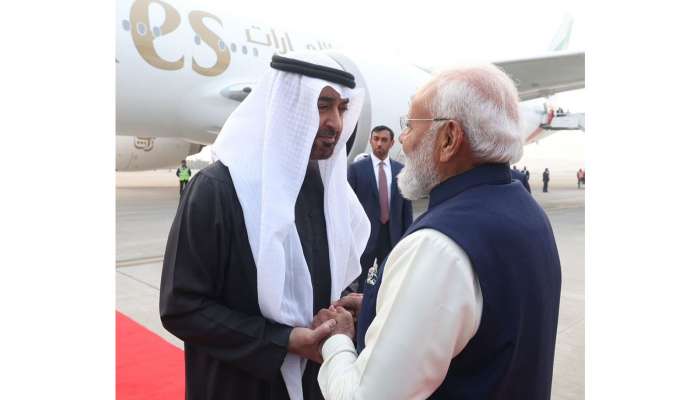
The visit itself was a testament to the strong personal relationship between Prime Minister Modi and President Al Nahyan. The UAE President was personally received at the Delhi airport by Prime Minister Modi, a gesture described by the Indian side as “a special gesture that is characteristic of the extremely warm and close relationship that the two leaders share.” This level of engagement underscores the importance both countries place on this burgeoning partnership. The focus on streamlining cross-border payments through interlinking national payment platforms is another example of practical cooperation aimed at facilitating bilateral economic relations.
Looking Ahead: A Future of Collaboration
Sheikh Mohamed bin Zayed Al Nahyan’s visit to New Delhi marks a pivotal moment in the India-UAE trade and strategic partnership. The ambitious targets set for trade growth, coupled with the expansion of cooperation into critical sectors like nuclear energy and infrastructure, demonstrate a shared vision for a prosperous future. The emphasis on MSME engagement and technological advancement further solidifies the long-term potential of this relationship. As both nations continue to navigate a rapidly changing global landscape, this strengthened partnership will undoubtedly play a crucial role in driving economic growth, fostering innovation, and enhancing regional stability. The commitment to these outcomes signals a sustained period of collaboration and mutual benefit for both India and the UAE.