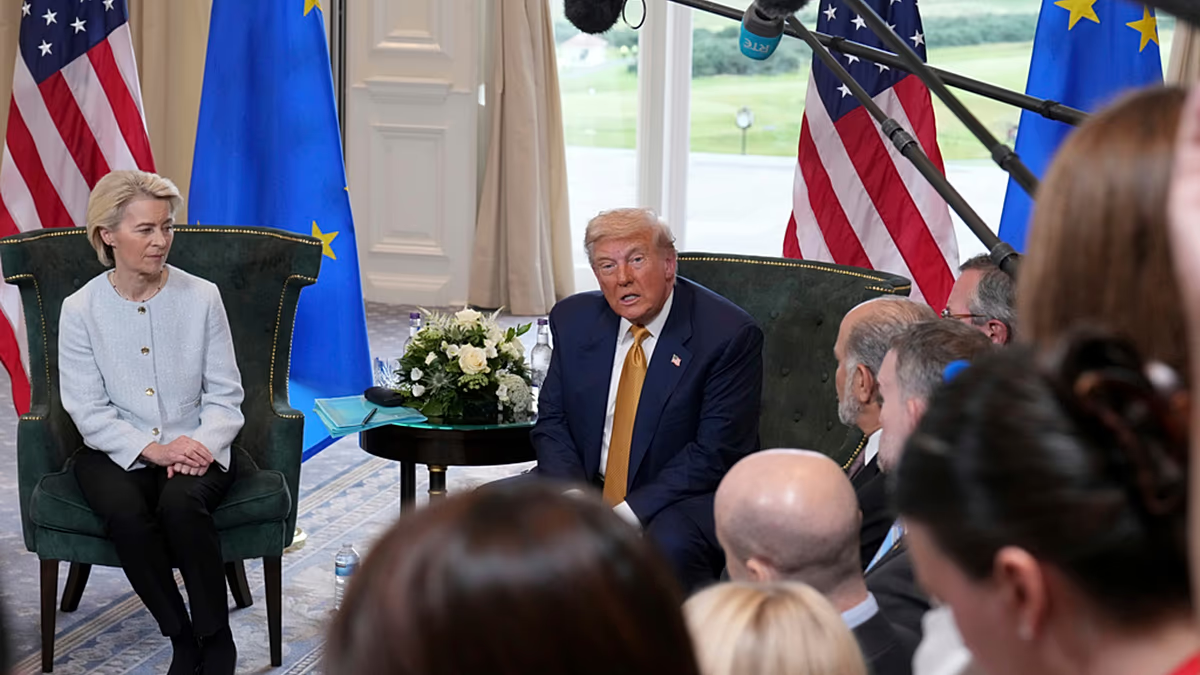

European Union leaders are preparing for a critical week as they attempt to de-escalate a growing tariff conflict with the United States, sparked by disagreements over a recent European military deployment to Greenland. Simultaneously, the EU is bracing for potential additional tariffs on six member states set to take effect on February 1st, as threatened by former US President Donald Trump. The situation presents a significant challenge to transatlantic trade relations.
Negotiations are underway to address what some officials believe is a misunderstanding regarding the scope and intent of “Operation Arctic Endurance,” the European military exercise. EU ambassadors met Sunday in Brussels to discuss strategies, prioritizing dialogue while also outlining potential retaliatory measures. The outcome of these discussions will heavily influence the future of trade between the EU and the US.
Escalating Tariff Conflict: Awaiting Resolution
The current dispute centers around Trump’s claims that the European deployment to Greenland represents a threat, prompting him to consider new tariffs. Italian Prime Minister Giorgia Meloni suggested a “problem of understanding and communication” may be at the root of the issue, a sentiment echoed by UK leaders. NATO Secretary General Mark Rutte is expected to meet with Trump at the World Economic Forum in Davos this week, potentially serving as a key mediator.
Potential Retaliation Measures
If diplomatic efforts fail, the EU has several options for responding to the threatened tariffs. The most readily available is the reactivation of a €93 billion package of counter-tariffs, initially prepared last spring but suspended following a trade agreement reached at Trump’s Scottish golf course. This package, set to automatically kick in on February 7th if not renewed, targets a range of US products, including yachts and soybeans.
However, the EU is also considering more forceful measures, including the use of its Anti-Coercion Instrument (ACI), often referred to as the “trade bazooka.” This instrument is designed to punish countries engaging in “economic blackmail” by restricting trade access. European Commission Vice-President Stéphane Séjourné described Trump’s threats as a “textbook case of coercion,” while German Vice-Chancellor Lars Klingbeil indicated a need to consider “sensitive measures.”
Despite the availability of the ACI, there is currently limited appetite for its immediate deployment. Officials caution that the instrument, which has never been used, could be time-consuming to implement. However, sources indicate growing support among EU member states for its potential use, signaling the seriousness of the current escalation. The ACI represents a significant shift in the EU’s approach to trade disputes.
Meanwhile, the European Commission is closely monitoring a pending US Supreme Court ruling regarding the legality of Trump’s use of a 1977 law allowing the invocation of national emergencies to justify reciprocal tariffs. Judges reportedly expressed skepticism during November hearings, raising hopes that the American justice system may intervene to prevent the tariffs from being imposed. This legal challenge adds another layer of complexity to the trade dispute.
Several EU leaders will be present at the World Economic Forum in Davos, providing an opportunity for direct engagement with Trump. Whether a meeting between President Ursula von der Leyen and Trump will occur remains unconfirmed. The forum represents a crucial venue for attempting to resolve the tariff issues before the February 1st deadline.
The coming days will be pivotal in determining the future of EU-US trade relations. Observers should watch for developments from the Davos meetings and the US Supreme Court ruling. Businesses engaged in transatlantic trade should prepare for potential disruptions and monitor the situation closely for updates on the evolving trade tensions.