
A looming trade war between the United States and several European nations is escalating rapidly, with President Donald Trump announcing a 10% tariff on goods from eight European countries beginning in February. The tariffs are a direct response to these nations’ refusal to consider selling Greenland to the US. This escalating dispute threatens billions of dollars in transatlantic commerce and potentially millions of jobs on both sides of the Atlantic.
The announcement, made earlier this week, targets countries openly opposing the Greenland acquisition. The US and the European Union maintain a substantial economic relationship, with annual trade in goods and services reaching €1.6 trillion. The situation is unfolding as EU leaders prepare to meet with President Trump at the World Economic Forum in Davos this week.
The Greenland Dispute and the Impending Trade War
The origins of this conflict lie in President Trump’s expressed interest in purchasing Greenland, an autonomous territory within the Kingdom of Denmark. When met with resistance from Denmark and other European nations, the US administration opted for a punitive economic approach. According to reports, the administration views the tariff as leverage to force a sale or extract financial concessions.
However, this strategy carries significant risk. Unlike the US trade deficit with China, the relationship with the EU is largely balanced, with a trade gap of only 3%. This means the impact of tariffs will be felt more symmetrically, potentially harming both economies. US exports to Europe currently support over 2 million American jobs, while European investment in the US sustains another 3.5 million positions.
Economic Repercussions for Europe
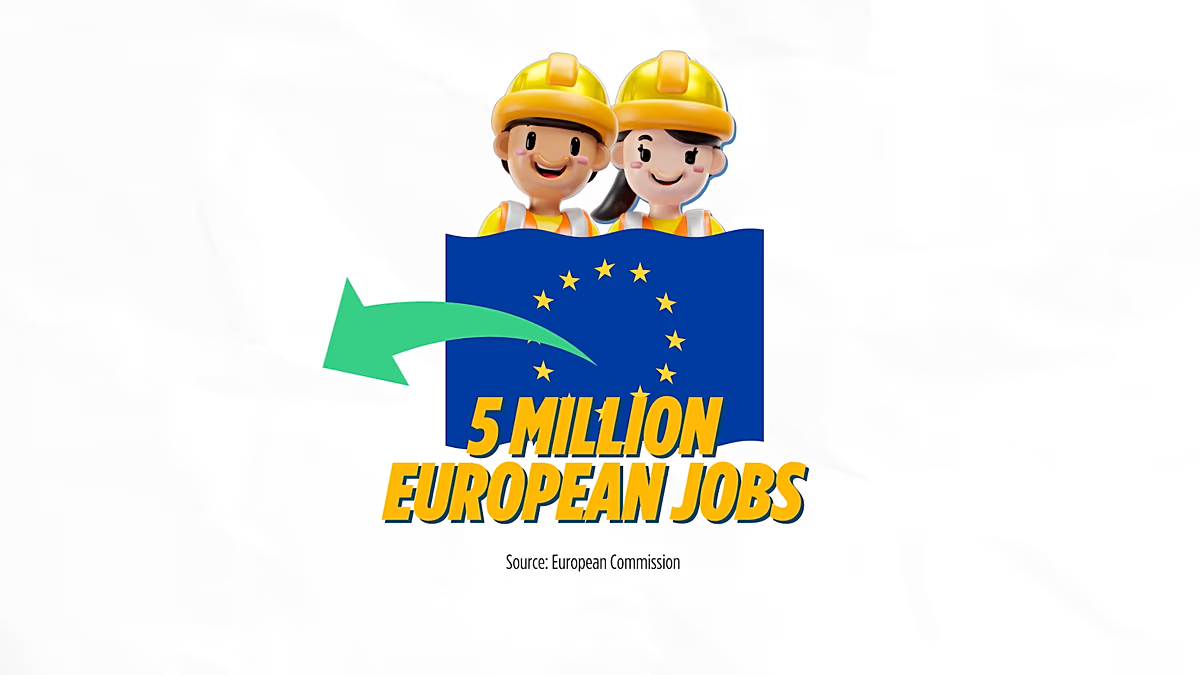
The impact on Europe is projected to be substantial. Exports to the US support approximately 5 million European jobs, and US companies operating within the EU employ another 4.5 million workers. The European Parliament is already signaling a firm stance against negotiation under duress. Manfred Weber, leader of the European People’s Party (EPP), stated that a comprehensive Brussels-Washington trade agreement is “not possible at this stage.”
Additionally, the EU is actively seeking alternative trade partners to mitigate the potential damage. Last Saturday, the EU finalized a deal with Mercosur, a trade bloc comprising Argentina, Brazil, Paraguay, and Uruguay, in an effort to diversify its markets and reduce reliance on the US. This move suggests a long-term shift in European trade strategy.
The Anti-Coercion Instrument and Potential Retaliation
Brussels is considering utilizing its Anti-Coercion Instrument, often referred to as a “trade bazooka,” to retaliate against the US tariffs. However, there is internal debate regarding the wisdom of escalating the conflict further. Some policymakers fear that a tit-for-tat exchange of tariffs could lead to a full-blown trade dispute with devastating consequences for global economic growth.
The situation is further complicated by the potential for broader economic instability. Experts warn that a prolonged international trade conflict could disrupt supply chains, increase prices for consumers, and dampen investor confidence. The Peterson Institute for International Economics has published extensive research on the potential impacts of trade wars, highlighting the risks of protectionist policies. Peterson Institute for International Economics
In contrast to previous trade tensions, this dispute is driven by a unique geopolitical demand rather than traditional economic concerns. This makes it more difficult to resolve through conventional negotiation tactics. The focus on Greenland, a strategically located island with potential resource wealth, adds another layer of complexity to the situation.
The upcoming meeting between EU leaders and President Trump in Davos will be crucial. Observers anticipate a tense atmosphere, and the outcome remains highly uncertain. The future of transatlantic economic relations hangs in the balance. Businesses and consumers on both sides of the Atlantic should closely monitor developments as this situation unfolds.
For ongoing updates and analysis, stay tuned to Euronews. Euronews