






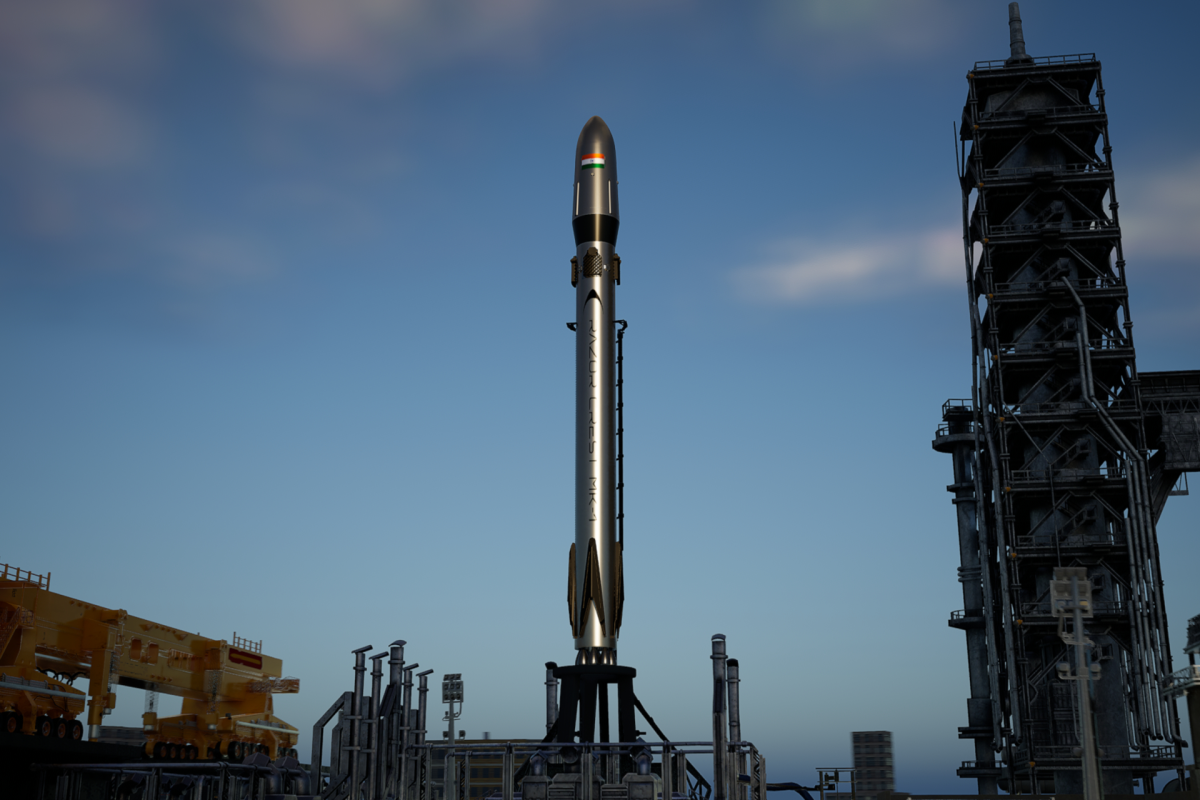

Bengaluru-based Ethereal Exploration Guild, operating as EtherealX, has significantly increased its valuation to $80.5 million following a successful $20.5 million Series A funding round. The Indian space tech startup is focused on developing a fully reusable launch vehicle and is preparing for critical engine hot-fire tests, with a technology demonstration flight slated for 2027. This funding signals growing investor confidence in India’s burgeoning private space sector.
The oversubscribed Series A round was led by TDK Ventures and BIG Capital, with participation from Accel, Prosus, YourNest, BlueHill, Campus Fund, and Riceberg Ventures. This investment follows a $5 million seed round completed in August 2024, which valued the company at $14.6 million. EtherealX’s rapid growth reflects the increasing demand for launch capacity and the potential for cost-effective access to space.
EtherealX’s Fully Reusable Launch System
As India aims to expand its space economy from $8 billion to $45 billion within the next decade, companies like EtherealX are playing a crucial role. The startup is differentiating itself through its commitment to full reusability – designing both the booster and upper stage of its vehicle to return for reuse. This approach, if successful, could substantially lower per-launch costs and increase flight frequency, challenging the current market dominance of SpaceX’s Falcon 9.
Currently, SpaceX primarily reuses its first-stage boosters, while the upper stages are typically expended. EtherealX’s ambition to recover both stages represents a more ambitious, and potentially more economical, approach to space access. However, achieving full reusability presents significant engineering challenges.
Engine Development and Testing
EtherealX is independently developing two key engines: the 80-kilonewton “Pegasus” for the upper stage and the 1.2-meganewton “Stallion” for the booster. Hot-fire tests for both engines are scheduled for June and July. Thrust, measured in kilonewtons and meganewtons, is a critical metric for determining a rocket engine’s lifting power.
The Pegasus engine boasts a vacuum-specific impulse of 323 seconds and utilizes a proprietary “full-flow segregated cooling cycle,” incorporating an in-house additively manufactured turbopump. The Stallion booster engine employs a gas-generator cycle and delivers 306 seconds of sea-level specific impulse. Specific impulse, a measure of fuel efficiency, is another key factor in determining payload capacity.
Razor Crest Mk-1 and Future Plans
EtherealX plans to utilize a clustered engine configuration for its medium-lift vehicle, the Razor Crest Mk-1. The design calls for nine Stallion engines on the booster and 15 Pegasus engines on the upper stage. This configuration is intended to provide the necessary power and redundancy for reliable launches.
The company is targeting a launch window of November-December 2027 for a technology demonstration vehicle, paving the way for commercial missions expected to commence towards the end of 2028. EtherealX aims to achieve payload capacities of up to 24.8 tons in expendable mode, 22.8 tons in partially reusable mode, and approximately 8 tons when fully reusable. The startup is projecting pricing between $350 and $2,000 per kilogram, depending on the chosen configuration and launch cadence.
To support its development efforts, EtherealX operates a rocket engine test site in Tamil Nadu (Base 001), focused on upper-stage engine qualification. Additionally, the company has secured a 150-acre manufacturing and testing campus in Andhra Pradesh, expected to be operational by mid-2026 for integrated engine and stage testing. This expansion demonstrates EtherealX’s commitment to building a comprehensive in-house capability.
EtherealX has already secured launch memoranda of understanding totaling around $130 million with customers including Space BD of Japan and Taiwan’s space agency, TASA. This early demand suggests a potential market for the company’s services. The latest funding will primarily be allocated to completing the flight qualification of the Stallion engine and conducting clustered-firing tests of the Pegasus engines.
Currently employing 67 people, EtherealX anticipates growing to approximately 90 employees in the coming months as it ramps up manufacturing and testing activities. The successful completion of the upcoming engine tests and the continued development of its launch infrastructure will be critical milestones for the company. The next key step will be the technology demonstration flight in 2027, which will validate the core concepts of EtherealX’s space tech and its fully reusable launch vehicle design. The progress of this ambitious project will be closely watched by the global space industry as India continues to establish itself as a significant player in the commercial space market.