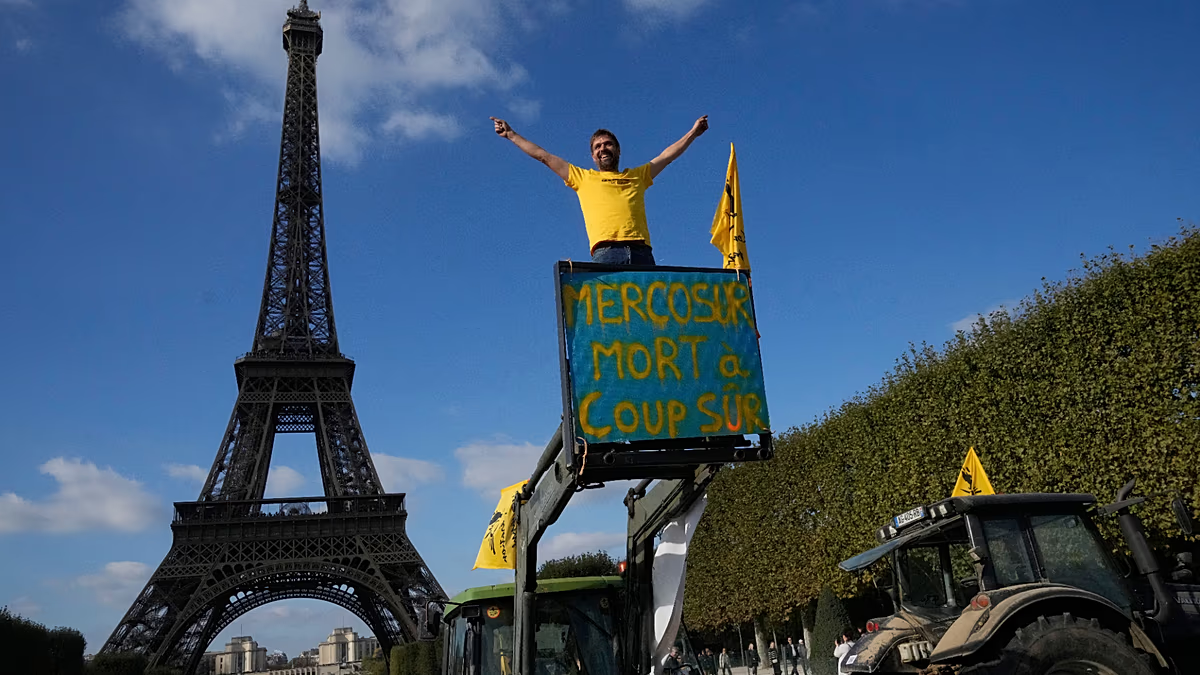

The European Union-Mercosur trade agreement, a deal decades in the making, was officially signed on Saturday by Argentina, Brazil, Paraguay, and Uruguay. The EU-Mercosur deal aims to strengthen the EU’s geopolitical standing, particularly in countering China’s influence in Latin America, but has already sparked significant political division within the bloc, most notably with strong opposition from France. The agreement, designed to create a vast transatlantic free-trade zone, is now facing scrutiny as it moves toward ratification.
European Commission President Ursula von der Leyen hailed the agreement as an “achievement of a generation” that would benefit future generations, stating it represents a choice for “fair trade over tariffs” and “a productive long-term partnership over isolation.” However, the path forward remains uncertain given the internal disagreements.
Deep Divisions Over the EU-Mercosur Deal
A key Council vote on January 9th revealed a stark split, with France voting against the agreement despite a majority of member states supporting it. This outcome raises concerns that the deal is being imposed on France by Brussels, potentially fueling eurosceptic sentiment. The agreement will now be presented to the European Parliament for final ratification steps on Monday.
Supporters of the EU-Mercosur deal emphasize its strategic importance in balancing economic power dynamics. Commission figures demonstrate that in 2000, the EU accounted for approximately six times more of Mercosur’s imports than China. Today, China’s share has surpassed the EU’s by roughly 40%, highlighting a shift in economic influence.
Beyond countering China, the deal is also viewed as a way to diversify EU trade relationships, especially as the United States implements stricter trade barriers and Beijing leverages its control over critical materials. Spanish MEP Javier Moreno Sánchez noted the importance of negotiation in the face of these challenges, stating the EU aims to avoid “the law of the strongest.”
French Opposition Intensifies
The situation in France is particularly volatile. Following the failed attempt to secure a blocking minority against the agreement, Jordan Bardella, leader of the far-right Rassemblement National (RN), initiated a no-confidence vote in the European Parliament, scheduled for next week, and a motion in the French National Assembly, which was ultimately rejected.
Critics in France argue the deal will unfairly disadvantage EU farmers by exposing them to competition from Latin American producers who do not adhere to the same stringent production standards. However, proponents counter that France’s agricultural challenges are largely domestic and that the EU-Mercosur deal has become a convenient scapegoat for pre-existing issues.
Jean-Luc Demarty, former director-general for trade at the European Commission, contends that the problems facing French agriculture stem from “absolutely lamentable national agricultural policy” over the past 15 years, leading to decreased competitiveness.
Despite the opposition, concessions were made to address concerns, including key environmental provisions, tariff-rate quotas on sensitive products like beef and poultry, and safeguard clauses to prevent market disruption. The Commission has also pledged €45 billion in support for EU farmers from 2028, a commitment that helped secure Italy’s backing. However, these measures have not appeased French concerns.
French President Emmanuel Macron has publicly questioned the economic benefits of the agreement, citing Commission estimates that suggest it will only increase EU GDP by 0.05% by 2040. Furthermore, the phased elimination of tariffs on EU cars – a key incentive for German support – over 18 years raises concerns that Chinese automakers may gain a significant foothold in Mercosur markets before the EU can fully capitalize on the agreement.
Impact on EU Businesses and Future Outlook
Businesses across the EU, particularly in sectors like services, dairy, wine, and spirits, are anticipating increased access to Mercosur markets and public procurement opportunities. MEPs supporting the deal emphasize these potential gains, though they have struggled to gain traction in France.
The implementation of similar trade agreements, such as the EU-Canada Comprehensive Economic and Trade Agreement (CETA), has faced challenges in some member states. According to Svenja Hahn, a German MEP, the utilization of beef quotas under CETA has been minimal, with only 2% currently used.
The EU-Mercosur agreement’s long and contentious journey highlights the difficulties of forging consensus on trade policy within the bloc. Experts like Eric Maurice from the European Policy Center suggest that the agreement was initially framed negatively, making it harder to communicate its benefits effectively.
Looking ahead, the deal’s fate hinges on the European Parliament’s ratification process and the resolution proposed to challenge it before the EU’s top court. The outcome will not only shape trade relations between the EU and Mercosur but also signal the future direction of EU trade policy and the strength of internal unity. Stay informed about the upcoming votes in the European Parliament and the potential legal challenges to this landmark agreement.