
European leaders are scrambling to formulate a unified response after former US President Donald Trump threatened a new round of trade tariffs against eight European nations. The move, triggered by a dispute over Greenland, has raised fears of a renewed transatlantic trade war and jeopardized the delicate balance of international relations. Trump’s announcement, made via social media on Saturday, proposes tariffs starting at 10% on products from Denmark, Sweden, Norway, France, Germany, the Netherlands, Finland, and the United Kingdom, potentially escalating to 25% if a deal isn’t reached for the “complete and total purchase of Greenland.”
The threat comes as several European countries were preparing a joint mission to Greenland, a self-governing territory within the Kingdom of Denmark. This collaborative effort, intended to bolster security in the Arctic region, appears to have provoked the retaliatory tariff announcement from the Trump administration. The situation is further complicated by a recent trade agreement between the EU and the US, which already saw concessions from Brussels.
Escalating Tensions and the Future of EU-US Trade
The Trump administration has been increasingly vocal about its desire to acquire Greenland, citing national security concerns. Officials have suggested the territory could be transferred to the US “the easy way or the hard way,” implying economic pressure if Denmark doesn’t cooperate. Danish officials have refuted claims that they are not adequately addressing security concerns in the Arctic, stating that no Chinese warships have been detected in Greenlandic waters for over a decade.
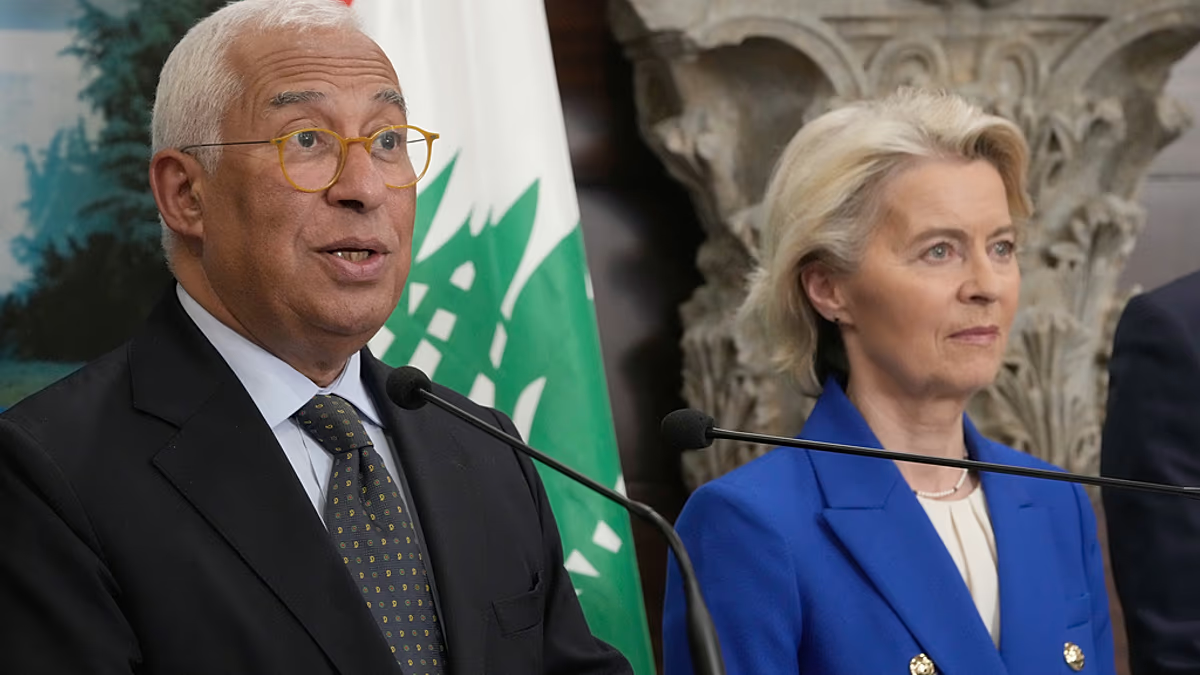
The proposed tariffs have been widely condemned by European leaders. French President Emmanuel Macron declared that the EU would not be intimidated by “threats,” and Swedish Prime Minister Ulf Kristersson stated his country “will not allow ourselves to be blackmailed.” EU Council President António Costa has pledged to coordinate a unified response among member states.
Ursula von der Leyen, President of the European Commission, echoed these sentiments, warning that the tariffs would “undermine transatlantic relations and risk a dangerous downward spiral.” She affirmed Europe’s commitment to upholding its sovereignty in the face of external pressure. The Commission, responsible for trade negotiations on behalf of the 27 EU member states, is now assessing the legal implications and potential countermeasures.
Calls for a Stronger EU Response
The current crisis has reignited debate within the EU regarding its approach to the US under Trump. Some are advocating for a more assertive stance, including the activation of the EU’s anti-coercion instrument. This relatively new tool, adopted in 2023, allows the EU to retaliate against countries using economic pressure for political ends by restricting market access and public procurement opportunities.
Bernd Lange, chair of the European Parliament’s trade committee, argued that “President Trump is using trade as an instrument of political coercion” and called for a suspension of tariff reductions on US goods. Manfred Weber, leader of the European People’s Party, has similarly urged a freeze on the EU-US trade deal until the threats are withdrawn.
The existing EU-US trade agreement, signed last summer, tripled duties on certain European products to 15% while simultaneously lowering tariffs on US industrial goods. At the time, the EU framed the deal as a necessary step to maintain US engagement in Ukraine and global stability, acknowledging significant concessions were made to Washington. However, the current situation is prompting a reevaluation of that strategy.
While the exact implementation and stacking of these new tariffs remain unclear, the potential for a full-blown trade war is very real. The dispute over Greenland, while seemingly unusual, highlights the broader tensions in the transatlantic relationship and the willingness of the Trump administration to use economic leverage to achieve its political objectives. The Arctic region is also becoming a focal point for geopolitical competition, with increasing interest from both Russia and China, adding another layer of complexity to the situation. The Council on Foreign Relations provides further context on Arctic security concerns.
Looking ahead, the EU’s response will be crucial in determining the future of its relationship with the US. The coming weeks will likely see intense diplomatic efforts and a careful consideration of the available options, including the potential deployment of the anti-coercion instrument. Businesses on both sides of the Atlantic should closely monitor developments as the threat of escalating trade disputes looms large.