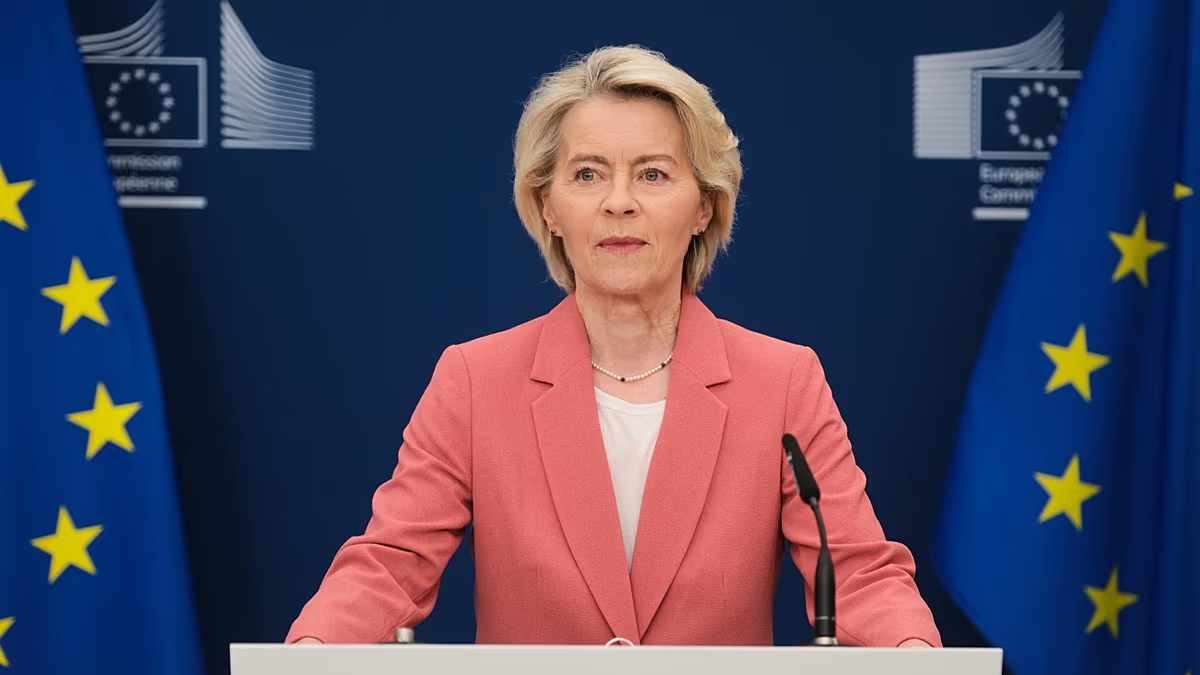

Claims circulating on social media allege European Commission President Ursula von der Leyen is “automatically increasing” her own salary by €2,400 per month. These assertions, amplified by far-right political figures like Florian Philippot, stem from a recent article in the German newspaper Bild reporting on pay rises for EU officials. While it is true that salaries for EU personnel have increased in recent years, the narrative of a self-imposed raise by von der Leyen is a misrepresentation of a complex, pre-defined adjustment mechanism.
The controversy resurfaced this week, gaining traction online as users questioned the fairness of the increases amidst broader economic concerns. The claims center around the seventh pay rise for EU staff in three years, prompting scrutiny of how these salaries are determined and whether they are justified. However, the process is far from a unilateral decision made by the Commission President.
How are the Salaries of EU Officials Determined?
Salaries of EU civil servants are adjusted annually, not at the discretion of individual leaders. This adjustment mechanism, established in 2013, was approved by both EU member states and the European Parliament. It operates based on a formula outlined in the EU Staff Regulations, designed to maintain the purchasing power of EU employees.
The calculation is conducted by Eurostat, the statistical office of the European Union, and doesn’t simply mirror inflation rates. Instead, it considers changes in the purchasing power of civil servants across all EU member states. This means an EU official’s salary in Brussels can rise or fall depending on adjustments made to the pay of Belgian civil servants.
Currently, the monthly salary for high-ranking EU officials, including Ursula von der Leyen, has increased from approximately €28,400 in 2020 to around €35,800 today. However, these increases haven’t always kept pace with national inflation. For example, in 2022, Brussels-based EU salaries rose by 4.4%, while Belgium experienced inflation of 10.5%.
Addressing Misinformation
A spokesperson for the European Commission explicitly stated to Euronews’ fact-checking team, The Cube, that “there is absolutely no such thing as ‘self-raising salaries’ at the European Commission.” The spokesperson further clarified that the 2025 salary update is projected to be lower than nominal increases observed in several member states, including Austria (3.4%), Sweden (6.7%), and Poland (18%).
Additionally, the Commission highlighted that EU staff have experienced a significant decline in real purchasing power over the long term. Figures from the Commission indicate a loss of around 11.9% in purchasing power for EU staff between 2004 and 2025, due to reforms in staff regulations and limitations on salary adjustments.
Do EU Officials Pay Taxes?
A common misconception is that EU salaries are not subject to taxation. This is inaccurate. While the European Union, as an international organization, isn’t under the tax jurisdiction of any single member state, EU officials are required to pay taxes at the EU level.
EU officials contribute to a progressive income tax system, potentially reaching a rate of 45%, alongside a solidarity levy of up to 7%, and standard social security contributions. These payments are directly allocated to the EU budget. Furthermore, they are also responsible for paying value-added tax (VAT), local taxes, and regional taxes, just like any other resident.
It’s also important to note that EU staff may receive allowances based on individual circumstances, such as expatriation or family support. These allowances can vary significantly, ranging from approximately €2,300 to €18,000 per month.
The debate surrounding EU employee compensation is likely to continue, particularly as cost of living pressures persist across Europe. Understanding the complex mechanisms behind salary adjustments, and separating fact from misinformation, is crucial for informed public discourse. Readers are encouraged to consult official sources, such as EUR-Lex, for accurate information on EU policies and regulations.