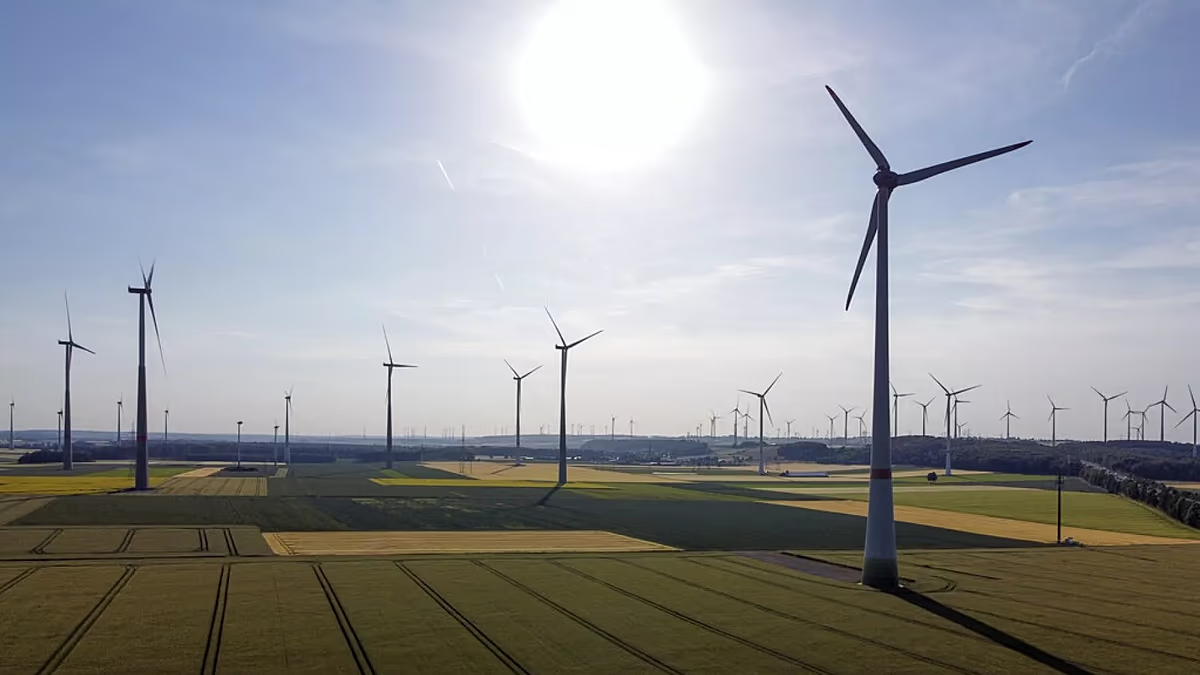

The European Union risks falling behind in wind energy production if member states don’t streamline permitting processes and adopt successful models like Germany’s, according to the new CEO of WindEurope, Tinne Van der Straeten. Speaking exclusively to Euronews, Van der Straeten highlighted permitting delays as a major obstacle to achieving the bloc’s ambitious climate goals. The call for action comes as the EU aims for a significant expansion of renewable energy sources by 2030.
Van der Straeten, formerly the Belgian energy minister, emphasized the need for a unified approach to accelerate wind power deployment across Europe. She pointed to Germany’s 2023 revised renewable energy law as a benchmark for efficient energy legislation, specifically its provisions for fast-tracking permits. This contrasts sharply with countries like Spain, which, despite substantial wind power potential, struggle with bureaucratic hurdles.
The Need to Streamline Wind Energy Permitting Across the EU
One of the key challenges facing the wind industry is the lengthy and complex process of obtaining permits for new projects. According to Van der Straeten, Spain’s difficulties stem from challenges in demonstrating the “overriding public interest” and a lack of flexibility in commissioning deadlines. These delays directly impact the EU’s ability to meet its renewable energy targets and reduce reliance on fossil fuels.
Germany’s success is partly attributed to its auction system, where companies compete for the right to build wind farms and secure payment for the electricity generated. Approximately 14GW of the 20GW installed in Germany in 2025 came from auctions, a result Van der Straeten described as “incredible.”
However, the auction model isn’t foolproof. A recent auction in Denmark for 3GW of offshore wind capacity received no bids, a failure analysts attribute to rising project costs, high interest rates, and insufficient government-set maximum bid prices, alongside the issue of negative energy prices.
Addressing Failed Auctions and Negative Pricing
Van der Straeten acknowledged the issue of failed auctions, stating her priority is to “make failed auctions a thing of the past.” She added that each failure presents a learning opportunity to improve future auction designs and attract investment.
Europe has recently experienced negative energy prices, a phenomenon where electricity supply exceeds demand, forcing generators to pay to offload surplus power. While Van der Straeten views this as a “sign of success” – indicating increased renewable energy production – she also recognizes it as a sign of an “immature” energy system that can deter investors.
To address this, she advocates for a more balanced energy system with increased storage solutions and demand-side management. This includes incentivizing energy-intensive companies to operate during periods of low energy prices, effectively acting as a “virtual battery.” Crucially, investments in the power grid are also essential to optimize the use of available clean power.
The EU’s revised energy market design aims to increase the use of support mechanisms like Contracts for Difference (CfD) and Power Purchase Agreements (PPA) to provide developers with revenue certainty, mitigating the risks associated with price volatility.
EU Wind Power Targets and the Rise of Competition
The EU has set a target of achieving at least 42.5% renewable energy consumption by 2030, requiring an estimated 500GW increase in clean power capacity within the next four years. Currently, onshore wind dominates Europe’s wind capacity, accounting for 87-91% of the total 291GW (including the United Kingdom), with offshore wind representing only 9-13% (37GW total). Within the EU-27, total wind capacity is 236GW.
The industry is focused on scaling up offshore wind capacity to at least 60GW by 2030 and 300GW by 2050, aligning with the EU’s carbon neutrality goals. EU leaders will convene at the North Sea Summit in Hamburg on January 26 to foster collaboration on offshore wind development.
Van der Straeten emphasized the importance of this commitment, noting that Europe’s offshore sector is “falling a little bit behind.” She envisions a new offshore wind deal where policymakers commit to specific auction volumes and the industry commits to building, manufacturing, and driving down energy prices.
However, Europe faces growing competition, particularly from China, which is rapidly expanding its offshore wind capabilities. The German Aerospace Centre has reported that Beijing is making significant advancements in this area. Van der Straeten acknowledged China’s rise but highlighted the wind industry’s “global diversified supply chain” and its strong presence across the European value chain.
The European Commission launched an investigation in April 2024 into potential unfair advantages stemming from massive Chinese state subsidies and cheap financing, which could distort the EU market. Industry leaders claim these subsidies have lowered Chinese turbine prices by as much as 50% compared to European rivals, posing a threat to EU energy security.
Looking ahead, the upcoming Industrial Accelerator Act, expected on January 29, aims to expedite permitting and support the clean transition of energy-intensive industries. Van der Straeten anticipates this policy will benefit the wind industry, citing the strong interest from companies like ArcelorMittal and Umicore in directly purchasing wind-generated power through PPAs.
The success of the EU’s wind energy ambitions hinges on coordinated policy, streamlined permitting, and a commitment to fair competition. Continued collaboration between policymakers and industry stakeholders will be crucial to unlock the full potential of wind power and achieve a sustainable energy future for Europe.