






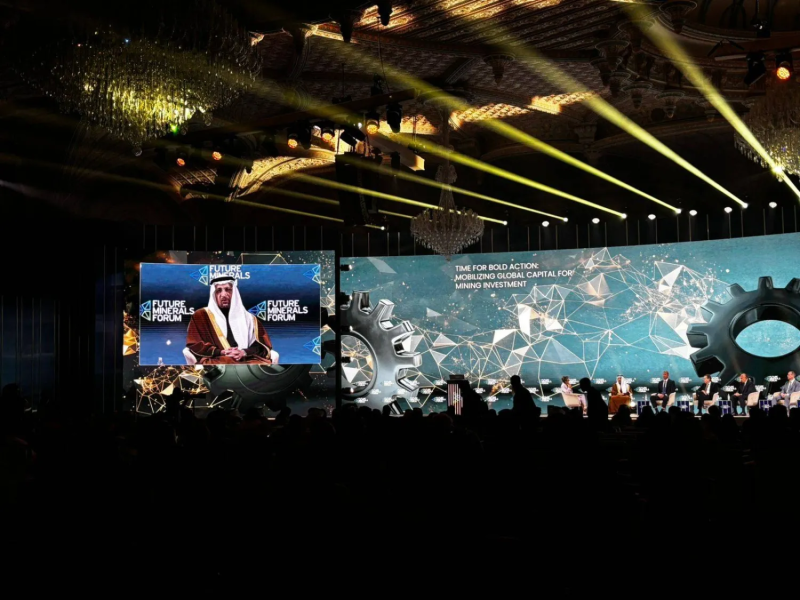

Riyadh – Global mining investment is facing a significant shortfall, with an estimated $5 trillion needed over the next decade to meet growing demand for critical minerals and metals, according to recent statements from Saudi Minister of Investment Khalid Al-Falih. The announcement, made at the 5th Future Minerals Forum in Riyadh on Wednesday, highlights a widening gap between available capital and the necessary funding for exploration, production, and infrastructure development within the mining sector. This investment is crucial for supplying materials needed for the energy transition and broader economic growth.
Al-Falih emphasized that this investment requirement encompasses the entire mining value chain, from initial resource discovery to processing, transportation, and the construction of supporting infrastructure. The forum, held January 9-11, brought together industry leaders, government officials, and investors to discuss strategies for unlocking mineral potential and securing supply chains. The minister’s comments underscore the urgency of attracting private capital to the industry.
The Global Mining Investment Gap
Despite substantial liquidity within the global investment community, a challenge remains in directing funds towards mining projects. Al-Falih stated the need to refine the mechanisms for attracting this capital, recognizing the sector’s fundamental importance to the world economy. He positioned mining not as a supplementary industry, but as an “essential and indispensable” component of future development.
The demand for minerals is being driven by several factors, including the global shift towards renewable energy technologies like electric vehicles and solar panels. These technologies require significant quantities of lithium, cobalt, nickel, and other critical minerals. Additionally, infrastructure development in emerging economies is contributing to increased demand for base metals like copper and iron ore.
Saudi Arabia’s Role and Strategy
Saudi Arabia is actively positioning itself as a key player in the global mining landscape. The country’s state-owned mining company, Ma’aden, serves as a successful example of profitability within the sector, bolstered by investments from the Public Investment Fund (PIF). This success is reflected in Ma’aden’s strong performance on the Saudi stock market, according to the ministry.
To address the perceived risk-reward imbalance for investors, the Saudi government has begun reinvesting revenues generated from the mining sector into areas where private investment is lacking. This strategy aims to de-risk projects and encourage broader participation. The government is also focused on providing comprehensive geological data, developing robust infrastructure, and establishing clear and stable regulatory frameworks.
The minister highlighted the government’s commitment to providing the necessary support for investment, including data transparency, infrastructure development, and streamlined legislation. This proactive approach is intended to reduce the barriers to entry for both domestic and international investors. He specifically mentioned the importance of financial resources to mitigate risks.
Attracting Capital to Mining Projects
The challenge of attracting capital isn’t unique to Saudi Arabia; it’s a global issue. Several factors contribute to investor hesitancy, including long lead times for project development, geopolitical risks, environmental concerns, and the cyclical nature of commodity prices. These factors can make mineral exploration and resource development appear less attractive compared to other investment opportunities.
However, the potential returns in the mining sector can be substantial, particularly for projects focused on critical minerals essential for the energy transition. The McKinsey and IHS estimates suggest that the long-term profitability of mining investments remains strong, despite the inherent risks. The report indicates that projects with secure access to resources and favorable operating conditions are likely to attract significant funding.
The Future Minerals Forum served as a platform to discuss innovative financing models and risk mitigation strategies. These included public-private partnerships, sovereign wealth fund investments, and the development of specialized investment vehicles focused on the mining sector. The discussions also touched upon the importance of environmental, social, and governance (ESG) factors in attracting responsible investment.
The Saudi government’s commitment to these areas is seen as a positive signal to potential investors. By addressing the key challenges and creating a more favorable investment climate, Saudi Arabia hopes to attract a significant portion of the $5 trillion in investment needed globally. The country is also actively seeking to diversify its economy away from oil, and mining is viewed as a crucial component of this diversification strategy.
Looking ahead, the success of Saudi Arabia’s efforts to attract mining investment will depend on its ability to consistently deliver on its promises of transparency, infrastructure development, and regulatory stability. The ministry has not yet announced specific timelines for the implementation of new policies or investment targets. Industry observers will be closely watching the progress of key mining projects and the evolution of the regulatory framework in the coming months to assess the effectiveness of the government’s strategy. The ongoing geopolitical landscape and fluctuations in commodity prices will also play a significant role in shaping investment decisions.