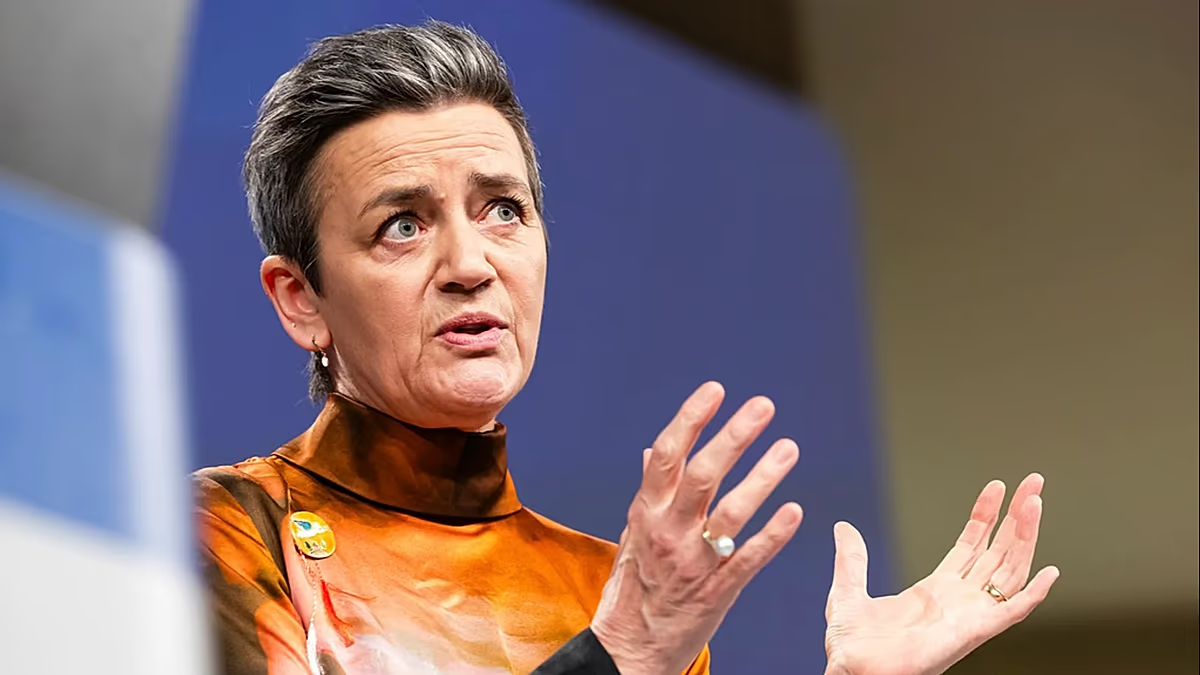

Growing tensions between the United States and Denmark over Greenland are raising concerns about the stability of the NATO alliance. Former European Commission head Margrethe Vestager has cautioned that a potential move by the US to acquire the territory, even through force, would represent a severe threat to the alliance. The White House is reportedly increasing pressure on Copenhagen to cede control of the strategically important, semi-autonomous Danish territory “one way or another,” according to recent reports.
The escalating situation centers on the US desire to gain a foothold in the Arctic, a region of increasing geopolitical significance. US officials argue that control of Greenland is vital for national security, citing the need to counter Russian and Chinese influence in the area. However, Denmark and, crucially, the Greenlandic people have consistently rejected any suggestion of a sale or transfer of sovereignty.
The Potential Impact on NATO and Arctic Security
Vestager’s warning underscores the gravity of the situation, stating that a NATO member attacking another would be an “existential threat.” This sentiment has been echoed by Danish Prime Minister Mette Frederiksen and European Commissioner for Defence Andrius Kubilius. The core issue revolves around the principle of national sovereignty and the potential precedent a US takeover would set within the alliance.
Polls within Greenland indicate overwhelming opposition to becoming a US territory. This local sentiment is a key factor in the Danish government’s firm stance against any transfer. Despite this, the US administration continues to pursue its objectives, leading to diplomatic friction and heightened anxiety in Europe.
Existing Agreements and Alternative Cooperation
Vestager highlighted that current treaties between the US and Denmark already provide avenues for increased cooperation in Greenland without requiring a change in ownership. These agreements cover areas such as defense and scientific research. She also emphasized Denmark’s longstanding commitment to NATO and international security.
Meanwhile, European nations, particularly France and Germany, have expressed solidarity with Denmark. Discussions are underway regarding potential responses, including the possibility of a European defense force modeled after NATO, to demonstrate a unified commitment to Arctic security. This would signal to the US that Europe views the region as a priority.
NATO Secretary General Mark Rutte attempted to downplay the crisis, stating the alliance is not in “crisis mode.” He suggested that both Denmark and the US are actively working to strengthen security in the Arctic region. However, Prime Minister Frederiksen has warned that any attempt to seize Greenland would irrevocably damage the NATO alliance and the post-World War II security framework.
EU’s Role and Greenland’s Future
Vestager indicated that the European Union could strengthen its relationship with Greenland through increased investment and closer political ties, should the Greenlandic people desire it. She explicitly stated that any further integration, including potential re-entry into the EU, is ultimately a decision for the people of Greenland to make.
The region is rich in critical minerals, adding another layer of complexity to the situation. These resources are increasingly important for the green energy transition and technological advancements, making Greenland a strategically valuable asset. The US interest in these minerals is a significant driver of its pursuit of greater influence in the territory.
US Secretary of State Marco Rubio is scheduled to meet with Danish officials on Wednesday to discuss the matter further. This meeting is expected to be a crucial opportunity for both sides to reiterate their positions and explore potential avenues for de-escalation. The broader geopolitical context, including rising Arctic competition, also plays a role in the current standoff.
As the situation unfolds, the international community will be closely watching the interactions between the US, Denmark, and Greenland. The outcome will not only determine the future of Greenland but also have significant implications for the future of NATO and the balance of power in the Arctic. Stay informed about developments as they occur and consider the long-term consequences of this escalating dispute.