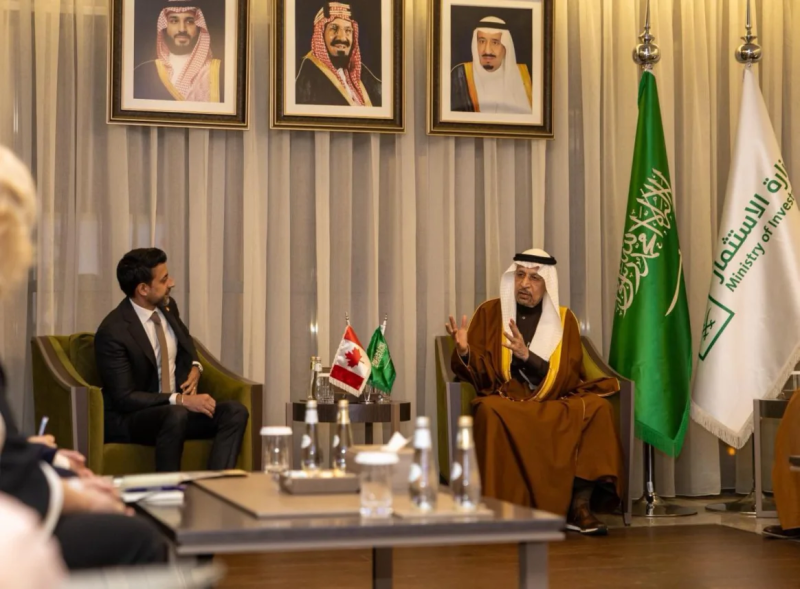

RIYADH — Saudi Arabia and Canada are actively working to strengthen their economic ties, with recent discussions focused on improving the investment climate and boosting bilateral trade. Saudi Minister of Investment Khalid Al-Falih met with Canadian Minister of International Trade Maninder Sidhu in Riyadh on Sunday to explore expanded partnerships and opportunities in key sectors. Trade between the two nations reached approximately SR12 billion in 2023, and both countries anticipate further growth.
The meeting, held in the Saudi capital, centered on strategies to attract high-quality investment and foster a more conducive business environment for companies from both Saudi Arabia and Canada. Officials reviewed potential collaborations in priority industries, building on existing economic relationships. This dialogue underscores a growing commitment to diversification and economic development within both nations.
Boosting Saudi-Canada Investment and Trade Relations
The discussions between Al-Falih and Sidhu represent a continuation of efforts to deepen the economic partnership between Saudi Arabia and Canada. While historically focused on a few key areas, both governments are now seeking to broaden the scope of cooperation. This includes exploring opportunities in emerging technologies, renewable energy, and infrastructure development, according to statements released by the Saudi Ministry of Investment.
Key Sectors for Collaboration
Several sectors were identified as particularly promising for increased collaboration. These include:
Mining and minerals represent a significant area of potential growth, given Saudi Arabia’s vast mineral resources and Canada’s expertise in extraction and processing. Renewable energy, particularly hydrogen and solar power, also featured prominently in the discussions, aligning with both countries’ commitments to sustainability. Additionally, opportunities in digital infrastructure and technology were explored, reflecting the global shift towards digitalization.
The SR12 billion in trade volume recorded in 2023 represents a substantial increase from previous years, though specific year-over-year growth figures were not immediately available. The Saudi Ministry of Investment indicated that this figure is expected to rise in the coming years, driven by new investment projects and expanding trade flows. Canada’s trade with Saudi Arabia is primarily comprised of exports like machinery, vehicles, and agricultural products, while Saudi exports to Canada largely consist of petrochemicals and plastics.
However, the relationship hasn’t been without its challenges. Diplomatic tensions in 2018 briefly disrupted trade and investment flows, but relations have since been normalized. Both countries appear committed to building a more stable and predictable partnership, focusing on mutual economic benefits. This commitment is reflected in the high-level meetings and ongoing dialogue between government officials.
Meanwhile, Saudi Arabia is actively pursuing its Vision 2030 plan, a comprehensive strategy to diversify its economy away from oil dependence. Attracting foreign investment is a crucial component of this plan, and Canada is viewed as a key partner in achieving these goals. Canada, for its part, is seeking to expand its global trade network and diversify its export markets.
In contrast to some other international partnerships, the Saudi-Canada relationship benefits from a strong legal framework and a shared commitment to transparency. Both countries have robust regulatory systems and a history of upholding contractual obligations. This provides a degree of certainty for businesses considering investing in either market. The Saudi government has been actively working to streamline its investment procedures and reduce bureaucratic hurdles, making it more attractive to foreign investors.
The meeting also touched upon the importance of human capital development and skills transfer. Canada has a highly skilled workforce and a strong education system, which could contribute to Saudi Arabia’s efforts to build a more knowledge-based economy. Potential collaborations in education and training were discussed, with a focus on developing the skills needed for the industries of the future. Further discussion on foreign direct investment (FDI) was also a key component of the meeting.
The Saudi-Canada Business Council, a joint initiative established to promote bilateral trade and investment, is expected to play a key role in implementing the outcomes of the ministerial meeting. The council will likely focus on identifying specific projects and opportunities, facilitating business-to-business connections, and advocating for policies that support increased trade and investment. The council’s next meeting is tentatively scheduled for late 2024.
Looking ahead, the success of this strengthened partnership will depend on continued dialogue, effective implementation of agreed-upon initiatives, and a stable geopolitical environment. Monitoring the progress of key projects, tracking trade and investment flows, and assessing the impact of policy changes will be crucial. The next several months will be critical in determining whether the current momentum can be sustained and translated into tangible economic benefits for both Saudi Arabia and Canada.