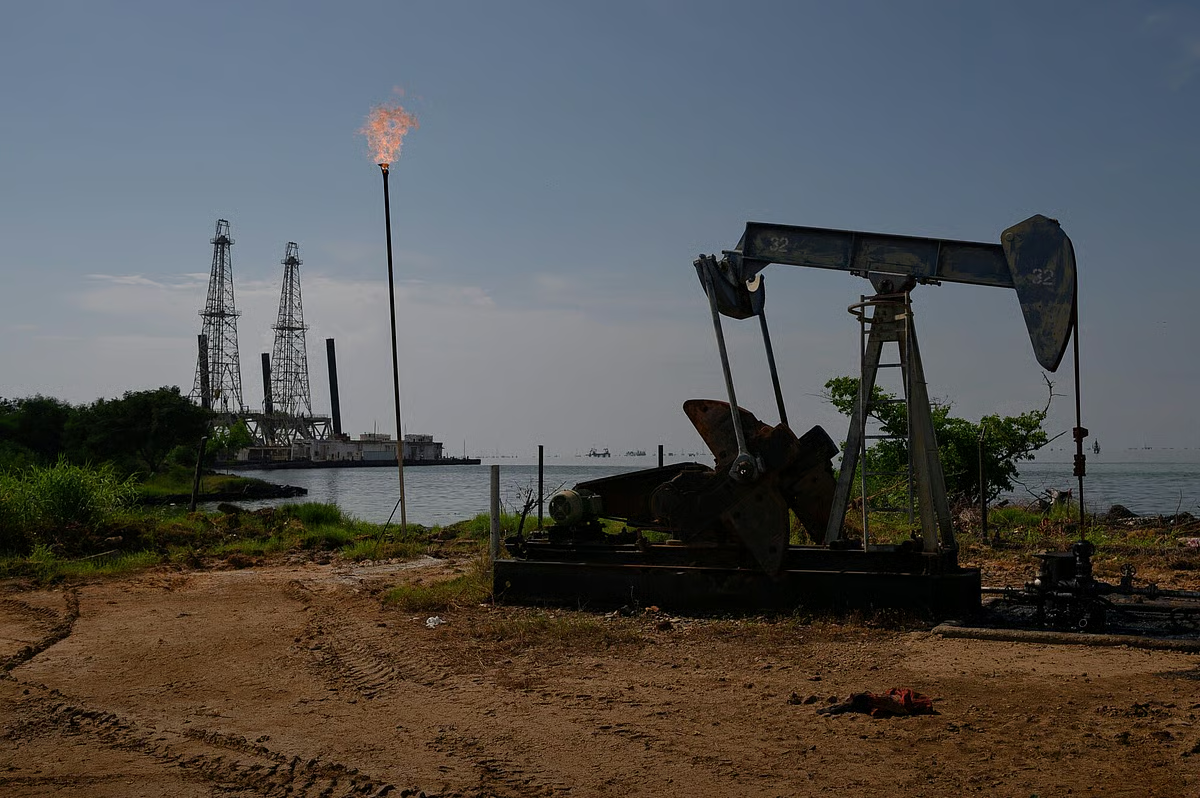

The United States government has authorized oil exports from Venezuela, a move intended to provide economic relief to the Venezuelan people while circumventing direct financial support to the Nicolás Maduro regime. The decision, announced in late October 2023, represents a significant shift in U.S. policy towards Venezuela and is being closely watched by energy markets and political analysts. This easing of Venezuela oil sanctions comes with stipulations designed to ensure funds reach humanitarian efforts.
The authorization allows companies currently holding licenses to operate in Venezuela to purchase oil and return the proceeds to designated accounts. These accounts will be managed by the U.S. and used for humanitarian assistance, including healthcare, food, and infrastructure projects. The move is a temporary measure, with a planned review after six months, according to statements from the Biden administration.
Understanding the Rationale Behind Venezuela Oil Sanctions Relief
The U.S. imposed increasingly stringent sanctions on Venezuela’s oil industry beginning in 2017, aimed at dislodging President Nicolás Maduro’s government. These actions were taken in response to concerns about human rights abuses, political repression, and corruption under Maduro’s rule. The sanctions severely curtailed Venezuela’s primary source of revenue, contributing to a major economic crisis and humanitarian emergency.
However, the sanctions also had unintended consequences, exacerbating the suffering of ordinary Venezuelans and failing to achieve a change in leadership. Reports from international organizations and think tanks consistently highlighted the deteriorating humanitarian situation and argued for increased access to aid. Additionally, the global energy market, particularly following Russia’s invasion of Ukraine, experienced volatility, prompting the U.S. to seek diverse oil supplies.
Geopolitical Context and Energy Security
The decision to allow limited oil exports is partially driven by a desire to stabilize global energy prices. The war in Ukraine disrupted oil supplies, and the Biden administration has sought to increase production from other sources to offset the shortages. Venezuela possesses some of the largest proven oil reserves in the world, making it a potentially significant contributor to global supply.
But the administration insists a core objective is humanitarian. The U.S. aims to provide a financial lifeline to the Venezuelan people without directly empowering the Maduro government. This is being attempted through a complex system of escrow accounts and oversight mechanisms, designed to prevent the regime from accessing the oil revenue.
The U.S. License System and Key Players
The authorization builds upon an existing licensing system administered by the U.S. Treasury Department’s Office of Foreign Assets Control (OFAC). Several U.S. companies have been granted licenses to operate in Venezuela, primarily focused on oil servicing and maintenance. These operators, including Chevron, will be the primary beneficiaries of the expanded access to Venezuelan crude.
The terms of the licenses require that any revenue generated from oil sales be deposited into protected accounts, preventing direct use by the Maduro administration. The administration has stated its intention to work with both the Venezuelan opposition and international aid organizations to ensure the funds are used for legitimate humanitarian purposes and bypass potential government interference. The success of this strategy remains uncertain.
Details of the Sanctions Authorization and Conditions
The renewed authorization specifically allows the purchase of Venezuelan crude oil and the return of funds through the established escrow mechanisms. The U.S. government has stressed a commitment to strictly monitoring the financial flow to ensure transparency and accountability. Several companies have already signaled their intent to resume or increase crude oil purchases, contingent upon navigating the logistical and regulatory complexities.
According to the Treasury Department, the licenses are conditional and can be revoked if the Maduro government fails to uphold its commitments related to free and fair elections. Negotiations between the U.S. and Venezuela have focused on establishing a framework for democratic transition, and the oil sanctions relief is viewed as a reciprocal gesture to encourage progress on those fronts.
The concessions are linked to the October 17 agreement brokered in Barbados between the Maduro government and the Unitary Platform, the main opposition coalition. This agreement included commitments to hold presidential elections in the second half of 2024, with international observers present. Concerns remain regarding the fairness of the electoral process and the potential for government manipulation, hindering effective economic aid distribution.
Implications for Venezuela and the Global Energy Market
The loosened sanctions are expected to provide a modest, but crucial, boost to Venezuela’s economy. Increased oil production could generate much-needed revenue for investment in vital infrastructure and social programs. However, the impact will be limited by the restrictions placed on the use of the funds and the ongoing challenges facing Venezuela’s oil industry—including years of underinvestment and a lack of skilled personnel.
In contrast, the effect on the global energy market is predicted to be relatively small in the short term. Venezuela’s oil production capacity is significantly below its peak levels, and it will take time to ramp up output. While additional Venezuelan oil could help to ease supply constraints, it is unlikely to fundamentally alter the global energy landscape. Experts estimate a potential increase of between 100,000 and 200,000 barrels per day within the next six months.
The move also carries significant political risks. Critics argue that it legitimizes the Maduro regime and provides it with a much-needed source of revenue, even if indirectly. The effectiveness of the U.S. strategy hinges on the Maduro government’s willingness to adhere to the conditions outlined in the agreement and deliver on its promises of democratic reforms.
The next six months will be crucial in determining whether this policy shift yields the intended results. Key factors to watch include Venezuela’s oil production levels, the implementation of humanitarian aid programs, and above all, concrete steps towards establishing a credible and transparent electoral system. The U.S. government has indicated it will closely assess progress on these fronts before deciding whether to maintain or modify the authorization for oil production and export.