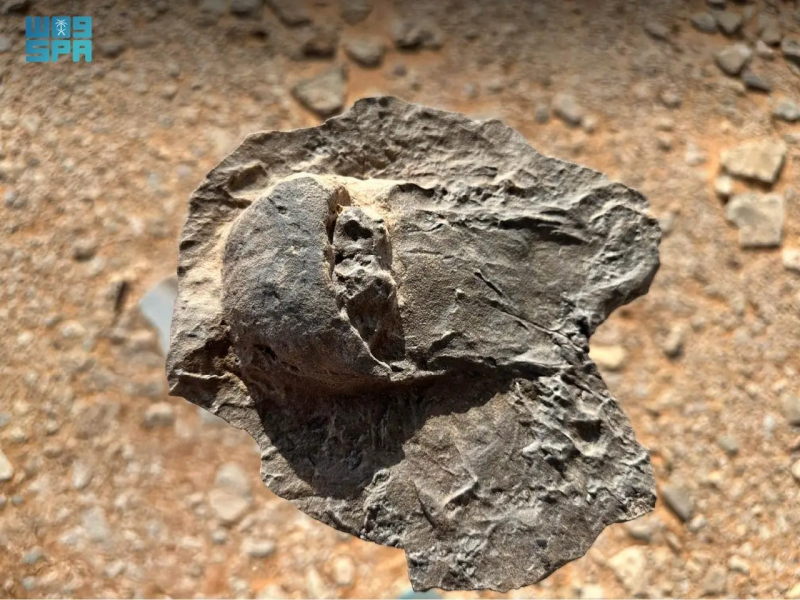

The Royal Commission for AlUla (RCU) has announced the documentation and forthcoming international publication of significant horseshoe crab fossils discovered in the AlGharameel Nature Reserve. Dating back approximately 465 million years to the Middle Ordovician period, these fossils represent a potentially new species and offer insights into the ancient biodiversity of the Arabian Peninsula. The finding reinforces AlUla’s growing reputation as a pivotal location for geological and paleontological research.
Located in northwestern Saudi Arabia, AlUla has yielded this globally important discovery, which was detailed in a peer-reviewed study published in the prestigious journal Gondwana Research. The fossils were found preserved in a unique manner – consistently upside down – alongside evidence suggesting the creatures attempted to right themselves. This is unprecedented and will contribute substantially to the understanding of paleoecological dynamics.
Unearthing Ancient Life: A New Perspective on Horseshoe Crab Evolution
Horseshoe crabs, often referred to as “living fossils,” have remained remarkably unchanged for hundreds of millions of years. Their fossil record, however, is not always complete, especially outside of well-studied regions like North America. This new discovery from AlUla fills a critical gap in that knowledge. According to the RCU, the fossils are unusually large compared to others from the same geological timeframe, possibly indicating distinct species adaptations.
The Significance of the AlGharameel Discovery
The AlGharameel Nature Reserve, a protected area within AlUla, is increasingly recognized for its remarkable geological formations and potential for paleontological finds. The concentration of horseshoe crab fossils discovered within the reserve is significant. These creatures thrived in shallow coastal environments during the Ordovician period, a time when the area was submerged under a vast sea.
The unique preservation of these fossils—deposited upside down—suggests a specific environmental event repeatedly affected these animals. Geological analysis indicates intense seasonal storms likely played a role, congregating the horseshoe crabs in coastal shallows and ultimately contributing to their burial and fossilization. This evidence of ancient storm patterns also provides valuable data for understanding long-term climate change in the region.
The identification of potential trace fossils—evidence of animal activity—alongside the horseshoe crab remains is critical. These trace fossils document the animals’ attempts to reorient themselves, providing a rare glimpse into their behavior. Researchers believe this behavior can be interpreted using modern biological understanding, allowing for advanced scientific inquiry.
Research Methodology and Future Classification
The investigation into these fossils occurred in two phases, led by Dr. Russell Bicknell of Flinders University in Adelaide, Australia. The initial phase focused on the documentation and preliminary analysis of the specimens. The current publication details these findings. This effort underscores the value of paleontological research in arid environments that were once marine habitats.
A second research phase is scheduled to begin in the first half of 2026. This phase will involve the collection of additional fossil samples and in-depth study of the potential new species. The goal is to gather sufficient data for a formal scientific classification, naming the species and establishing its place within the horseshoe crab family tree. The RCU has preserved the current specimens within its museum collections to facilitate this ongoing research.
The RCU emphasizes its commitment to scientific transformation through initiatives like this. By supporting international collaborations and developing research programs, the commission aims to position AlUla as a global hub for geological discoveries. This extends beyond purely scientific benefit to encourage sustainable tourism and education focusing on the region’s natural heritage.
The area’s relatively unexplored nature suggests further fossil finds are probable. The Ordovician period was a time of significant marine biodiversity and the geological conditions in AlUla are favorable for fossil preservation. This discovery adds to a growing body of evidence suggesting the region was a vibrant ecosystem millions of years ago.
Looking ahead, the success of the second research phase hinges on uncovering more complete specimens and acquiring sufficient data for conclusive classification. Scientists will also be looking to analyze the sedimentary environment in greater detail to fully grasp the conditions that led to this remarkable fossil assemblage. The official scientific designation of this potential new species, and a comprehensive understanding of its evolutionary significance, remain key objectives and will likely be a focus of attention within the paleontology community in the coming years.