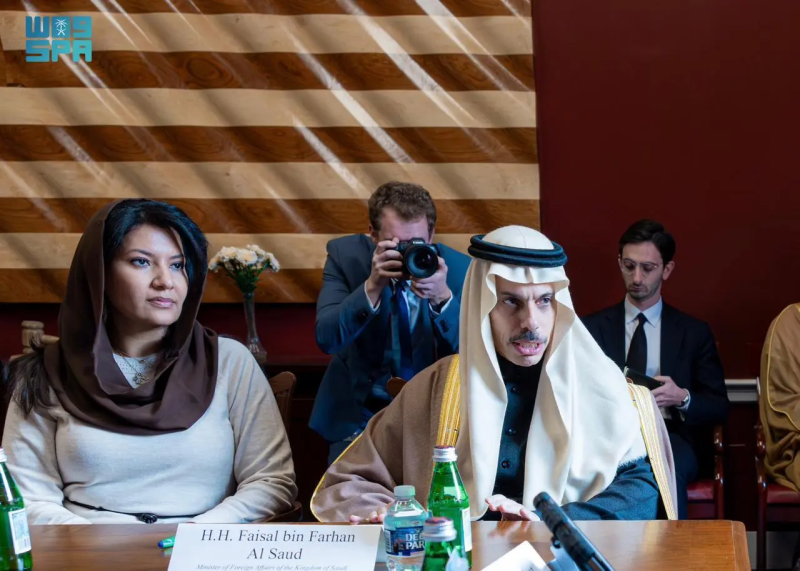

WASHINGTON — Saudi Foreign Minister Prince Faisal bin Farhan Al Saud held discussions with key members of the US House Foreign Affairs Committee in Washington D.C. on Wednesday, focusing on Saudi Arabia-US relations and pressing regional concerns. The meetings included conversations with Committee Chairman Brian Mast and Vice Chairman Gregory Meeks, alongside several other representatives. This visit underscores the continuing importance of the strategic partnership between the two nations amid complex geopolitical challenges.
The discussions took place as Saudi Arabia navigates a delicate balance between its traditional alliances and evolving regional dynamics, and as the US seeks to reaffirm its influence in the Middle East. Attendees reviewed the long-standing ties between the Kingdom and the United States, expressing a mutual desire to fortify cooperation on issues of mutual benefit. Princess Reema bint Bandar, the Saudi Ambassador to the US, and Mohammed Al-Yahya, an advisor to the Foreign Minister, also participated in these meetings.
Strengthening Saudi Arabia-US Relations & Addressing Regional Issues
The primary purpose of the meetings, according to statements released by both sides, was to explore avenues for strengthening the bilateral relationship. This includes potential collaboration on economic diversification initiatives within Saudi Arabia’s Vision 2030 plan. The US has signaled interest in supporting Saudi efforts to move away from a sole reliance on oil revenue, positioning itself as a key partner in that transformation.
However, the conversation extended beyond economic cooperation. Regional stability was a significant focus, with a particular emphasis on de-escalation efforts related to conflicts in Yemen and Sudan. The Saudi Foreign Minister and Committee members reportedly exchanged views on shared concerns regarding Iranian influence and maintaining security in vital waterways like the Red Sea and the Strait of Hormuz.
Yemen Peace Talks & Humanitarian Aid
The ongoing peace negotiations in Yemen, facilitated by Saudi Arabia and Oman, were a central topic. The US has consistently supported a negotiated settlement to the conflict, and discussions likely centered around how to ensure the sustainability of any ceasefire agreement. Sources indicate that humanitarian access to Yemen and the alleviation of the dire humanitarian crisis were also addressed.
Sudan Conflict & Regional Implications
The protracted conflict in Sudan, which erupted in April 2023, also garnered substantial attention. Saudi Arabia has been actively involved in mediation efforts to end the fighting between the Sudanese Armed Forces and the Rapid Support Forces. The meetings likely explored ways to coordinate international pressure for a return to civilian rule and prevent further regional destabilization, with concerns around potential refugee flows and the involvement of external actors.
Additionally, the situation in the Palestinian territories was undoubtedly discussed. Saudi Arabia has recently intensified its diplomatic efforts to revive the peace process, and the US, traditionally a key mediator, provided updates on its own initiatives. There is a growing consensus that a two-state solution remains the most viable path to lasting peace, though significant obstacles persist.
The meetings with the House Foreign Affairs Committee come at a pivotal moment in international diplomacy. Saudi Arabia is actively seeking to play a more prominent role in mediating regional disputes, and the US views the Kingdom as a crucial partner in maintaining stability in the Middle East. This recent engagement represents a continuation of previously initiated discussions, solidifying a commitment to ongoing dialogue.
Meanwhile, the US Congress is currently reviewing various aspects of its foreign policy towards the region. Legislation related to security assistance and arms sales is often subject to scrutiny, and the Saudi Foreign Minister’s visit provided an opportunity to directly address concerns raised by lawmakers. Such direct engagement is beneficial for both sides as it fosters a better understanding of each other’s perspectives.
Experts suggest the dialogue also encompassed potential cooperation on counterterrorism efforts and cybersecurity initiatives. These areas represent shared vulnerabilities and necessitate close collaboration between the two nations. The Kingdom has invested heavily in both areas in recent years, aiming to strengthen its internal security and contribute to global efforts. The evolving threat landscape increasingly demands a unified and proactive approach to security challenges.
In contrast to some previous periods marked by tension, the current tone of US foreign policy towards Saudi Arabia appears more pragmatic and focused on areas of mutual interest. The Biden administration, while initially signaling a reassessment of the relationship, has recognized the strategic importance of maintaining a close partnership with the Kingdom. This shift in approach is reflected in the increased frequency of high-level meetings and the renewed emphasis on collaborative initiatives.
The US maintains a significant military presence in the region, and Saudi Arabia hosts several key US military installations. These facilities play a vital role in ensuring regional security and deterring potential adversaries. Maintaining open communication channels on defense and security matters remains a priority for both governments, ensuring continued cooperation in addressing shared threats. Topics such as ballistic missile defense and maritime security likely featured in these discussions.
The visit is also part of a broader pattern of Saudi diplomatic engagement aimed at diversifying the Kingdom’s partnerships. Saudi Arabia has been actively strengthening ties with other countries, including China and India, reflecting a desire to reduce its dependence on any single power. The kingdom’s approach to geopolitical strategy is becoming increasingly multi-faceted reflecting its ambitions as a leading regional and global power.
Looking ahead, the focus will likely shift to translating the discussed areas of cooperation into concrete actions, especially regarding Yemen and Sudan. The timing of any significant developments remains uncertain, contingent on the progress of peace talks and the evolving security situation on the ground. Further congressional reviews of US policy towards Saudi Arabia are also anticipated, requiring continued dialogue and engagement from both sides.