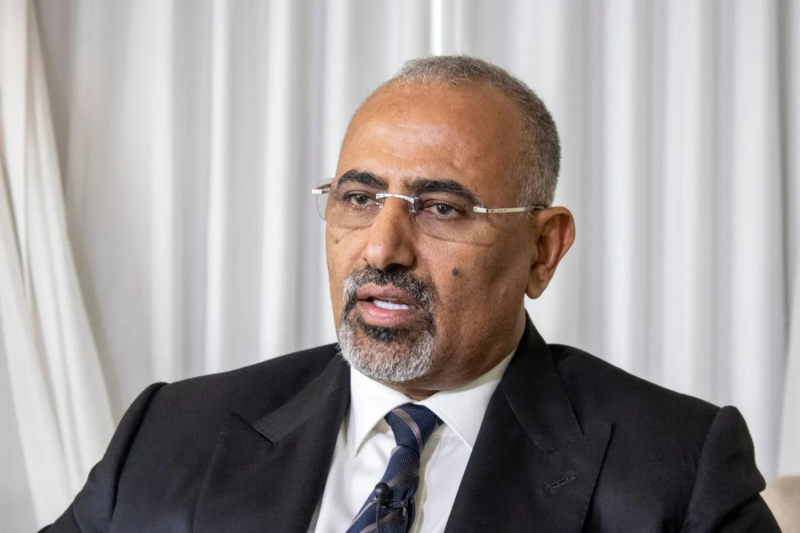

RIYADH — Aidarus Al-Zoubaidi, President of the Southern Transitional Council (STC) in Yemen, reportedly went into hiding Wednesday following a mobilization of forces that prompted a preemptive military response from the Saudi-led coalition. The incident marks a significant escalation in tensions between the STC and the internationally recognized Presidential Leadership Council (PLC). According to a statement from the Joint Forces Command, the coalition acted to prevent potential unrest in Aden and a broader conflict in the Al-Dhale governorate.
The events unfolded after Al-Zoubaidi received a request from the coalition on January 4th to travel to Saudi Arabia for talks with PLC President Rashad Al-Alimi and coalition leadership, aimed at addressing recent military movements by STC-affiliated groups in Hadhramaut and Al-Mahrah. While an STC delegation prepared to depart, intelligence indicated Al-Zoubaidi was simultaneously amassing troops and weaponry.
Escalating Tensions and the Southern Transitional Council
The Southern Transitional Council, advocating for greater autonomy for southern Yemen, has a complex relationship with the Yemeni government and the Saudi-led coalition. Formed in 2017, the STC has at times operated independently, leading to clashes with government forces and challenging the authority of the PLC, which was established in April 2022 to provide collective leadership during the ongoing Yemeni conflict. The coalition aims to support this broadly accepted Yemeni government.
The coalition statement alleges that Al-Zoubaidi authorized the distribution of weapons in Aden to individuals, Moumin Al-Saggaf and Mukhtar Al-Noubi, with the intention of creating instability in the city. This action, coupled with the military mobilization, reportedly prompted the coalition’s response. The report indicates authorities were unaware of Al-Zoubaidi’s whereabouts after his departure was noticed.
Coalition Response and Security Measures
In response to the perceived threat, coalition forces, in coordination with the Yemeni government and National Shield Forces, requested intervention from PLC Vice President Abd Al-Rahman Al-Mahrami, also known as Abu Zara’a, to secure Aden. Coalition forces then located and targeted the mobilized units near Al-Zand camp in Al-Dhale.
The preemptive strike, carried out around 4 a.m. local time, was designed to disable the forces and avert an escalation of conflict, according to the Joint Forces Command. This action aimed to safeguard civilians and prevent the expansion of hostilities into Al-Dhale governorate, a region that has seen intermittent fighting.
The coalition has reiterated its commitment to working with the Yemeni government to maintain security and counter any military activities that endanger urban populations. They urged residents of Aden and Al-Dhale to avoid military installations, convoys, and gatherings of armed personnel. Citizens were also requested to report any suspicious activities to security services.
This incident occurs against the backdrop of a broader push for a comprehensive political settlement to the Yemeni civil war, which began in 2014. The conflict pits the Houthis, a predominantly Zaidi Shia Muslim rebel group, against the internationally recognized government and the Saudi-led coalition supporting it. The fighting has created one of the world’s worst humanitarian crises, with millions facing starvation and displacement.
Previous efforts to de-escalate tensions between the STC and the PLC often involved Saudi mediation. The planned meeting between Al-Zoubaidi and Al-Alimi was another attempt to foster dialogue and address the concerns of the southern movement. However, this latest development suggests deep-seated mistrust and the potential for further instability.
The role of local actors like Al-Saggaf and Al-Noubi, highlighted by the coalition, demonstrates the complex web of allegiances and influences within southern Yemen. Understanding these dynamics is crucial for any long-term stabilization efforts. Moreover, the political landscape in Yemen remains incredibly fragile, dependent on continued external support and delicate power-sharing arrangements.
According to analysts, this episode underscores the challenges of implementing a lasting peace in Yemen, particularly concerning the integration of diverse political and military groups. The potential for renewed clashes between the STC and government forces, despite coalition efforts, remains a significant concern for regional stability and the continuation of humanitarian aid delivery.
Furthermore, the incident highlights the consistent struggle to assert control in Yemen and the difficulties faced by the Saudi-led coalition in navigating the complex regional dynamics. The coalition’s actions are likely to be viewed differently by various parties within Yemen, potentially exacerbating existing divisions. The future of southern Yemen is also becoming increasingly uncertain.
The coalition has not announced any further immediate action but stated it would continue to monitor the situation closely. The next step likely involves further investigation into the activities of those connected to Al-Zoubaidi and continued efforts to locate him. The outcome of these investigations and whether further dialogue can be initiated remain uncertain, and the situation bears close watching in the coming days and weeks as the Yemen conflict continues to evolve. The international community is also monitoring these events and will likely reassess its aid and diplomatic strategies based on the unfolding situation.