






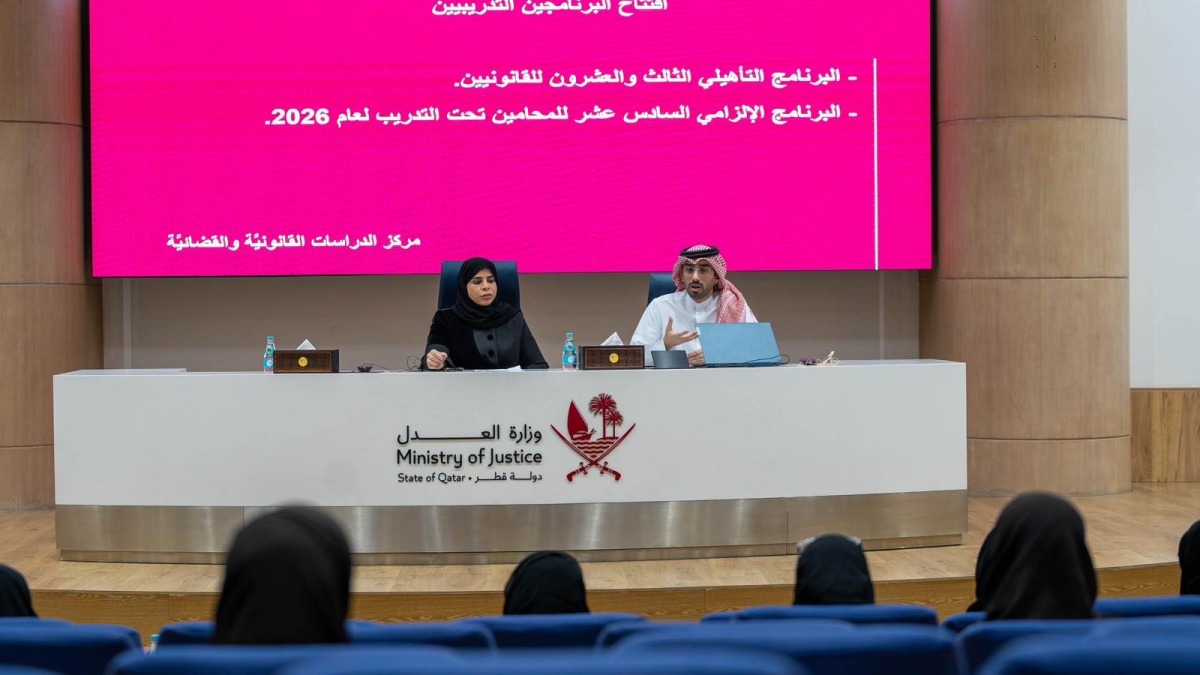

Doha, Qatar – The Ministry of Justice (MoJ) in Qatar has unveiled its Specialized Legal Training Plan for 2026, aiming to enhance the skills and knowledge of legal professionals throughout the country. The plan incorporates both continuous professional development opportunities and specialized programs designed for diverse roles within the legal sector. This initiative builds upon a significant increase in legal training activity in 2025, reflecting Qatar’s commitment to strengthening its legal system and supporting its national vision.
The announcement came following an introductory meeting held yesterday by the Center for Legal and Judicial Studies (CLJS) at the Ministry of Justice, with participation from approximately 110 legal professionals. These include 94 individuals enrolled in the twenty-third Legal Professionals Qualification Program and 16 trainee lawyers participating in the sixteenth Mandatory Training Program. The overall goal is to develop national capacity and contribute to the objectives outlined in Qatar National Vision 2030.
Expanding Legal Expertise Through Specialized Training
The 2026 Legal Training Plan will feature 118 specialized courses delivered throughout the year, averaging eight courses per month. Participants will be divided into four groups to receive tailored theoretical and practical instruction. This comprehensive approach is intended to prepare them to address evolving societal needs and maintain competitiveness in the legal field.
During the introductory meeting, Dr. Abdullah Hamad Al Khalidi, Director of CLJS, emphasized the ministry’s dedication to developing highly competent Qatari legal and judicial personnel. The ministry’s mission includes ongoing skill development for legal professionals and preparation of qualified candidates for positions within the judiciary, public prosecution, and other legal sectors.
Key Components of the 2026 Plan
The program will focus on equipping participants with the necessary expertise to carry out their duties effectively and efficiently. This includes a focus on legal drafting, legal research, and staying current with legislative and jurisprudential changes. Furthermore, the training will incorporate emerging technologies, including artificial intelligence tools, to enhance legal practice.
Attendees received detailed information regarding program requirements, including expectations for participation in lectures, workshops, and field visits. The ministry also outlined the attendance and leave system, the evaluation process, and a rewards system recognizing top performers. Compliance with established training rules will be strictly enforced, according to the briefing.
Additionally, the 2026 plan is a continuation of efforts that saw considerable growth in 2025. According to data published on the Ministry of Justice’s website, the number of training courses increased by 14.6 percent last year. This increase led to a 24.78 percent rise in the number of legal professionals benefiting from specialized and mandatory programs.
However, it wasn’t solely the number of courses that expanded. The ministry also significantly increased its outreach and educational efforts, organizing 77 legal awareness workshops in 2025. This represents a 250 percent increase compared to the 30 workshops held in 2024, demonstrating a push for broader legal literacy within the community.
The initiative reflects a broader trend within the Gulf Cooperation Council (GCC) nations to invest in human capital and strengthen legal frameworks to support economic diversification and national development goals. These legal qualifications aim to build a robust and adaptable legal workforce.
Looking ahead, the CLJS will begin delivering the specialized training courses in January 2026. The effectiveness of the program will likely be evaluated based on participant feedback, performance metrics, and its contribution to the overall quality of legal services in Qatar. It remains to be seen how quickly new technologies like AI will be fully integrated into the training curriculum and adopted by legal professionals throughout the state.