






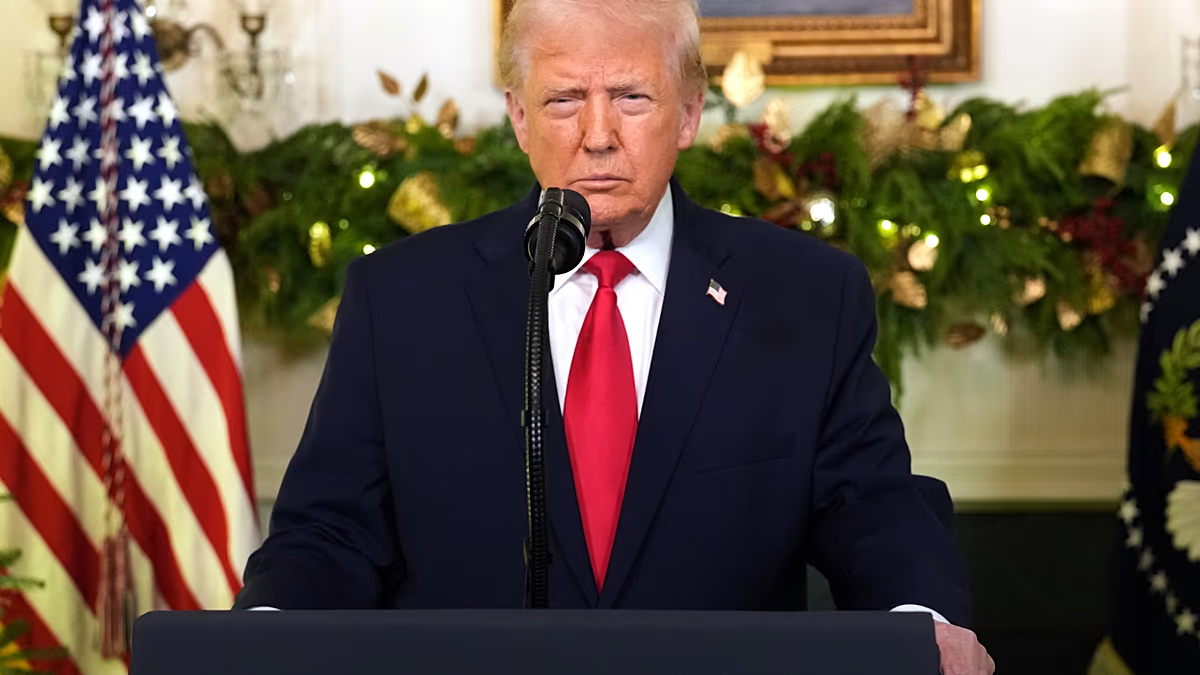

Donald Trump’s return to the White House in 2025 marked a significant shift in US politics, with the president pursuing an assertive “MAGA” agenda across trade and international relations. As 2025 draws to a close, the approaching midterm elections present a new set of challenges for Trump, particularly regarding the future of transatlantic relations with Europe. The relationship, historically a cornerstone of economic prosperity and security, has faced scrutiny under Trump’s administration.
The US has presented a critical view of Europe, citing concerns about immigration, economic policy, and a perceived loss of identity. Europeans, while recognizing the potential for lasting change, are assessing how to navigate this evolving dynamic, with the outcome potentially influenced by the results of the upcoming midterms. The question remains: how should Europe respond to an uncompromising leader in Washington?
Navigating a Shifting Landscape: The Future of US-Europe Relations Under Trump
One potential strategy for European nations is to observe a possible weakening of Trump’s power as the year progresses and anticipate the end of his term. Recent polls suggest a decline in the president’s popularity, even among his core supporters. Key demographics, such as Hispanic voters, who were instrumental in his initial victory, are showing decreased support due to his stringent immigration policies and ICE raids.
While Trump maintains confidence in the enduring appeal of the “MAGA” movement, analysts suggest a shift in public sentiment may be occurring. “The electorate is deeply insecure and could move away from Trump in his second term – the question is whether it is structural or just a passing phenomenon,” stated Ian Lesser, a distinguished fellow at the German Marshall Fund, to Euronews.
American Unease and Blame
A growing number of Americans express unease about the direction of the country under Trump’s leadership. From tariffs to healthcare, and from criticisms of Europe to internal changes within the White House, a majority of citizens feel a sense of instability. Polling data indicates that many Americans are attributing rising costs of living to Trump’s policies.
According to a Public First poll from mid-November, 46 percent of Americans believe the cost of living is at an all-time high, a sentiment shared by 37 percent of those who voted for Trump in 2024. Furthermore, 46 percent of respondents hold Trump responsible for these high prices. This perception of economic hardship is a significant factor shaping public opinion.
Despite these concerns, Trump dismisses the notion of an “affordability crisis,” claiming prices have actually decreased. He attributes any negative perceptions to a “con job” by Democrats. However, Democratic strategist Julie Roginsky countered, “The economy is sagging, and Trump’s insistence that the affordability crisis is a ‘Democrat hoax’ sounds absurd when even his most loyal voters are staring at the price of meat…like they’ve wandered into a luxury boutique.”
The Economy and Trump’s Policies
The affordability crisis is part of a broader economic picture marked by volatility. Unemployment rose to 4.6% in November, a level not seen since the height of the COVID-19 pandemic. Some economists attribute this to Trump’s tariff policies, implemented on April 2nd, which were intended to revitalize US manufacturing. However, the opposite has occurred.
The US economy has lost 60,000 manufacturing jobs, factory construction is down by at least 5%, and inflation has increased by 3%. Dean Baker, senior economist at the Center for Economic and Policy Research, notes that the promised $20 trillion in investment, contingent on tariff reductions, has not materialized. “This sum is equal to two thirds of annual GDP…But there is zero evidence of it anywhere in the data.”
Adding to the economic uncertainty, the US Supreme Court is currently reviewing the legality of Trump’s tariffs, with a ruling expected in early 2026. The White House, however, maintains a positive outlook, attributing any economic challenges to the previous administration. Spokesperson Kush Desai stated, “Cleaning up Joe Biden’s economic disaster has been a Day One priority for President Trump.”
Recent macroeconomic figures show real growth at an annualized rate of 4.3% in the third quarter, driven by strong consumer spending. However, this growth was offset by a decline in consumer confidence, with the Conference Board’s gauge falling for the fifth consecutive month in December – the longest streak since 2008.
Shifting Electoral Winds and Declining Support
Recent election results suggest a growing shift in voter sentiment. Republican candidates have experienced significant losses in various races, including the mayoral election in Miami, which was won by a Democrat for the first time in nearly 30 years. The special election for Tennessee’s 7th congressional seat, a traditionally Republican stronghold, saw the Republican margin narrowed to just 8 points – a double-digit swing towards the Democrats.
Republican strategist Matt Whitlock described this as a “flashing red light warning sign,” suggesting that a similar shift nationwide could result in a “blue wave far worse than 2018.” Even Trump’s endorsement proved insufficient to secure victory in Tennessee, indicating a potential weakening of his influence.
Disappointment with Trump’s policies is also evident among key demographic groups. A recent YouGov poll reveals a significant decline in support among Latinos, with approval ratings down by 38 points. Similarly, younger voters are increasingly disapproving of Trump’s performance, with disapproval rates rising by 30 and 34 points, respectively. These groups are particularly concerned about Trump’s immigration policies.
Trump’s executive orders on immigration, including the declaration of a national emergency at the US-Mexico border and the attempted end to birthright citizenship, have sparked widespread fear and criticism. Reports from the Cato Institute indicate that ICE is increasingly targeting migrants with no criminal record. Stories like that of Diana Santillana Galeano, a daycare worker arrested by ICE agents, highlight the human cost of these policies.
As the midterm elections approach, the evolving political landscape presents both challenges and opportunities for Trump. Whether he can regain support by focusing on issues that address economic concerns remains to be seen. The future of US-Europe relations, and the broader direction of US policy, will likely be shaped by the outcome of these elections and the shifting dynamics of the American electorate.
Looking ahead, European nations should closely monitor the political developments in the US and prepare for a range of potential scenarios. Continued engagement and a proactive approach will be crucial to navigating the complexities of this evolving relationship.